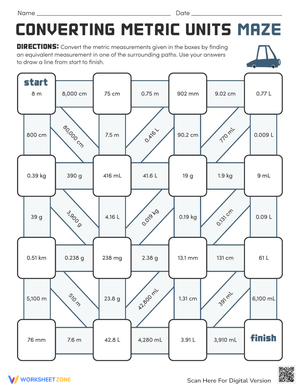
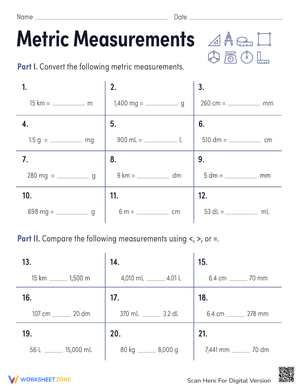
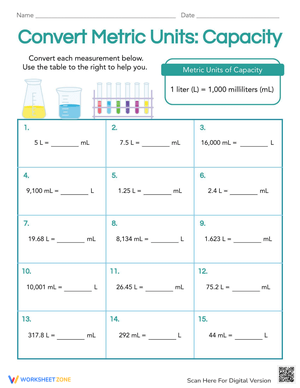
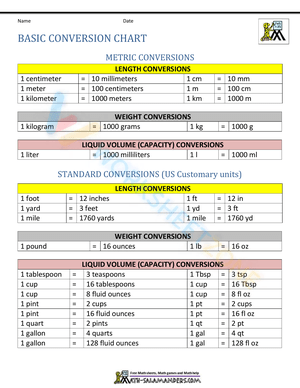
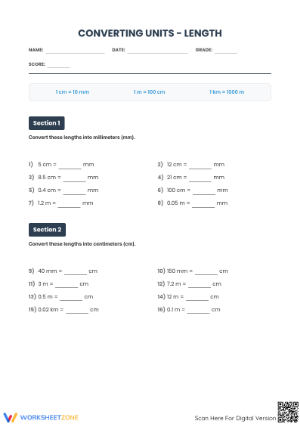
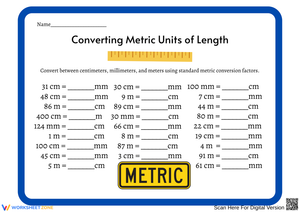
5th grade converting metric units worksheets give teachers what a conversion chart alone cannot — structured practice that moves from recognizing unit relationships to applying them inside realistic, multi-step situations. This set covers length, mass, and capacity with a clear progression: direct conversions first, then comparison tasks, then word problems where students must decide when and how to convert before solving.
Why the Base-10 Structure Changes How You Teach Metric Conversion
Metric conversion is one of the few measurement topics where the number system and the unit system reinforce each other directly. Kilo-, centi-, and milli- each represent a power of 10, which means students can use place value reasoning — something they have been building since second grade — instead of hunting for the right memorized rule. A kilometer is 1,000 meters for the same structural reason that 1,000 ones make a thousand: the prefix tells you the magnitude.
Students who understand that connection can reason through an unfamiliar conversion. Students who memorized "move the decimal two places" may get single-step items right and then reverse the operation when a problem runs the other direction. The worksheets in this set give students repeated exposure to the prefix-to-power-of-10 relationship across all three unit families, asking them to notice the pattern rather than just apply a rule.
What Students Practice Across the Set
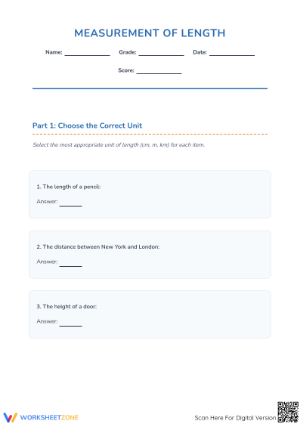
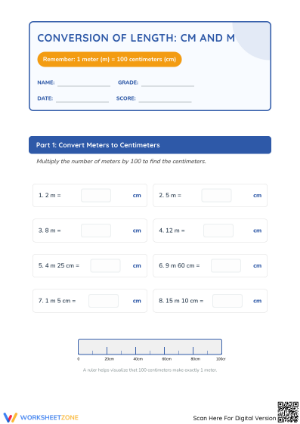
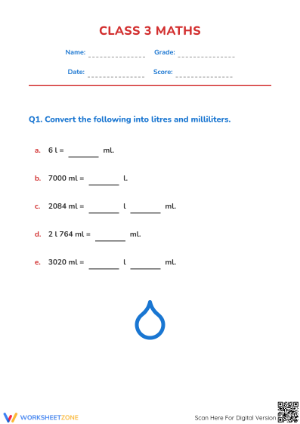
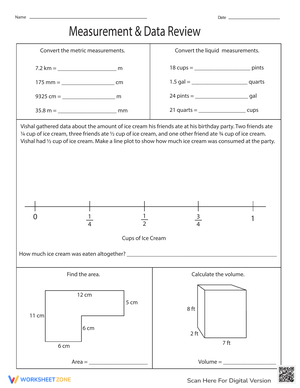
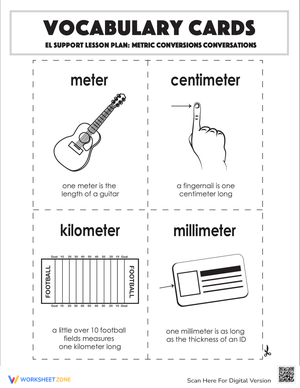
Each worksheet targets a defined slice of metric work rather than mixing all unit types together before students have solid footing in any one of them. Length worksheets move between kilometers, meters, centimeters, and millimeters. Mass worksheets focus on kilograms and grams. Capacity worksheets work with liters and milliliters. Later in the set, all three categories combine in mixed review — which is where teachers get the clearest window into whether students can actually transfer the skill.
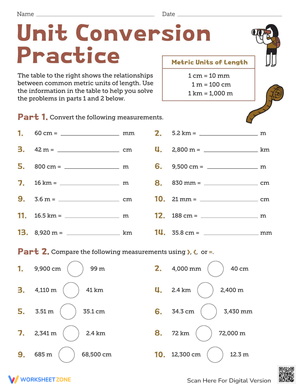
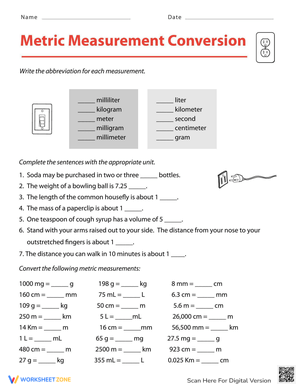
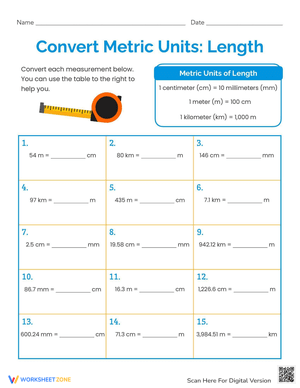
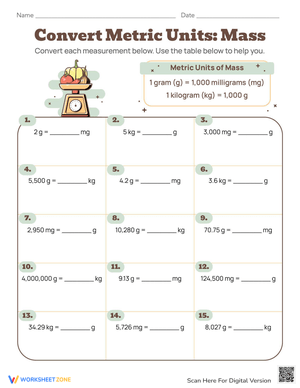
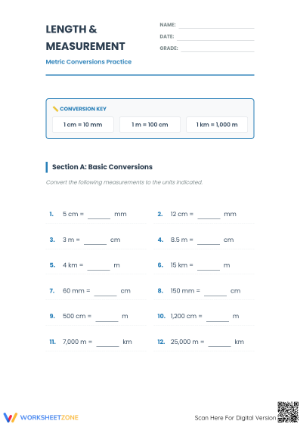
- Single-step conversions written as equations and missing-value problems within one unit family
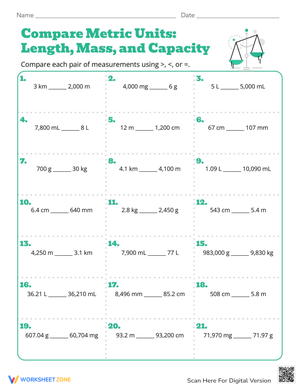
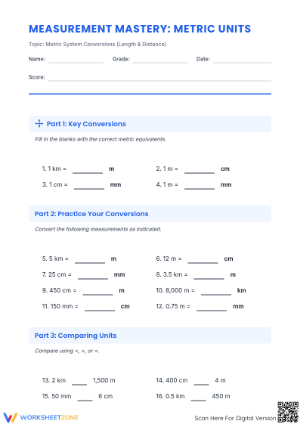
- Comparison tasks where students mark which measurement is greater, using conversion to support the answer
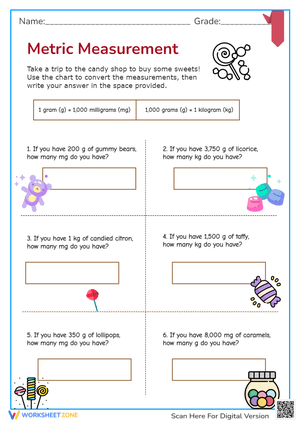
- Multi-step word problems where converting is a prerequisite step before any arithmetic can begin
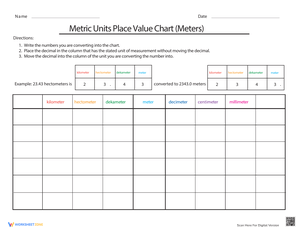
- Equivalent-value tables that reinforce the proportional relationship between paired units
Students also underline unit labels, rewrite measurements in a new unit, and sort expressions from least to greatest — not just fill in blanks. That variety keeps the cognitive work from collapsing into pattern-matching on one format.
Mistakes Students Make That These Worksheets Help You Catch
The most consistent error in metric conversion is inversion — multiplying when the problem calls for division, or dividing when it calls for multiplication. This usually signals that the student attached the procedure to the direction ("kilograms to grams") without understanding the size relationship behind it. A student who writes 4 g = 4,000 kg has not just misapplied a rule; that student has no working mental model of which unit is larger. The comparison tasks in the set surface that confusion because they require students to explain which quantity is greater, not just produce a converted number.
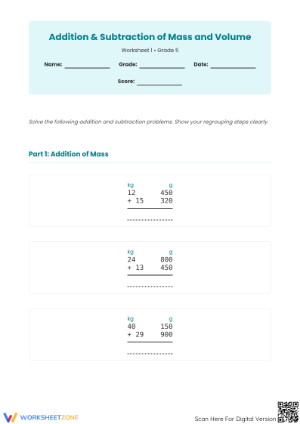
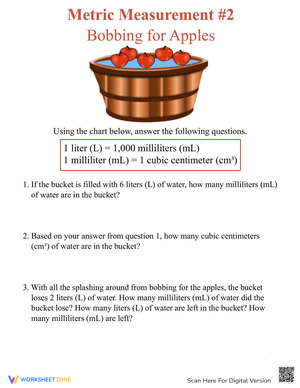
A second pattern: students who can convert within a single unit family often stumble when a word problem buries the conversion step inside an addition or subtraction situation. Converting 2.5 liters to milliliters is manageable in isolation. The same conversion becomes harder when the problem asks how many more milliliters one container holds than another, with both containers given in different units. That exact scenario appears in several word problems in the set — intentionally — because it reflects what state assessments actually ask at this grade level.
Standard Alignment
These worksheets address 5.MD.A.1 from the Common Core State Standards for Mathematics: "Convert among different-sized standard measurement units within a given measurement system and use these conversions in solving multi-step, real world problems." The standard appears at the start of the Grade 5 Measurement and Data domain because unit conversion is foundational to the multi-step reasoning that runs through the rest of fifth grade and into middle school science and math. A set of 5th grade converting metric units worksheets aligned to 5.MD.A.1 must address both procedural fluency and applied reasoning — the resources here do both within the same set, not as separate sequences.
Getting the Most Out of These Worksheets Across a Lesson Sequence
5th grade converting metric units worksheets work best as a short recurring routine spread across the unit rather than a single-day block. One worksheet used as a Monday warm-up establishes the conversion pattern for the week. A more demanding worksheet mid-week — assigned during independent practice — gives students time with multi-step problems while the teacher circulates or pulls a small group. A focused 5- to 7-item worksheet on Friday, taking less than 10 minutes, functions as a formative check before moving on.
Small-group use is also worth planning deliberately. Students who still conflate larger and smaller units benefit from a focused worksheet on a single unit family — meters to centimeters only, for example — rather than a mixed review asking them to track three categories at once. Students who have those relationships in hand can move straight to the multi-step word problems and work on deciding when to convert before computing. Because the tasks are easy to scan, teachers can observe student thinking during the work rather than waiting to collect an exit ticket.
Adjusting the Work for a Range of Learners
Students who need more support benefit most from the single-family worksheets with a reference strip of metric prefixes and their corresponding powers of 10 placed at the top of the work area. That reference strip — not the answer, but the relationship — lets students reason through a conversion without holding the prefix value in working memory while also computing. Removing the strip once a student shows fluency on a given worksheet is a natural progression, not a penalty.
Students ready for more challenge can work with the mixed-review and multi-step word problem worksheets, with the added requirement of showing each conversion as a labeled equation before writing the final answer. That documentation step catches students who estimate or guess and reveals whether the reasoning behind a correct answer is genuinely solid. Several word problems also support extension by asking students to identify which unit is most reasonable for a given measurement context — a judgment task that moves past procedural accuracy into conceptual understanding of unit magnitude.
Frequently Asked Questions
What metric units do 5th graders most often need to convert?
Grade 5 students most often work with length (kilometers, meters, centimeters, millimeters), mass (kilograms, grams), and capacity (liters, milliliters). Those three families cover the conversions that appear in classroom word problems, science contexts, and state assessment tasks at this grade level.
How does 5.MD.A.1 shape what belongs in a metric conversion worksheet?
The standard specifically pairs two expectations: convert within a measurement system, and use those conversions in multi-step real-world problems. A worksheet aligned to 5.MD.A.1 cannot rely on direct conversion alone. The resources here include both procedural items and applied word problems so teachers can assess both skills — fluency and transfer — not just one.
What is the clearest way to teach metric conversions without students memorizing isolated rules?
Anchor every conversion to the prefix meaning. When students know that centi- means one-hundredth and milli- means one-thousandth, they can derive the conversion factor from the prefix rather than retrieve it from memory. The pattern-based tasks in the set ask students to justify their answers in terms of unit size, which reinforces that reasoning across repeated practice rather than drilling one direction at a time.
Can these worksheets support intervention as well as grade-level instruction?
Both. The single-family worksheets are narrow enough to use with students who need targeted reteaching on one conversion type. The mixed-review and word problem worksheets suit grade-level instruction and students who are ready to deepen the skill. Teachers have also used 5th grade converting metric units worksheets as reliable sub-plan material because the instructions are self-evident and every task is self-contained.














 Interactive Worksheet Maker
 Quiz Maker
 Word Search Maker
 Crossword Puzzle Maker
 Word Scramble Generator
 Sentence Scramble Generator
 Handwriting Worksheet Generator
 Name Tracing Generator
 Fill In The Blank Generator




 BACK TOSCHOOL