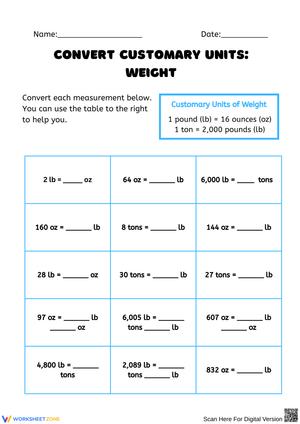
5th Grade Converting Customary Units printable worksheets
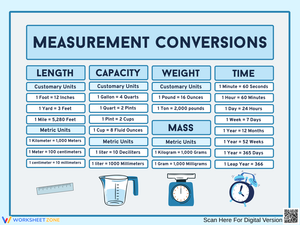
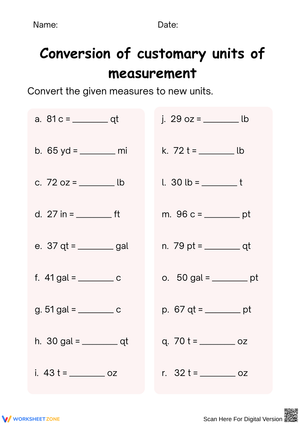
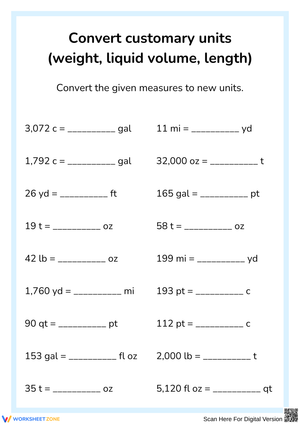
5th grade converting customary units printable worksheets give teachers a focused set of practice resources for the three unit families students are expected to convert at this grade level: length, weight, and capacity. Each worksheet targets the benchmark relationships that carry the most instructional weight — 12 inches to 1 foot, 3 feet to 1 yard, 16 ounces to 1 pound, and the cups-pints-quarts-gallons chain — and moves students through direct conversions, comparison problems, and applied word problems within a clean, printable format that needs no prep beyond printing.
What Each Worksheet Covers
The worksheets move students through several levels of work with the same set of benchmark relationships. The item types across the set include:
- Direct conversions: convert 48 inches to feet, convert 3 pounds to ounces, convert 2 gallons to quarts.
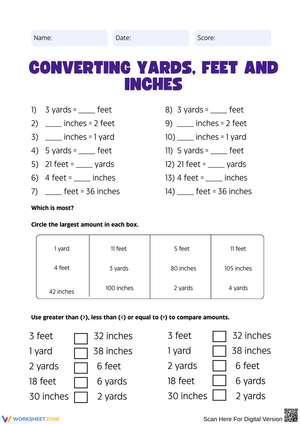
- Comparison problems: decide which quantity is greater — 5 quarts or 18 cups, for example — which requires students to convert before they can compare.
- Missing-value sentences: 5 yards = ___ feet, 32 ounces = ___ pounds.
- Multi-step word problems: a recipe calls for 3 pints of water and a student has only a 1-cup measuring cup — how many cups will that take?
That range matters because recall and application are different cognitive tasks. A student who completes one-step conversions without hesitation may still stop cold when a word problem requires identifying which unit relationship even applies. Including both item types on each worksheet makes that gap visible before a unit quiz rather than during one.
Errors That Show Up Consistently in Student Work
The most common mistake isn't forgetting the benchmark facts — students usually remember that 16 ounces equals 1 pound after enough repetition. The breakdown happens when choosing the operation. A student converting 4 pounds to ounces knows the relationship but writes 4 ÷ 16 instead of 4 × 16 because they guess at direction rather than reason through it. That single decision accounts for a large share of wrong answers and is worth addressing explicitly before independent practice, not after worksheets come back marked up in red.
Capacity causes the most confusion, specifically the cups-pints-quarts-gallons chain. Students who have memorized adjacent pairs (2 cups = 1 pint, 2 pints = 1 quart) still trip when a problem skips a step and asks them to convert cups directly to quarts. One practical fix: before starting capacity problems, have students write the full chain in order on the worksheet itself. Keeping that sequence visible during solving is meaningfully different from trying to reconstruct it mid-problem while also managing the arithmetic.
Fitting These Worksheets Into Your Lesson Planning
The most practical use is as the independent practice segment in a focused lesson routine. Spend the first eight minutes reviewing one unit family and its benchmark facts — not all three families at once, which spreads attention too thin in a standard math block. Model two examples showing both conversion directions (larger unit to smaller, smaller unit to larger), then release students to the worksheet. Circulate and look specifically at the comparison problems, since those are where operation confusion surfaces fastest. Used consistently, 5th grade converting customary units printable worksheets also work well as Monday morning warm-ups — a short set of six to eight direct conversion items resets measurement thinking after the weekend before new content begins.
Each worksheet is self-contained enough for sub days. Directions are clear without a separate lesson plan attached. Teachers running math centers can assign the length, weight, and capacity worksheets across three separate stations during a single period, keeping unit families separated without requiring students to navigate between different materials mid-session.
Standard Alignment
These worksheets address CCSS 5.MD.A.1, which requires students to convert among different-sized standard measurement units within a given measurement system and apply those conversions in multi-step, real-world problems. In classroom terms, this standard lands mid-unit — after students have reviewed multiplication and division of whole numbers and built initial familiarity with benchmark relationships, but before instruction moves into decimal operations. The word problem items on each worksheet reflect the "multi-step, real-world problems" language in the standard directly: students identify which unit relationship applies, decide the conversion direction, and carry that reasoning into a calculation rather than converting in isolation.
Adjusting the Work for Different Learners in the Same Room
For students still building fluency with benchmark facts, keep a printed reference chart visible during worksheet time. Removing that support too early turns a conversion problem into a memory test — which tells you nothing useful about whether the student understands how the units relate. Once the facts are secure, pull the chart and use performance on direct conversion items as your signal for readiness on comparison and word problem work.
Students who move through direct conversions quickly benefit from the multi-step word problems in the set. A useful extension after completing a worksheet: ask those students to write their own word problem using one unit family. Constructing a problem with sensible quantities requires a stronger understanding of the relationship than solving one does. The range from single-step conversions to applied multi-step situations means 5th grade converting customary units printable worksheets can support multiple groups in the same room without requiring a separate resource set for each tier.
Frequently Asked Questions
Which unit families do Grade 5 students need to convert within the customary system?
Length (inches, feet, yards), weight (ounces, pounds), and capacity (cups, pints, quarts, gallons) are the three families covered at this grade level. Miles appear in some curricula, but the benchmark relationships above are the core target of CCSS 5.MD.A.1 and carry the most classroom weight at fifth grade.
Should I introduce all three unit families at the same time?
Most teachers see better results from one family at a time. When length, weight, and capacity appear together in the same lesson, students mix up benchmark facts across families — writing 2 pints = 1 yard is the kind of error that shows up more often in mixed-family practice than in separated practice. Because the worksheets are organized by unit family, you can assign them in sequence without any editing or resorting.
Do these worksheets work for students who know the facts but still make errors on word problems?
They do. The word problem items require students to identify which unit relationship applies, decide the conversion direction, and carry that reasoning into a multi-step calculation. That chain of decisions is where many Grade 5 students stall. Varied contexts — recipes, sports measurements, classroom distances — help build the reasoning pattern across repeated exposures rather than just reinforcing fact recall.
Can these worksheets be used for math centers or sent home as homework?
Each worksheet includes clear enough directions to work without teacher support, which makes the set functional for math centers, independent station work, and take-home practice. The included answer key lets students or parents check work without recalculating every item. These 5th grade converting customary units printable worksheets print cleanly in black and white, so there are no formatting problems when running classroom copies in bulk.
Clear All