


























Views
Downloads



Printable Measuring Angles with a Protractor Grade 4-6
Paste this activity's link or code into your existing LMS (Google Classroom, Canvas, Teams, Schoology, Moodle, etc.).
Students can open and work on the activity right away, with no student login required.
You'll still be able to track student progress and results from your teacher account.
This comprehensive measuring angles worksheet helps students master the precise use of a protractor through 20 targeted practice problems. By analyzing diagrams and solving real-world word problems, learners develop the essential geometric skills needed to identify and classify angles accurately. This resource ensures students gain confidence in their mathematical reasoning and spatial awareness.
At a Glance
- Grade: 4-6 · Subject: Math
- Standard:
CCSS.MATH.CONTENT.4.MD.C.6— Measure angles in whole-number degrees using a protractor and classify angle types- Skill Focus: Measuring and classifying angles
- Format: 5 pages · 20 problems · Answer key included · PDF
- Best For: Independent practice or small group geometry review
- Time: 30–45 minutes
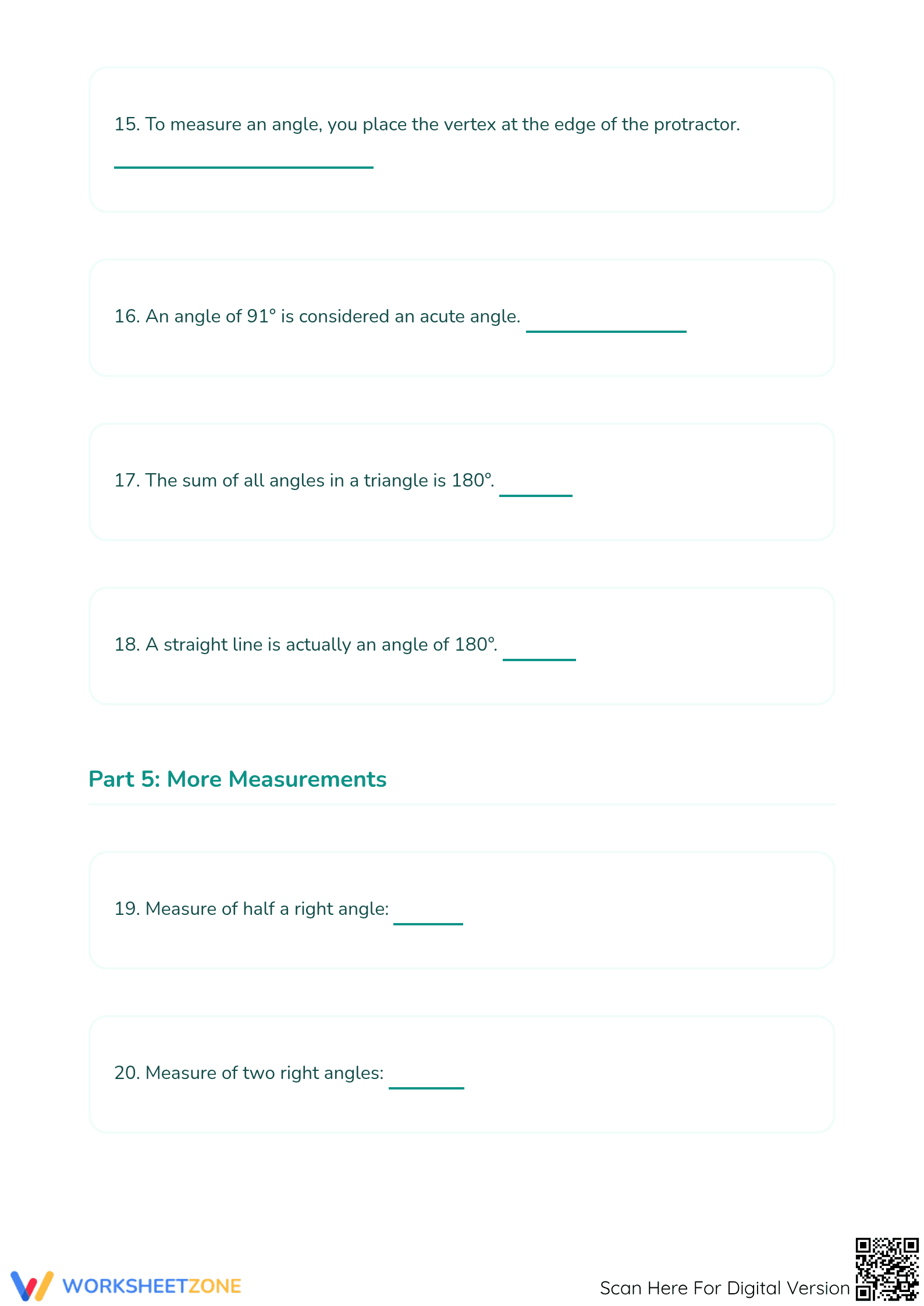
This 5-page PDF contains 20 tasks designed to build protractor mastery. It begins with visual analysis, moves into angle arithmetic, and includes a section for angle classification. Students encounter clock-based geometry, true/false conceptual checks, and word problems involving pizza slices and carpentry. A full answer key is provided for immediate feedback.
Skill Progression
- Guided practice: The first six questions provide a clear protractor diagram with labeled rays, helping students learn how to read scales and calculate differences between rays.
- Supported practice: Questions 7-13 transition into classification and application, using familiar objects like clocks to bridge the gap between abstract angles and real-world shapes.
- Independent practice: The final sections challenge students with 7 conceptual true/false statements and complex measurements, requiring them to synthesize their knowledge without visual scaffolds.
This structure follows the gradual-release model, moving from direct observation to independent mathematical application.
Standards Alignment
The worksheet is primarily aligned with `CCSS.MATH.CONTENT.4.MD.C.6`, which requires students to measure angles in whole-number degrees using a protractor. It also supports `CCSS.MATH.CONTENT.4.G.A.1` by asking students to identify and classify right, acute, and obtuse angles within various geometric contexts. Both standard codes can be copied directly into lesson plans, IEP goals, or district curriculum mapping tools.
How to Use It
Use this worksheet during the "Independent Practice" phase of a geometry unit after students have been introduced to the mechanics of a protractor. It is particularly effective as a formative assessment to identify students who struggle with reading the dual scales of a protractor. Expect completion to take 30–45 minutes; observe students during Part 1 to ensure they are correctly aligning the vertex and baseline.
Who It's For
This resource is designed for upper elementary and middle school students in grades 4, 5, and 6 who are developing their geometry skills. It provides necessary scaffolding for struggling learners through clear diagrams while offering extension word problems for advanced students. It pairs naturally with an interactive geometry software or a physical protractor demonstration on a document camera.
According to the RAND AIRS 2024 report, the ability to translate abstract geometric concepts into concrete measurements is a critical predictor of success in middle-school algebra. This worksheet facilitates that transition by requiring students to perform 20 distinct operations involving `CCSS.MATH.CONTENT.4.MD.C.6`. By integrating classification tasks with numerical measurement, the resource aligns with the Fisher & Frey (2014) framework for purposeful literacy in mathematics, ensuring students understand the underlying logic of rotational measurement. The inclusion of multi-step word problems further supports the development of higher-order thinking skills, as students must apply their technical measurement proficiency to solve practical scenarios. This dual-focus approach ensures that learners build both procedural fluency and conceptual depth in geometry, providing a solid foundation for future studies in trigonometry. This content is designed to be easily extractable for curriculum audits and standards-based progress monitoring.


