




























Views
Downloads

Corresponding Angles Worksheet | Grade 6 Essential Math

Paste this activity's link or code into your existing LMS (Google Classroom, Canvas, Teams, Schoology, Moodle, etc.).
Students can open and work on the activity right away, with no student login required.
You'll still be able to track student progress and results from your teacher account.
This Grade 6 geometry worksheet provides students with targeted practice in identifying and calculating angle measures within parallel line systems. By analyzing transversals, learners develop the geometric reasoning necessary to determine unknown values for corresponding, alternate interior, and supplementary angles. This resource ensures students move beyond rote memorization to explain the logic behind every calculation.
At a Glance
- Grade: 6 · Subject: Math
- Standard:
CCSS.MATH.CONTENT.8.G.A.5— Use informal arguments to establish facts about angles created by parallel lines- Skill Focus: Transversal angle relationships
- Format: 2 pages · 7 problems · Answer key included · PDF
- Best For: Independent practice or formative assessment
- Time: 20–30 minutes
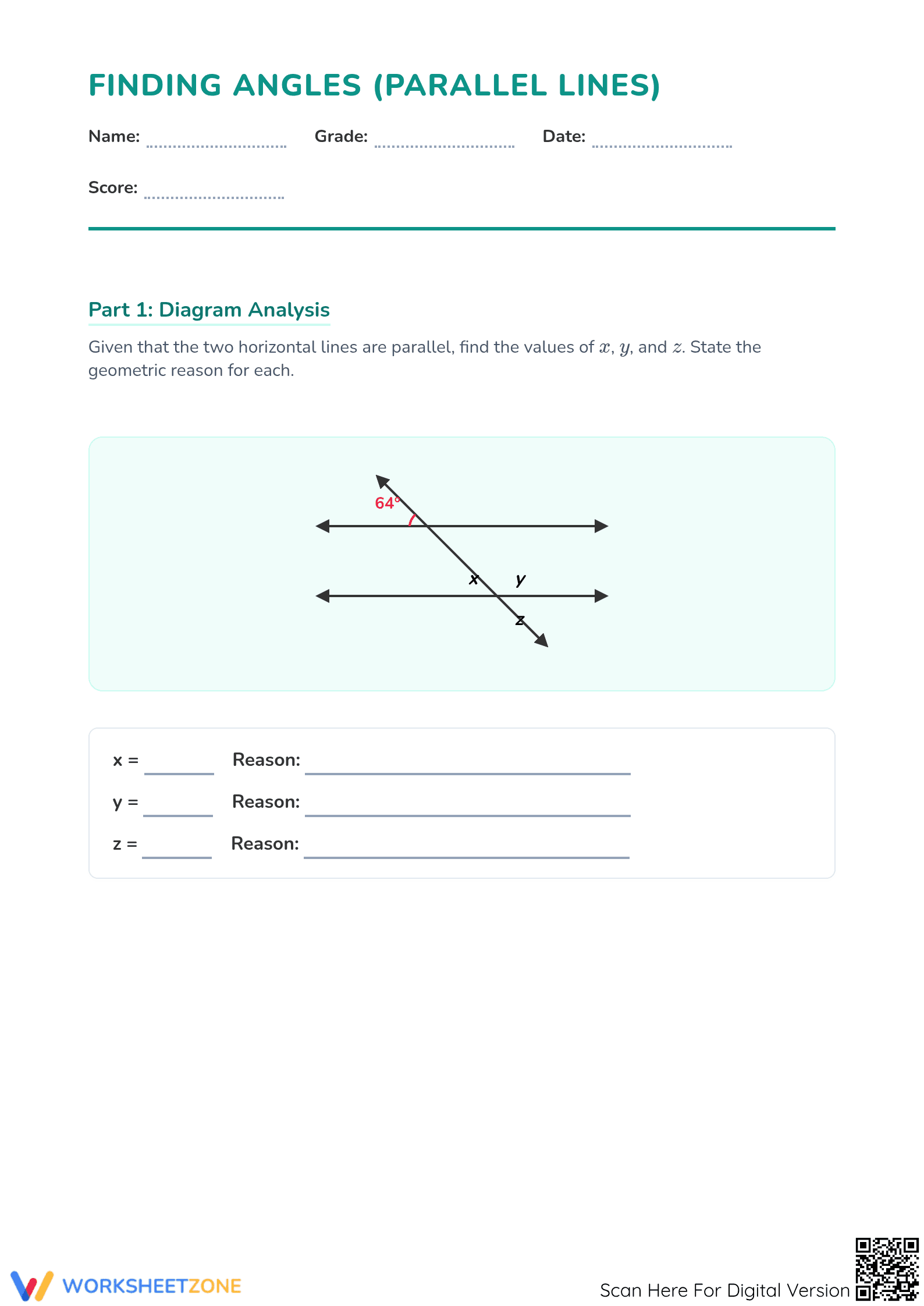
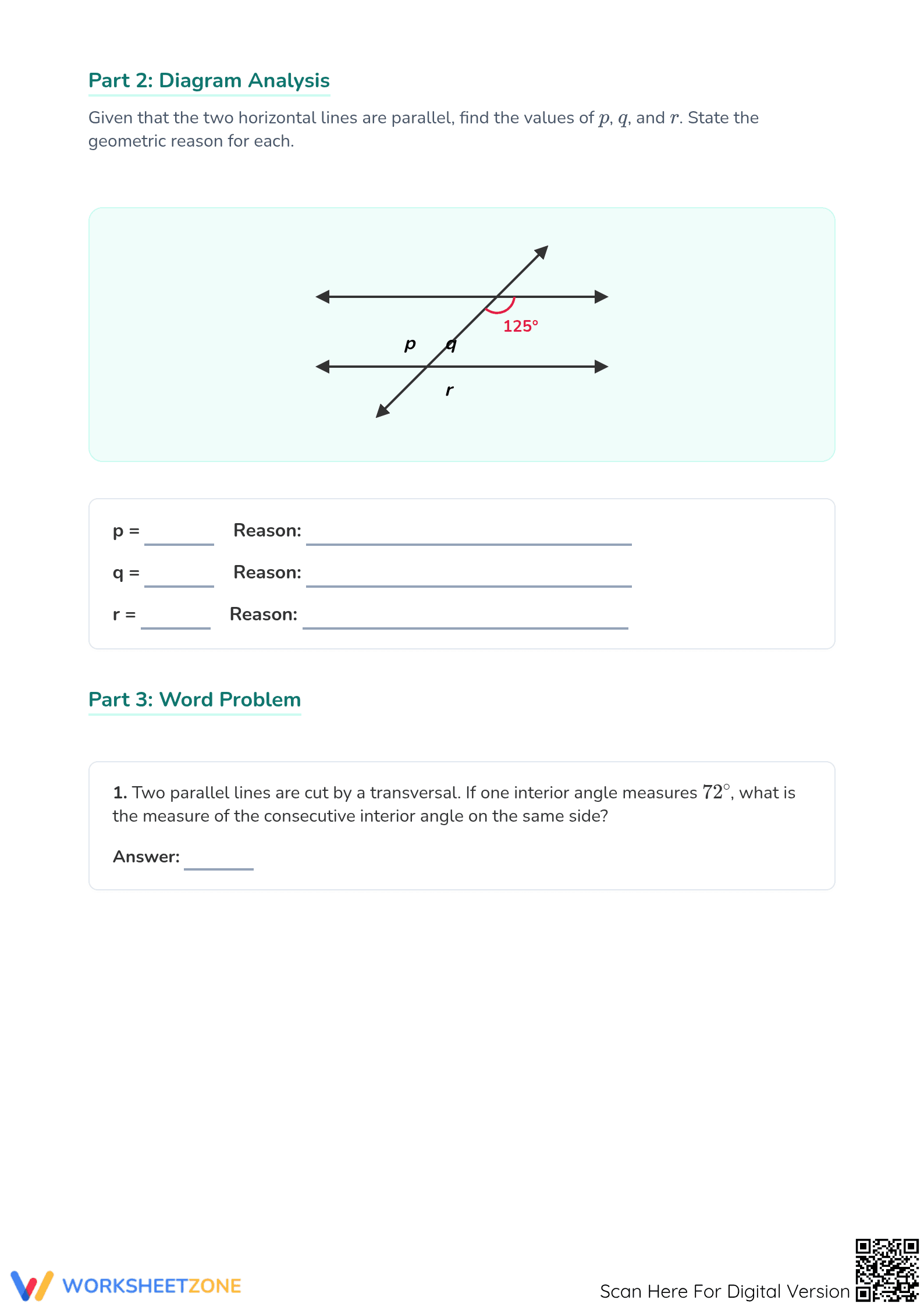
What's Inside: This comprehensive 2-page PDF features two detailed diagram analysis sections and a concluding word problem. Students are presented with 7 distinct tasks that require them to find missing variables (x, y, z, p, q, r) and provide a written geometric reason for each. The layout includes ample white space for student work and a clear, professional answer key for rapid grading.
Skill Progression
- Guided Practice: The first diagram provides a clear anchor angle (64 degrees), prompting students to identify three related angles using basic vertical and corresponding properties.
- Supported Practice: The second page increases complexity by shifting the transversal orientation, requiring students to apply their knowledge to a new visual context with 3 additional variables.
- Independent Application: The final word problem removes visual scaffolds entirely, forcing students to visualize parallel lines and calculate consecutive interior angles based on text descriptions.
This structure follows a gradual-release model, moving from visual identification to abstract mathematical reasoning.
Standards Alignment
This resource aligns primarily with `CCSS.MATH.CONTENT.8.G.A.5`. Students must use informal arguments to establish facts about the angles created when parallel lines are cut by a transversal. Additionally, it supports foundational geometry skills by reinforcing the definition of supplementary and vertical angles. Both standard codes can be copied directly into lesson plans, IEP goals, or district curriculum mapping tools.
How to Use It
This worksheet is most effective during the "You Do" phase of a lesson after students have been introduced to the vocabulary of transversals. Use it as a mid-unit formative assessment to check if students can distinguish between corresponding and alternate interior angles. Expect students to complete the 7 tasks in approximately 25 minutes. A quick tip: observe if students use formal vocabulary like "corresponding" to gauge mastery.
Who It's For
This resource is designed for Grade 6 students ready for advanced geometry, as well as Grade 7 and 8 students reviewing for state testing. It pairs well with anchor charts or direct instruction on parallel line theorems. The clear labeling makes it accessible for English Language Learners who benefit from visual-heavy tasks.
Research by Fisher & Frey (2014) emphasizes that the gradual release of responsibility is vital for mathematical mastery, particularly when transitioning from visual diagrams to abstract word problems. This worksheet facilitates that transition by requiring students to provide a "Reason" for every answer, reinforcing the metacognitive process of geometric proof. By documenting the logic behind the 7 tasks, students internalize the properties of parallel lines cut by a transversal. According to the CCSS.MATH.CONTENT.8.G.A.5 framework, establishing these informal arguments is a prerequisite for high school geometry. This resource provides the structured repetition needed to ensure that these angle relationships move from short-term memory to long-term fluency, allowing for more complex applications in later grades. The inclusion of a word problem further tests the student's ability to decode mathematical language without a pre-drawn figure.


