


























Views
Downloads




Essential Complementary and Supplementary Angles Worksheet
Paste this activity's link or code into your existing LMS (Google Classroom, Canvas, Teams, Schoology, Moodle, etc.).
Students can open and work on the activity right away, with no student login required.
You'll still be able to track student progress and results from your teacher account.
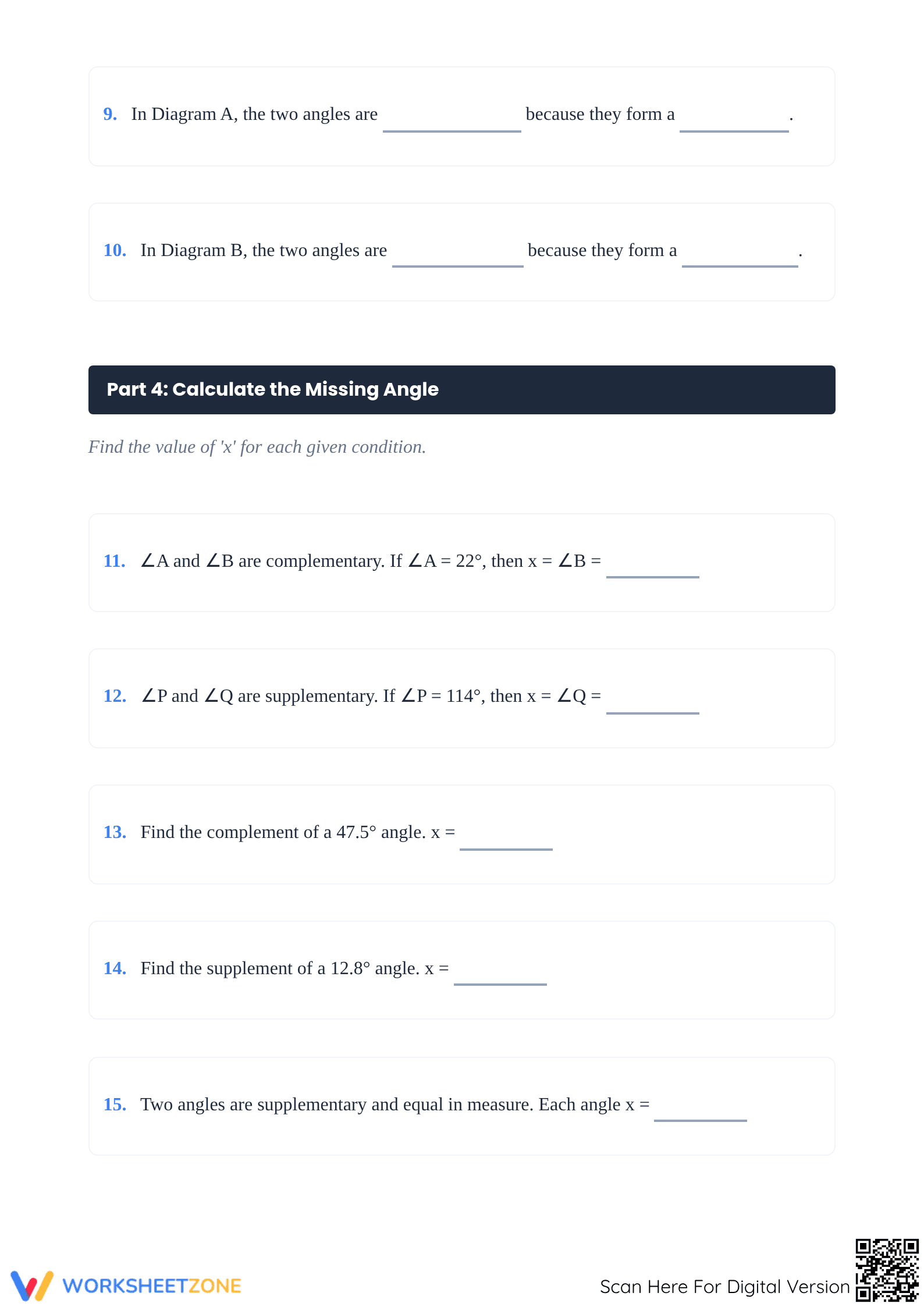
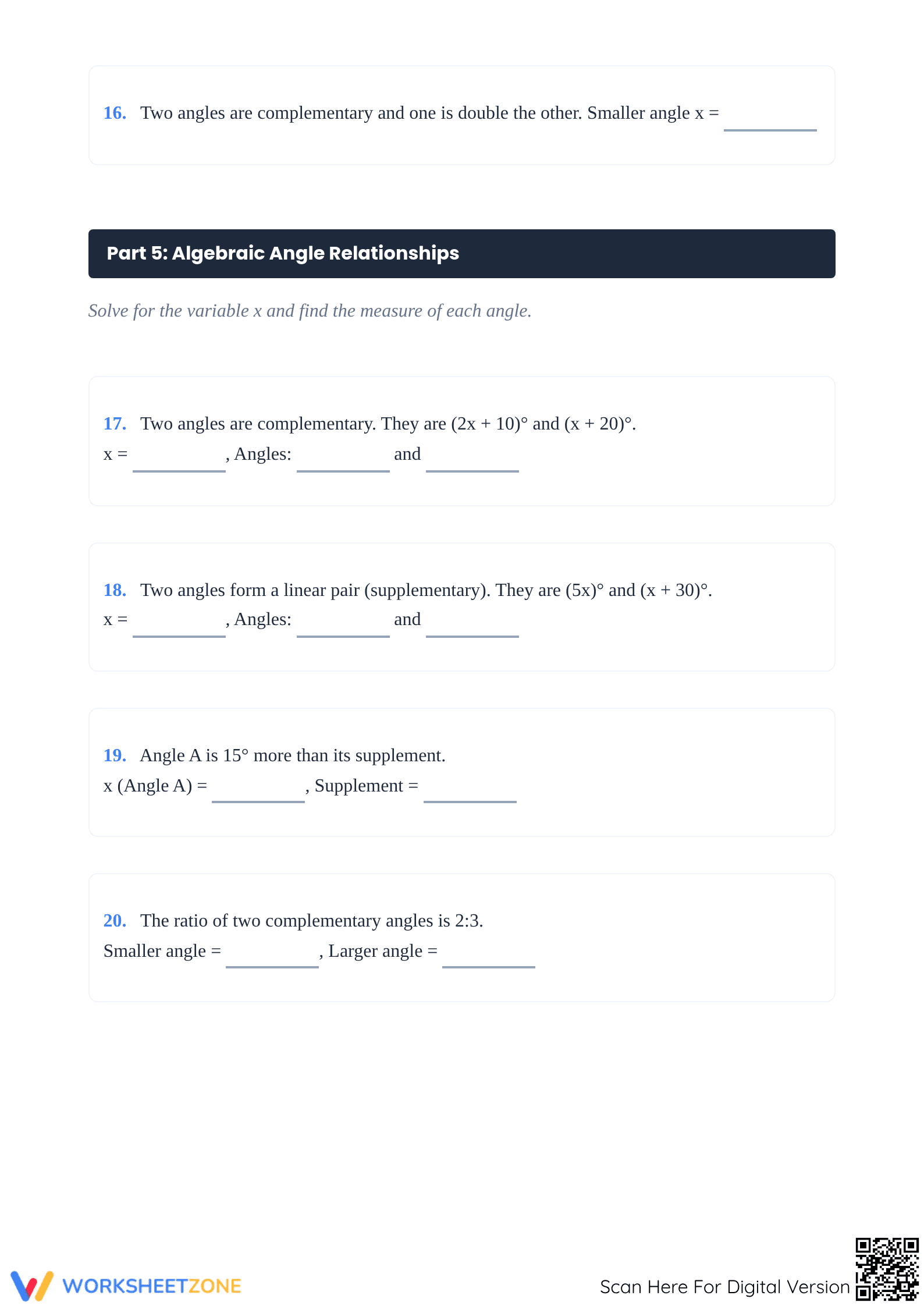
This comprehensive geometry resource provides structured practice for students learning to identify and calculate angle relationships. By moving from foundational definitions to complex algebraic problems, the worksheet ensures students build the necessary fluencies to solve for unknown variables in geometric figures. Students will gain confidence in distinguishing between angle pairs that sum to 90 and 180 degrees.
At a Glance
- Grade: 7 · Subject: Math
- Standard:
CCSS.MATH.CONTENT.7.G.B.5— Use angle facts to write and solve equations for an unknown angle- Skill Focus: Complementary and Supplementary angle relationships
- Format: 5 pages · 25 problems · Answer key included · PDF
- Best For: Independent practice and homework assignments
- Time: 40–50 minutes
This 5-page instructional packet is divided into six logical parts. It begins with clear definitions of key concepts, followed by identification exercises involving 8 distinct angle pairs. The worksheet then progresses to diagram analysis, calculation of missing values, and a dedicated section for algebraic relationships. The final "Advanced Challenge" uses complex intersections to test higher-order thinking. A full answer key is provided for immediate feedback.
This zero-prep workflow allows teachers to implement the lesson in under two minutes. Step 1: Print the 5-page PDF. Step 2: Distribute to students for independent work or as a sub-plan. Step 3: Use the included answer key for rapid grading or student self-correction. This streamlined process makes it an ideal resource for emergency sub folders or unexpected schedule shifts.
This worksheet is strictly aligned to CCSS.MATH.CONTENT.7.G.B.5. This standard requires students to use facts about supplementary, complementary, vertical, and adjacent angles in a multi-step problem to write and solve simple equations for an unknown angle in a figure. The inclusion of algebraic variables like (2x + 10) ensures that the practice meets the rigorous demands of middle school geometry.
Use this worksheet as a primary practice tool after a direct instruction lesson on angle properties. It works effectively as a "Check for Understanding" mid-unit or as a comprehensive review before a geometry assessment. Teachers can observe students during Part 5 to identify common misconceptions regarding algebraic substitution in geometric contexts. Expect students to take approximately 45 minutes to complete the full 25-task sequence accurately.
This resource is designed for Grade 7 students, but is highly effective for Grade 8 and 9 students requiring remediation or additional fluency practice. The clear definitions in Part 1 provide necessary scaffolding for English Language Learners and students with IEPs. It pairs naturally with a geometry anchor chart or a short instructional video on solving linear equations within geometric shapes.
Research by EdReports (2024) emphasizes that high-quality mathematics instructional materials must balance conceptual understanding with procedural fluency to drive student mastery of geometric standards. This worksheet adheres to those findings by providing explicit definitions before requiring the application of the CCSS.MATH.CONTENT.7.G.B.5 standard through 25 varied problems. By incorporating both numeric calculations and algebraic reasoning, the resource supports the "gradual release of responsibility" model, which Fisher & Frey (2014) identifies as a critical component of effective secondary instruction. Furthermore, the inclusion of diagram analysis helps students bridge the gap between abstract angle facts and visual spatial reasoning, a skill cited by NAEP as a significant predictor of future success. This self-contained module provides the rigorous, standards-based practice necessary for long-term retention of angle relationships in diverse mathematical contexts.


