


























0
Views
0
Downloads

0.0
0
Save
0 Likes
Share
Measuring Angles: Find the Missing Angle Worksheet
0 Views
0 Downloads
Paste this activity's link or code into your existing LMS (Google Classroom, Canvas, Teams, Schoology, Moodle, etc.).
Students can open and work on the activity right away, with no student login required.
You'll still be able to track student progress and results from your teacher account.
Information
Description
What It Is:
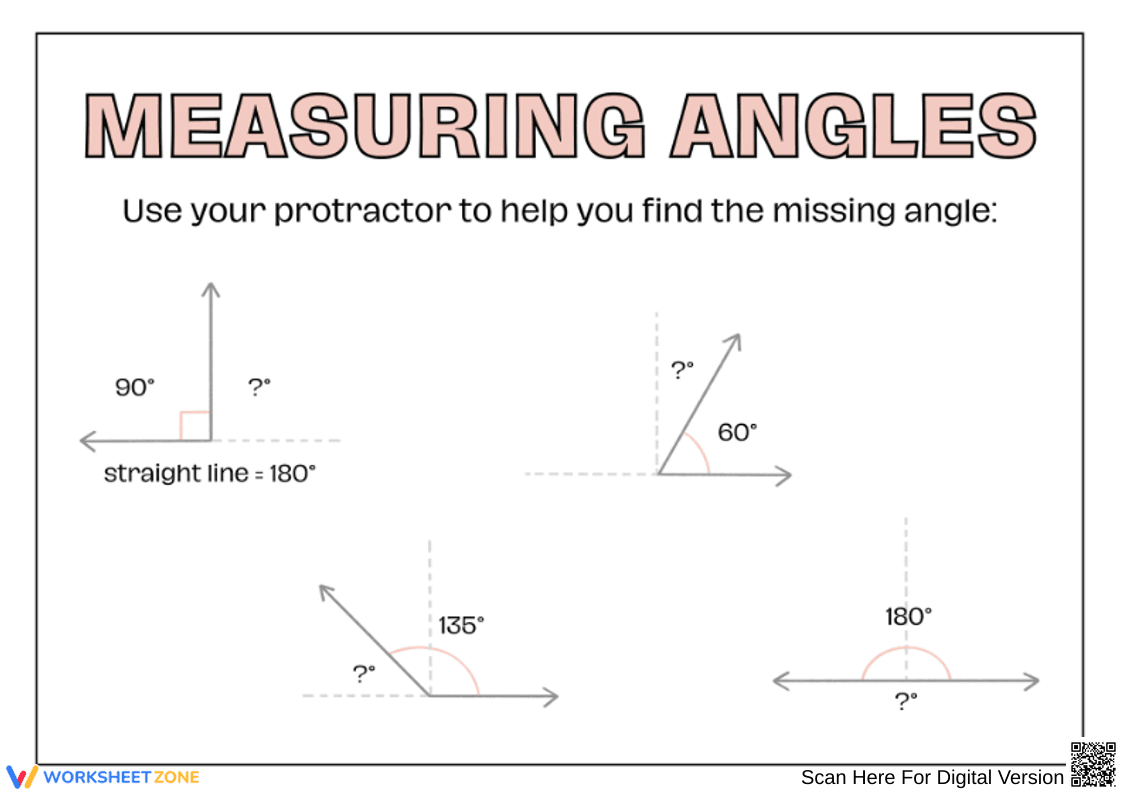
A practice worksheet that helps students find missing angles using their understanding of straight lines, right angles, and angle relationships. Students use a protractor and visual cues to determine unknown angle measures in a variety of diagrams, including straight-line angle pairs, complementary angles, and supplementary angles. Clean graphics and minimal text make the page student-friendly and easy to use.
Why Use It:
This worksheet strengthens students’ ability to measure angles accurately and apply key geometric facts such as “a straight line equals 180°” and “right angles measure 90°.” It reinforces problem-solving, spatial reasoning, and the ability to analyze partial angle information—important skills for geometry and real-world measurement tasks.
How to Use It:
• Have students use a protractor to measure the visible angle and determine the missing angle using angle relationships.
• Encourage students to write down their reasoning (e.g., 180° − 90° = 90°).
• Use as independent practice, small-group instruction, test review, or a warm-up activity.
• Pair with lessons on complementary, supplementary, and adjacent angles for deeper understanding.
Grade Suitability:
Best suited for Grades 4–7.
• Ideal for geometry units involving angle measurement and relationships.
• Works well for both review and introductory lessons.
Target Users:
Teachers, tutors, homeschool educators, and students practicing angle measurement and reasoning.
A practice worksheet that helps students find missing angles using their understanding of straight lines, right angles, and angle relationships. Students use a protractor and visual cues to determine unknown angle measures in a variety of diagrams, including straight-line angle pairs, complementary angles, and supplementary angles. Clean graphics and minimal text make the page student-friendly and easy to use.
Why Use It:
This worksheet strengthens students’ ability to measure angles accurately and apply key geometric facts such as “a straight line equals 180°” and “right angles measure 90°.” It reinforces problem-solving, spatial reasoning, and the ability to analyze partial angle information—important skills for geometry and real-world measurement tasks.
How to Use It:
• Have students use a protractor to measure the visible angle and determine the missing angle using angle relationships.
• Encourage students to write down their reasoning (e.g., 180° − 90° = 90°).
• Use as independent practice, small-group instruction, test review, or a warm-up activity.
• Pair with lessons on complementary, supplementary, and adjacent angles for deeper understanding.
Grade Suitability:
Best suited for Grades 4–7.
• Ideal for geometry units involving angle measurement and relationships.
• Works well for both review and introductory lessons.
Target Users:
Teachers, tutors, homeschool educators, and students practicing angle measurement and reasoning.


