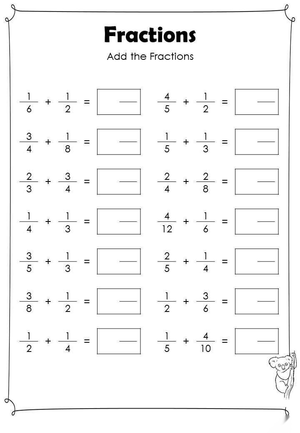
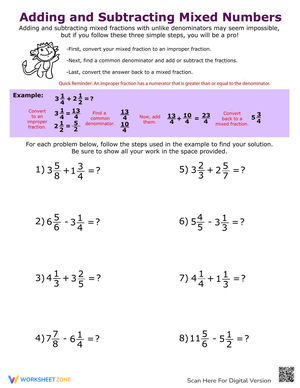
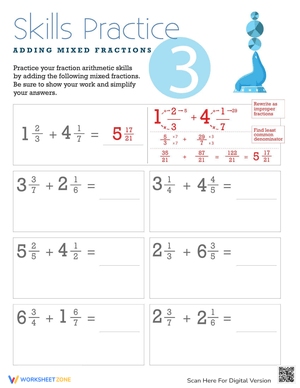
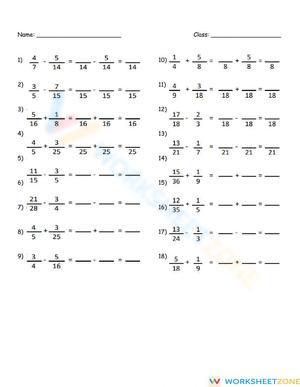
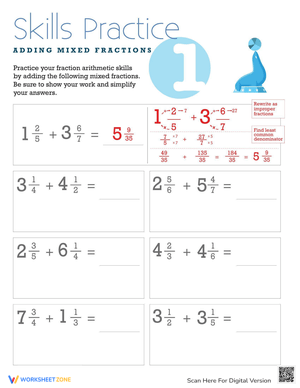
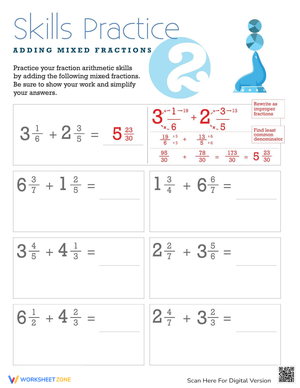
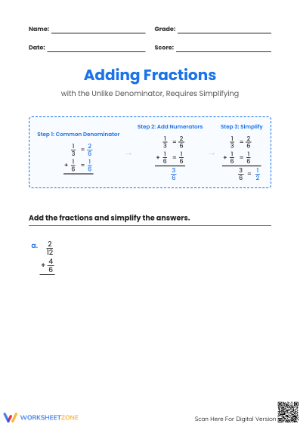
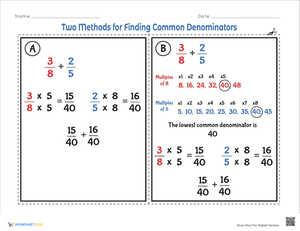
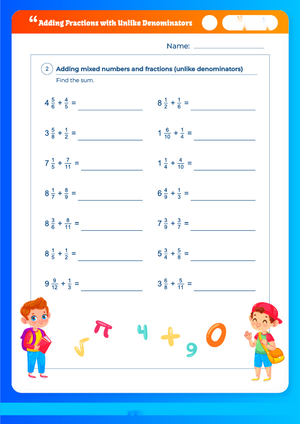
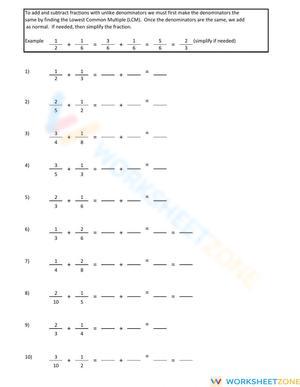
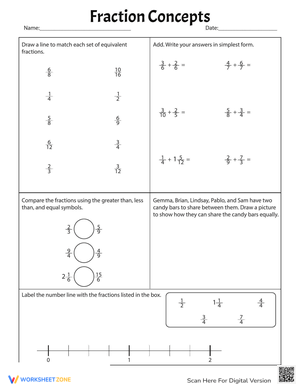
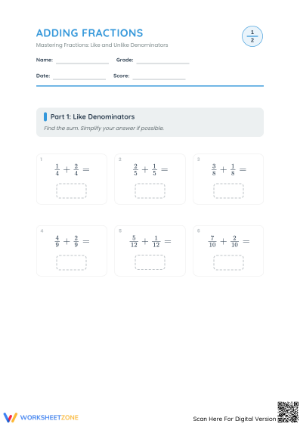
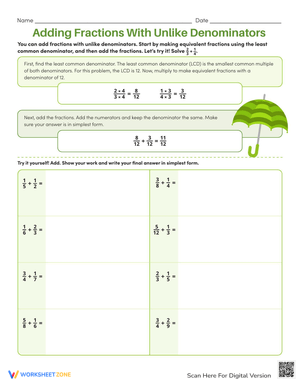
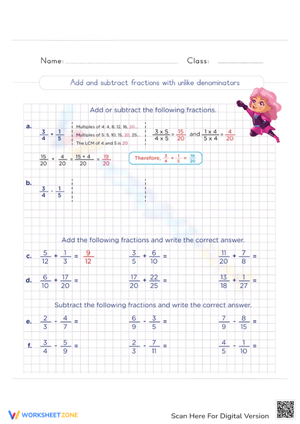
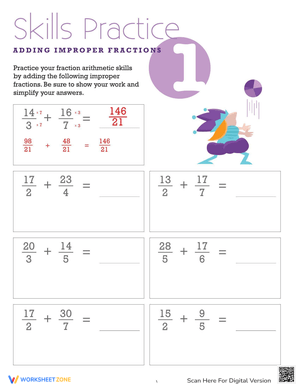
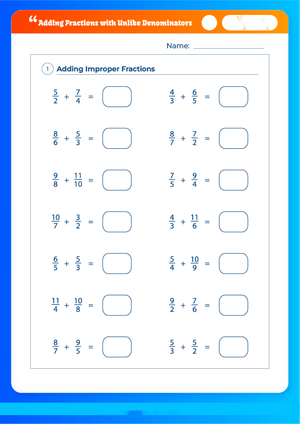
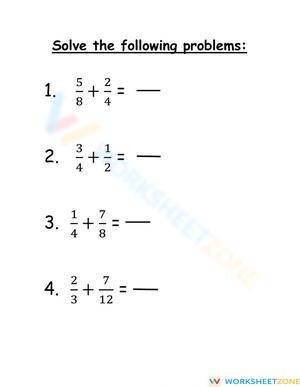
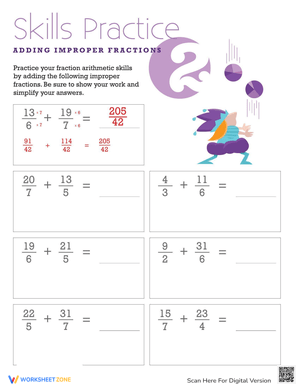
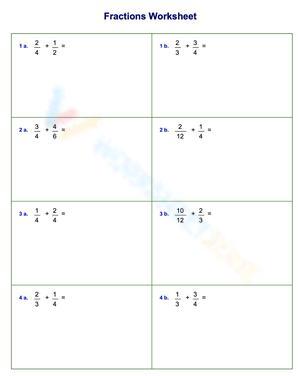
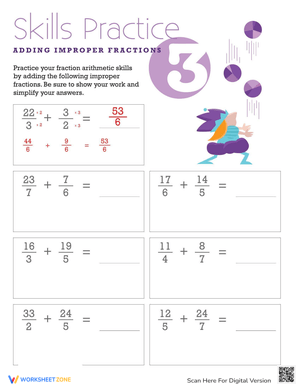
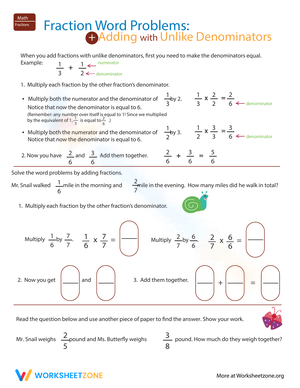
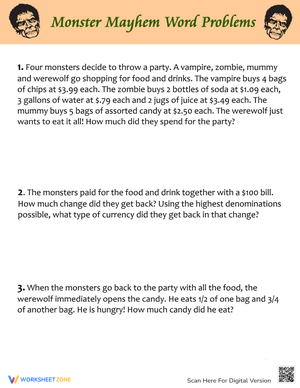
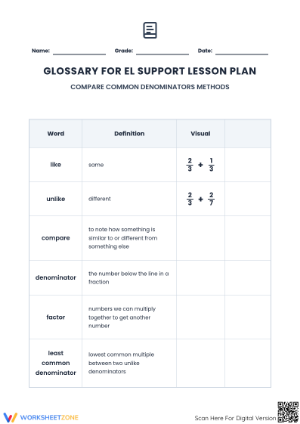
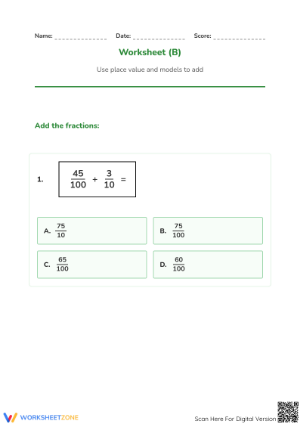
These adding fractions with unlike denominators worksheets for 5th grade give teachers a focused tool for the exact moment fraction instruction starts to split — when some students can rename fractions fluently and others are still adding straight across the denominator. Each worksheet targets the renaming step explicitly: students identify both denominators, locate a common denominator, rewrite each fraction as an equivalent, and then add. That narrow focus makes the set practical for classwork, small-group review, and quick formative checks without requiring teachers to reframe the purpose each time they use it.
The Skills Each Worksheet Builds
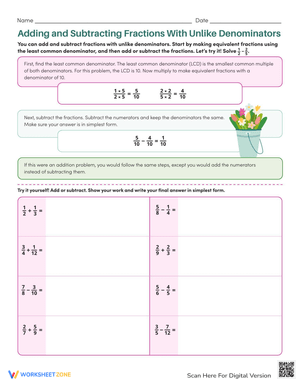
The set moves students through four decisions that unlike-denominator addition actually requires. First, they examine the two denominators and confirm they are not the same. Second, they find a common denominator — which means thinking about factor relationships, not just multiplying the denominators together. Third, they rewrite both fractions as equivalent fractions sharing that denominator. Fourth, they add the numerators, check the result for reasonableness, and simplify when the sum is not in lowest terms.
Beyond bare computation, the worksheets include several types of tasks:
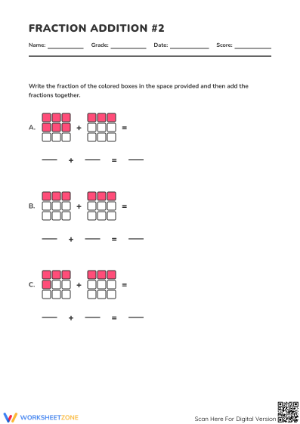
- Visual models — area bars and partitioned shapes where students can see why fourths and eighths share a workable common denominator before they move to abstract computation
- Equivalent fraction rehearsal — direct practice turning one-half into two-fourths or three-sixths, isolated from the addition step so students nail the rename before combining
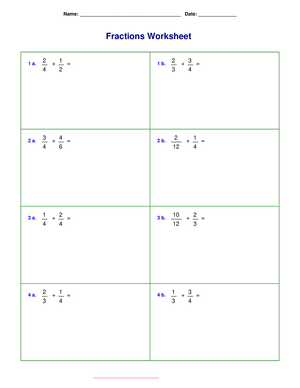
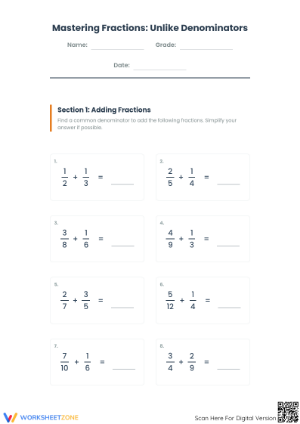
- Mixed denominator pairs — some straightforward (halves and fourths), some less predictable (thirds and sevenths), so students cannot apply the same denominator choice every time
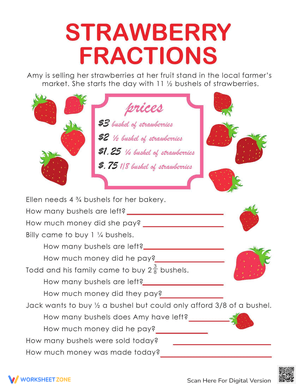
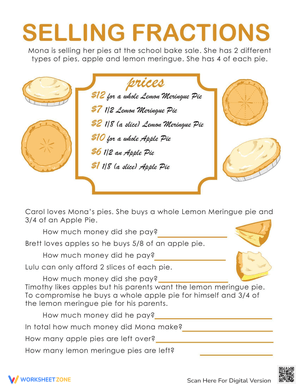
- Word problems — short contexts involving recipes, distances, and time that require the same reasoning applied outside a column of bare numbers
- Answer keys — included so the resources function smoothly in stations, homework review, and intervention folders without requiring teacher oversight at every problem
Student Mistakes Worth Catching Early — And What They Tell You
The most common error with unlike-denominator addition is also the most predictable: students add both numerators and both denominators, writing two-fifths plus one-third as three-eighths. It is a misapplication of whole-number addition logic, and it shows up even after teachers have modeled the correct approach. A student who writes three-eighths confidently has not simply forgotten a step — they hold a deeper misunderstanding about what denominators represent.
A second pattern appears once students understand that a common denominator is needed: they choose one that works but is inefficient. Faced with one-fourth plus one-sixth, a student may convert to twenty-fourths instead of twelfths. That choice produces correct arithmetic in theory, but the numerator multiplication grows large and errors creep in during the renaming step. The third pattern is skipped simplification — a student arrives at six-eighths and stops, either not noticing the shared factor of two or deciding the problem is finished once the addition is done.
The most useful diagnostic move is to sort errors by step rather than by final answer. A worksheet built around unlike-denominator pairs lets a teacher trace exactly where the breakdown happened — during denominator selection, the equivalent-fraction rewrite, numerator addition, or simplification. Each error pattern points to a different small-group prompt or reteach example, not just a mark in the gradebook. Adding fractions with unlike denominators worksheets for 5th grade are especially practical for this kind of step-by-step error analysis because the skill has enough discrete, visible steps to make the breakdown location clear on paper.
Standard Alignment
5.NF.A.1 in the Common Core State Standards for Mathematics requires students to add and subtract fractions with unlike denominators by replacing given fractions with equivalent fractions, producing equivalent sums and differences. The standard's language is deliberate: the expectation is not only procedural accuracy but genuine understanding of why equivalent fractions are the mechanism that makes unlike-denominator addition work at all.
In classroom terms, this places unlike-denominator addition at the center of the Grade 5 fraction unit — after students build equivalent fraction fluency in Grade 4 under 4.NF.A.1, and before they apply fraction operations to more complex problem types in Grade 6. Teachers who use this set for initial instruction, mid-unit review, and end-of-unit formative checks are working with 5.NF.A.1 at three different grain sizes, which matches how most multi-week fraction units actually unfold.
How to Build These Worksheets Into a Week of Fraction Instruction
The most effective placement is as the first independent attempt after explicit teaching — not as a cold station activity students encounter without context. In a typical whole-group lesson, a teacher might model one problem using an area bar, solve a second using equivalent fractions only, and then release students to a worksheet. At that point, the worksheet is not filler. It is where students apply the thinking they just watched modeled, and the teacher can circulate and catch wrong moves before they settle into habits.
Adding fractions with unlike denominators worksheets for 5th grade also fit naturally into recurring weekly structures. Two or three computation items work as a Monday warm-up that reactivates equivalent fraction thinking from the previous week — useful for those first eight minutes after morning meeting when students need something purposeful before the main lesson begins. A visual-model worksheet pairs well with fraction bar manipulatives in a math center, letting students confirm one problem physically before working through the rest independently. A short four- or five-item set with at least one word problem functions as a Friday exit check without the weight of a formal quiz.
For teachers running a multi-day sequence, a reasonable arc moves from visual-model worksheets on day one, to common-denominator fluency worksheets on day two, to mixed-review and word-problem worksheets by days three and four. That progression keeps the resources tied to instruction rather than accumulating as a disconnected stack of practice.
Adjusting Each Worksheet for Students at Different Starting Points
The range inside a single Grade 5 classroom can be wide. Some students are still unsteady on equivalent fractions — they know that one-half equals two-fourths but cannot reliably rename thirds or fifths without a visual. Others have solid equivalence fluency and are ready to work with less familiar denominator pairs or explain their reasoning in writing. The set does not have to serve those students at the same pace or with the same items.
For students who need more support, select items with smaller, more familiar denominator pairs: halves, thirds, fourths, and sixths produce obvious common-denominator relationships. Pairing those items with fraction bar manipulatives gives students a physical check on each equivalent fraction they write. For on-level students, mix predictable pairs with less obvious ones — fourths and fifths, or thirds and sevenths — so they have to decide on a useful denominator rather than retrieve a memorized answer. For students who are moving ahead, add a short written prompt: "Explain why you chose that denominator instead of a different one." That one sentence turns a fluency exercise into a reasoning task without requiring a different worksheet entirely.
Adding fractions with unlike denominators worksheets for 5th grade that include word-problem sections reveal something computation-only items cannot: whether a student's procedural knowledge transfers when the numbers appear inside a real situation. A student who handles a column of computation items accurately may still stumble when those same fractions show up in a sentence about mixing paint or measuring ribbon. Using the word-problem sections as a separate formative check gives teachers a cleaner read on actual conceptual transfer — not just mechanical fluency.
Frequently Asked Questions
What prerequisite fraction skills should students have before working through this set?
Students need a working understanding of equivalent fractions and basic denominator comparison. They do not need perfect fluency first, but they should be able to explain why one-half and two-fourths name the same amount. Without that conceptual base, the common-denominator step feels like an arbitrary rule rather than a logical move — and students who are following steps without understanding them break down quickly when the denominator pairs become unfamiliar.
Can these worksheets work for both grade-level instruction and intervention?
They work for both, but item selection matters. Intervention students benefit most from worksheets that use smaller denominator pairs and include built-in visual models that slow the equivalence step down. Using the same worksheet at the same pace as grade-level instruction often frustrates students who have gaps in equivalent fraction understanding rather than helping them fill those gaps.
How do the word problems in the set differ from the computation items?
Computation items confirm that students can execute the renaming and adding steps in a clean, decontextualized format. Word problems ask students to decide when fraction addition is the right operation, pull the relevant fractions out of a sentence, carry out the process, and then interpret the result in context. They assess something genuinely different — and the gap between a student's computation accuracy and their word-problem performance is often wider than expected until a teacher looks at both side by side.
Do all the worksheets in the set include answer keys?
Answer keys are included throughout the set, which makes the resources practical for math stations, homework review, and small-group intervention folders where the teacher is not standing at every student's side. A teacher can assign a worksheet for structured independent practice, collect it, and use the key to sort errors by type during a planning period rather than regrading each item by hand in class.














 Interactive Worksheet Maker
 Quiz Maker
 Word Search Maker
 Crossword Puzzle Maker
 Word Scramble Generator
 Sentence Scramble Generator
 Handwriting Worksheet Generator
 Name Tracing Generator
 Fill In The Blank Generator




 BACK TOSCHOOL