


























Views
Downloads

Grade 5 Adding Fractions — Printable No-Prep Worksheet
Paste this activity's link or code into your existing LMS (Google Classroom, Canvas, Teams, Schoology, Moodle, etc.).
Students can open and work on the activity right away, with no student login required.
You'll still be able to track student progress and results from your teacher account.
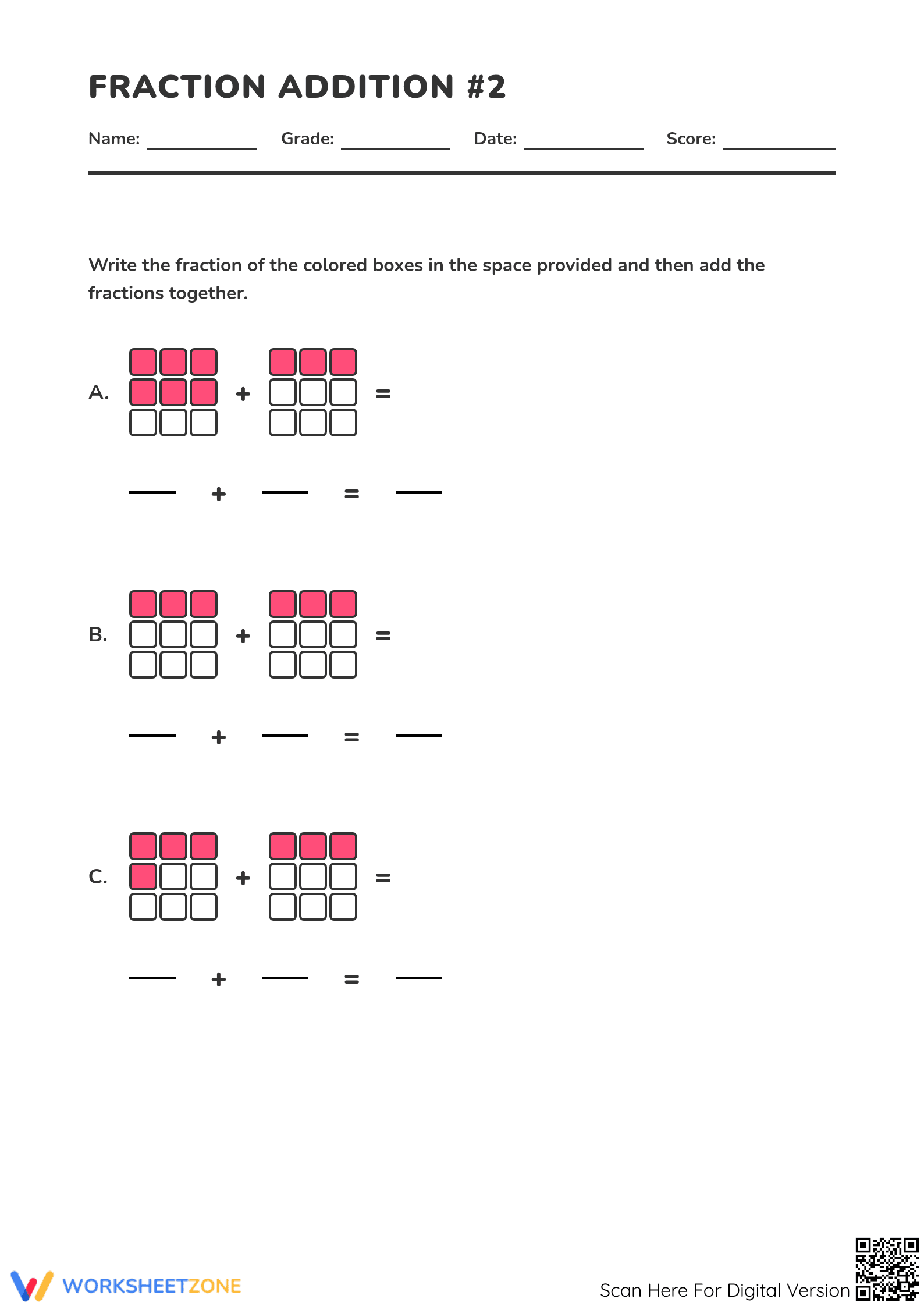
Mastering fraction addition requires a transition from visual understanding to abstract computation. This comprehensive worksheet bridges that gap by starting with grid-based models before progressing to numeric addition with unlike denominators. Students will develop a concrete sense of fractional parts before applying the algorithms needed for complex operations.
At a Glance
- Grade: 4–5 · Subject: Math
- Standard:
5.NF.A.1— Add fractions with unlike denominators using equivalent fraction replacements- Skill Focus: Adding fractions with like and unlike denominators
- Format: 2 pages · 10 problems · Answer key included · PDF
- Best For: Independent practice and small group instruction
- Time: 20–30 minutes
What's Inside
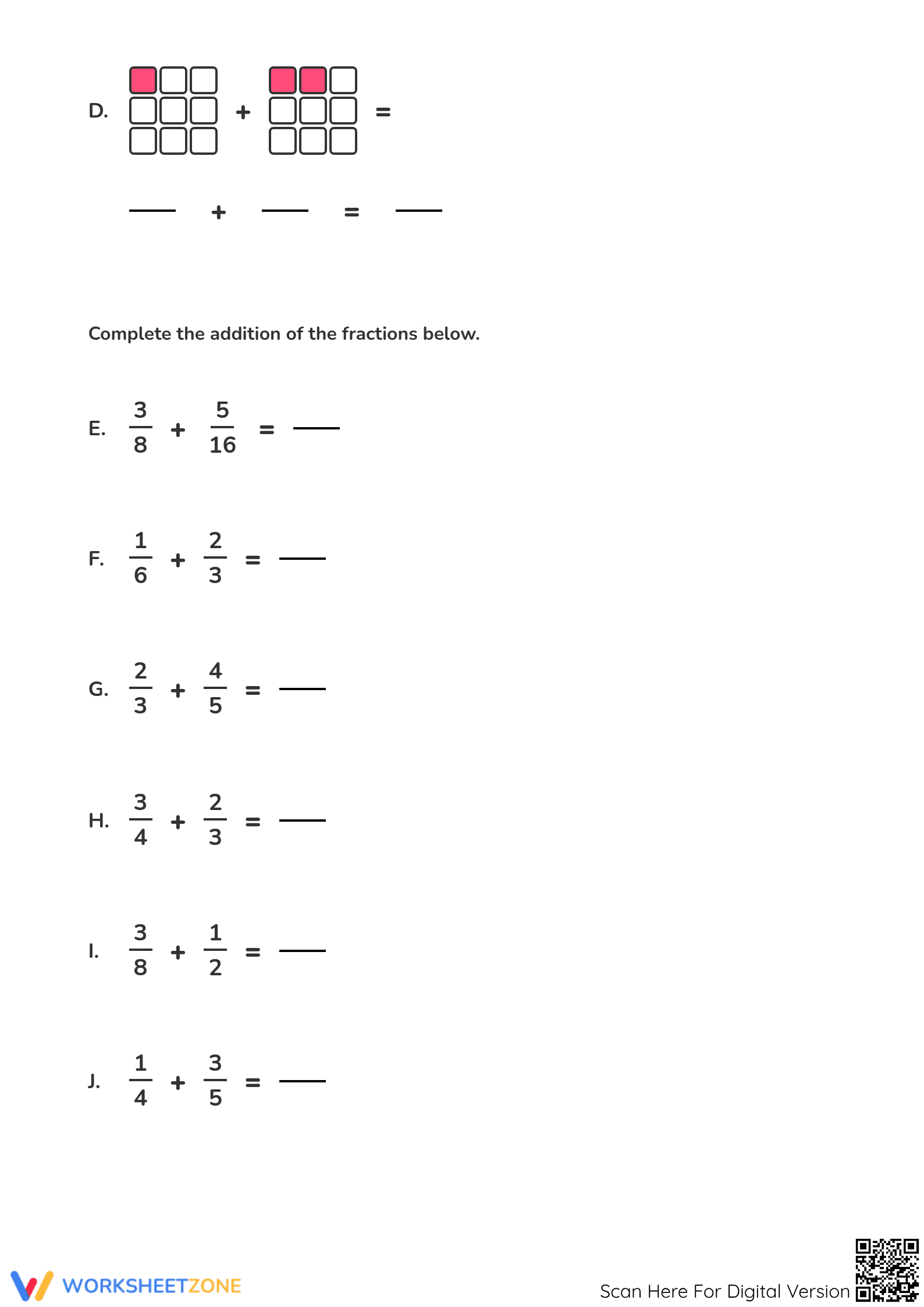
This two-page resource contains 10 structured problems. The first page features four visual addition tasks using 3x3 grids (denominators of 9) to reinforce the concept of combining parts of a whole. The second page transitions to numeric addition, challenging students to find common denominators for fractions with unlike values ranging from halves to sixteenths. A full answer key is provided for rapid grading.
Zero-Prep Workflow
- Step 1: Print — Select the "Fit to Page" setting and generate the two-page document in approximately 30 seconds.
- Step 2: Distribute — Hand out the worksheets at the start of your independent work block; students can begin immediately due to the intuitive visual cues.
- Step 3: Review — Utilize the included answer key to check student work in under 60 seconds, identifying common errors in denominator conversion.
This streamlined workflow ensures that teacher preparation time remains under 2 minutes, making it an ideal choice for substitute lesson plans or unexpected classroom transitions.
Standards Alignment
The primary focus is 5.NF.A.1, which requires students to add and subtract fractions with unlike denominators by finding equivalent fractions. The visual models on page one also support 4.NF.B.3.A, focusing on adding fractions with like denominators. Both standard codes can be copied directly into lesson plans, IEP goals, or district curriculum mapping tools to ensure rigorous instruction.
How to Use It
Use this resource during the "independent practice" phase of a lesson after students have been introduced to the concept of common denominators. It serves as an excellent formative assessment tool; observe whether students correctly identify the visual parts before attempting the numeric problems. Expect completion in 20 to 30 minutes depending on proficiency levels.
Who It's For
Designed for Grade 4 and Grade 5 students, this worksheet is particularly effective for learners who benefit from visual scaffolds. For differentiation, provide the first page to students struggling with basic concepts and the second page to those ready for computational challenges. It pairs naturally with fraction tiles or anchor charts displaying common equivalent fractions.
Research from the NAEP highlights that a strong grasp of visual fraction models in the upper elementary grades is a significant predictor of success in middle school algebra. This worksheet leverages the dual-coding theory by presenting both pictorial and symbolic representations of fraction addition, which facilitates deeper cognitive processing of mathematical relationships. By starting with 3x3 grids, students establish a mental framework for fractional parts that they can later apply when calculating least common multiples for unlike denominators. The gradual release of scaffolding—from shaded boxes to bare numbers—aligns with the "I Do, We Do, You Do" instructional model recommended by Fisher & Frey (2014) for effective mathematics instruction. This evidence-based approach ensures that students do not merely memorize procedures but build the conceptual understanding necessary for long-term mastery of rational numbers and proportional reasoning in higher-level math.


