


























Views
Downloads




Printable Fraction Word Problems Worksheet | Grade 5/6 Math
Paste this activity's link or code into your existing LMS (Google Classroom, Canvas, Teams, Schoology, Moodle, etc.).
Students can open and work on the activity right away, with no student login required.
You'll still be able to track student progress and results from your teacher account.
Master the complexities of adding and subtracting fractions with unlike denominators through these practical, real-world word problems. This comprehensive resource ensures students can confidently apply mathematical operations to everyday scenarios, moving beyond rote calculation to true conceptual application and problem-solving mastery.
At a Glance
- Grade: 5 · Subject: Math
- Standard:
CCSS.MATH.CONTENT.5.NF.A.2— Solve word problems involving addition and subtraction of fractions with unlike denominators- Skill Focus: Fraction Word Problems
- Format: 5 pages · 25 problems · Answer key included · PDF
- Best For: Independent practice and formative assessment
- Time: 45–60 minutes
What's Inside
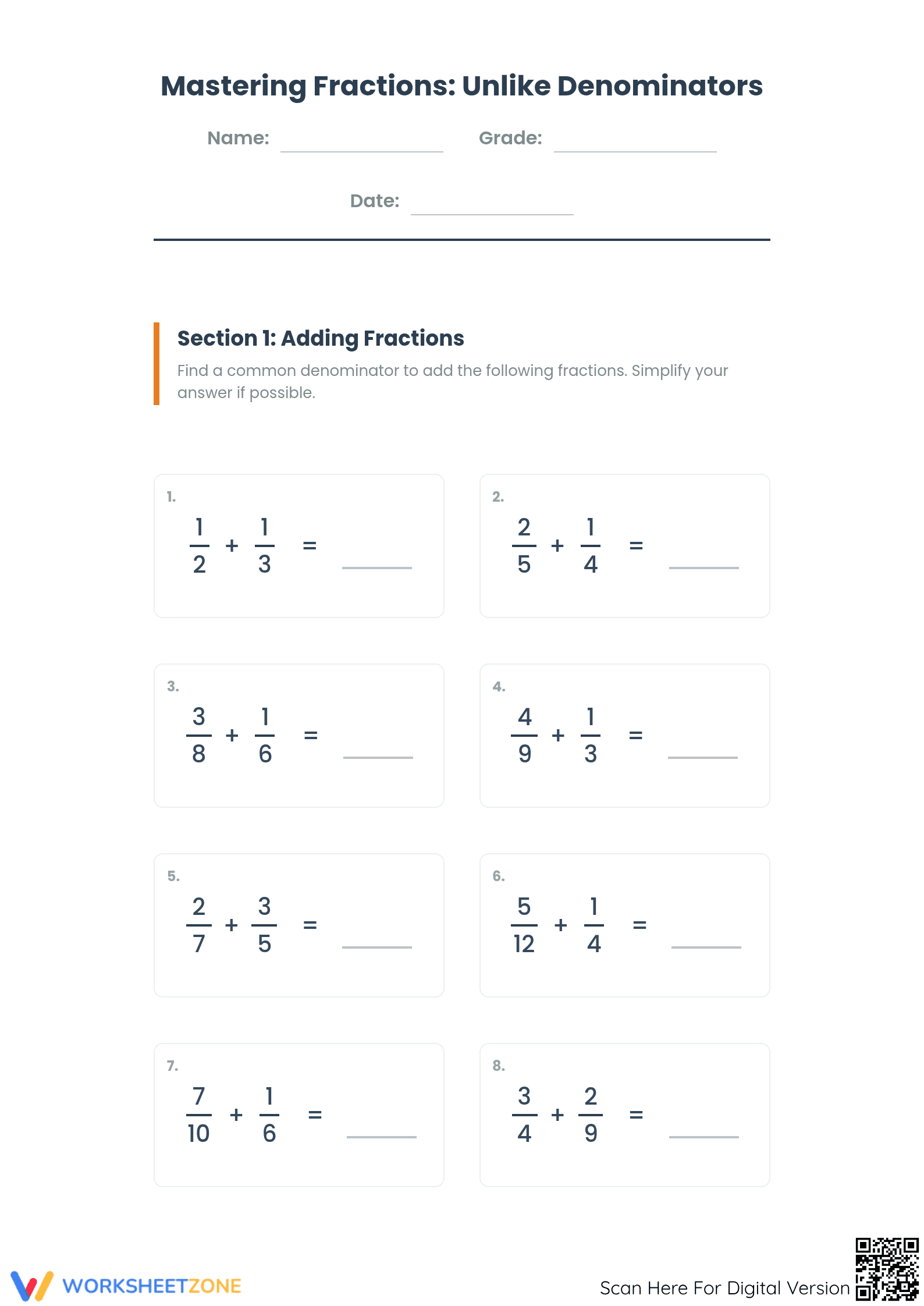
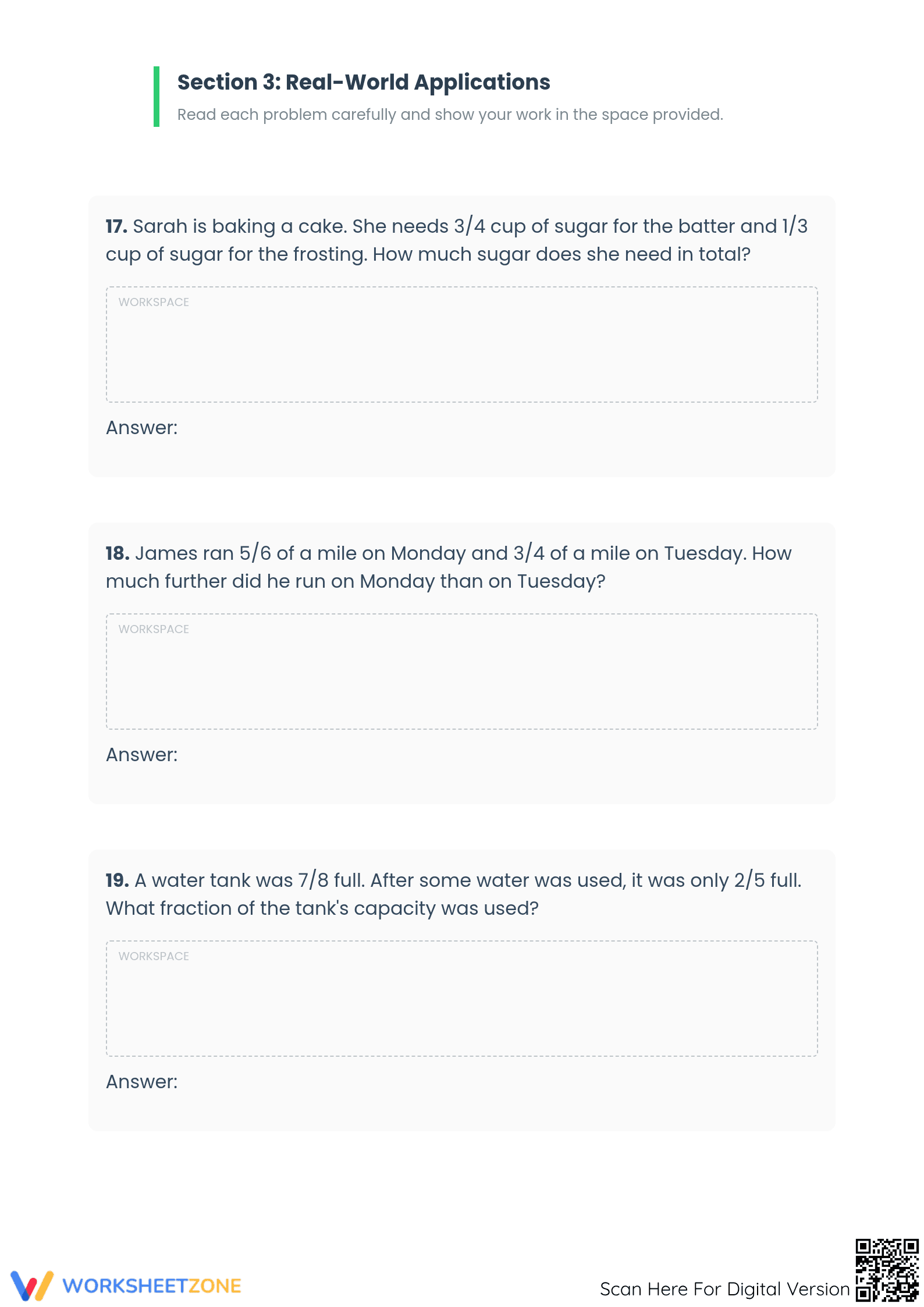
This 5-page worksheet collection contains 25 unique word problems designed to challenge Grade 5 and 6 students. Each scenario requires identifying the correct operation, finding common denominators, and simplifying the final result. A complete answer key is included for immediate feedback and grading efficiency.
Skill Progression
- Guided Practice: Initial problems feature familiar contexts like cooking and measurement with simpler fraction pairings to build confidence.
- Supported Practice: Middle tasks introduce multi-step scenarios requiring more complex common denominator identification and fraction simplification.
- Independent Practice: Final problems present sophisticated multi-variable situations where students must parse dense text to extract mathematical expressions without scaffolding.
This sequence follows a gradual-release model, transitioning students from teacher-supported modeling to fully independent mastery of fraction application.
Standards Alignment
Primary standard CCSS.MATH.CONTENT.5.NF.A.2: Solve word problems involving addition and subtraction of fractions referring to the same whole, including cases of unlike denominators. Students must use benchmark fractions and number sense of fractions to estimate mentally and assess the reasonableness of answers. Both standard codes can be copied directly into lesson plans, IEP goals, or district curriculum mapping tools.
How to Use It
Use this worksheet during the formative phase of a math workshop or as a comprehensive homework assignment after direct instruction on unlike denominators. For effective assessment, observe students' ability to correctly identify whether a problem requires addition or subtraction before they begin their calculations. Expected completion time ranges from 45 to 60 minutes.
Who It's For
Designed for Grade 5 and Grade 6 students who have mastered basic fraction operations and are ready for real-world application. It naturally pairs with visual fraction models or anchor charts that demonstrate common denominator strategies for diverse learners.
According to the RAND AIRS 2024 analysis of mathematical proficiency, exposure to diverse word problem contexts significantly improves a student's ability to transfer fraction skills to unfamiliar situations. This resource addresses the critical need for rigorous application of CCSS.MATH.CONTENT.5.NF.A.2 by providing 25 structured opportunities for students to solve word problems involving addition and subtraction of fractions with unlike denominators. By integrating these tasks into daily practice, educators can bridge the gap between abstract computation and functional literacy. Fisher & Frey (2014) emphasize that gradual-release models in mathematics help reduce cognitive load when students encounter complex linguistic cues in word problems. This worksheet's structure supports that research by scaffolding the transition from simple to complex scenarios, ensuring that Grade 5 learners build the persistent mental models required for upper-elementary success.


