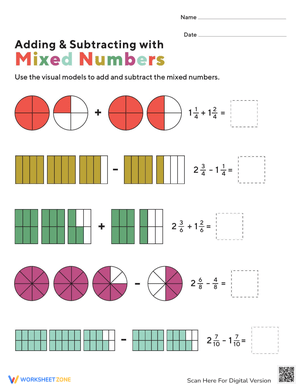
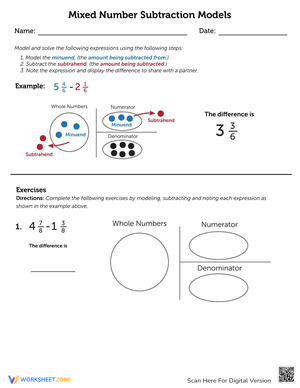
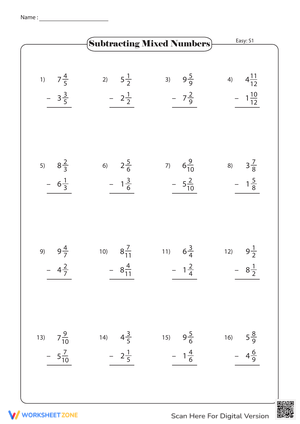
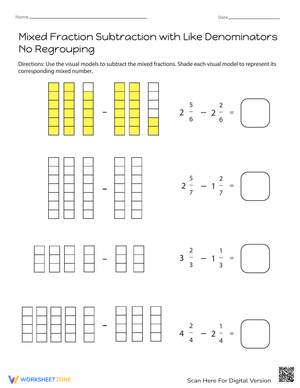
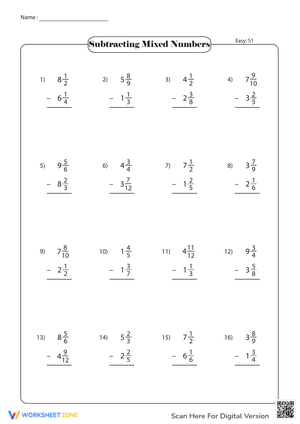
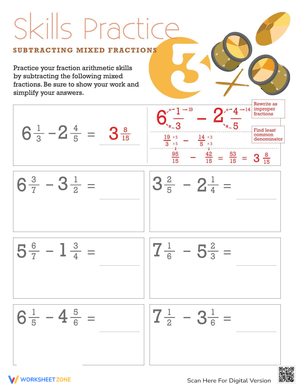
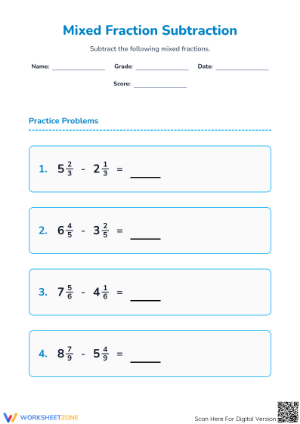
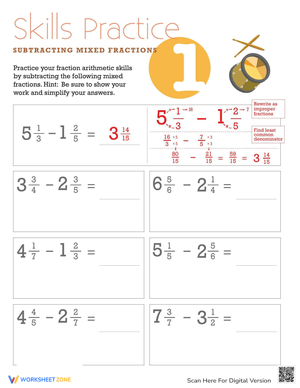
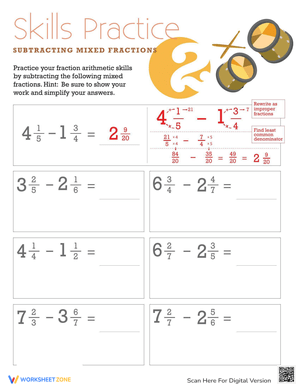
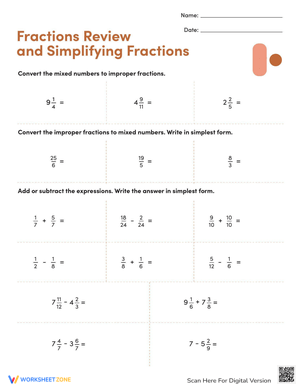
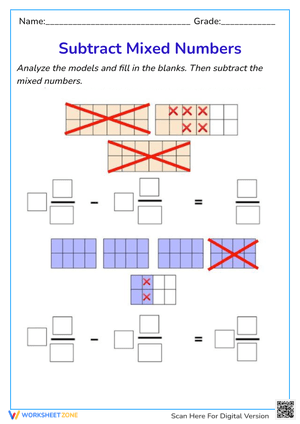
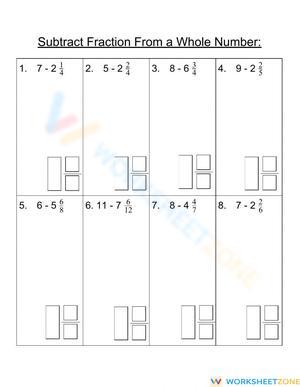
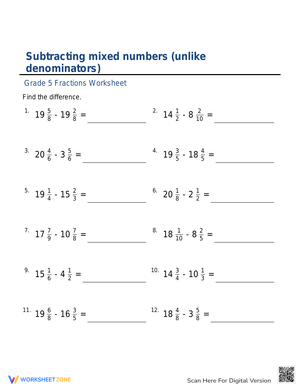
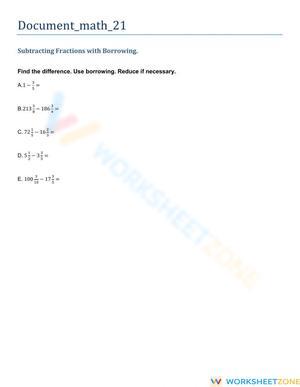
These subtracting mixed numbers worksheets for 5th grade give teachers what a broad fraction review cannot: targeted, repeated exposure to the specific decision points students face when working with mixed quantities — whether the denominators match, whether regrouping is necessary, and whether the final answer is reasonable in context. The set moves from like denominators through unlike denominators into regrouping cases and word problems, so teachers can assign worksheets selectively based on assessment results or work through the full progression from the beginning of the unit.
The Specific Skills Targeted
Mixed-number subtraction at Grade 5 is not a single skill — it is a sequence of related decisions that students learn to make accurately under increasing complexity. Each worksheet targets a distinct layer of that sequence rather than combining all three demands into one problem type from the start.
- Like-denominator subtraction — Students subtract fractional parts directly and manage whole numbers without the added work of finding equivalent fractions. This entry point builds familiarity with the mixed-number structure before complexity increases.
- Unlike-denominator subtraction — Students find a common denominator, rewrite both fractional parts, and subtract. Success here depends on whether students understand that the denominator names the size of the pieces, not just a number to match.
- Regrouping cases — Students recognize that the fractional part of the minuend is less than the fractional part of the subtrahend and rename one whole as an equivalent fraction before subtracting. This step breaks down most often in student work.
- Word problems — Students translate a measurement or recipe context into a subtraction expression, compute, and interpret the result. The answer must make sense in the situation, not just as a fraction on paper.
Separating like from unlike denominators lets teachers isolate where the trouble actually lives. A student who handles like denominators confidently but stalls on unlike denominators has a fraction-equivalence gap, not a subtraction gap. A student who manages equivalent fractions but falls apart on regrouping is missing one specific piece: that one whole can be renamed as a fraction equal to the denominator currently in use.
Where Students Consistently Break Down With Mixed-Number Subtraction
The most persistent regrouping error in Grade 5 looks like this: a student working on 4 1/6 minus 2 5/6 sees that 1/6 is less than 5/6, crosses out the 4 to make it a 3, and then subtracts 5/6 from 1/6 anyway. The student completed the borrowing action but skipped the renaming. The fractional part of the minuend should become 7/6 — because one whole equals 6/6, and 6/6 plus 1/6 is 7/6 — but many students leave it at 1/6 and treat the regrouping step the same way they would handle whole-number borrowing. Including a labeled step in the workspace, a line or box where students write the renamed mixed number before subtracting, interrupts that error before it becomes automatic.
A second pattern appears when unlike denominators are introduced alongside regrouping. Students correctly convert the fractions to a common denominator and then subtract the smaller fraction from the larger one regardless of which belongs to the minuend. The conversion is accurate; the direction is wrong. Asking students to circle the two fractional parts and compare them before subtracting — not after converting — gives them a pause point that catches this error without requiring teacher intervention on every problem.
Fitting These Worksheets Into a Grade 5 Fraction Unit
The most effective placement for these resources is not a single long work session but a spaced sequence across several days. Use a like-denominator worksheet as a warm-up on the first day of instruction, when students need to feel the structure of mixed-number subtraction before new complexity is introduced. Assign an unlike-denominator worksheet for independent practice after the second lesson, once students have seen the equivalent-fraction step demonstrated and discussed. Reserve the regrouping worksheet for day three or four — after a short formative check identifies who still needs to work through that conceptual trade before moving on.
A subtracting mixed numbers worksheets for 5th grade set also fits naturally into a rotation structure. One group solves the current practice worksheet independently while a second group meets with the teacher for guided reteaching on the step that produced the most errors. A third group checks completed work against an answer key and marks problems for revisiting. That arrangement keeps every student in the same topic family without requiring everyone to do the same worksheet at the same time.
For quick assessment, pull five regrouping problems and use them as an exit ticket on Thursday. What comes back tells you whether Friday should move into word problems or hold on computation for one more day. Because the format is printable, selecting five problems from a full worksheet takes about two minutes of planning time.
Standard Alignment
These resources address two connected Common Core State Standards for Mathematics expectations at Grade 5. Standard 5.NF.A.1 requires students to add and subtract fractions with unlike denominators, including mixed numbers, using equivalent fractions to produce common denominators. Standard 5.NF.A.2 extends that computation into word problems and asks students to assess the reasonableness of their answers. In classroom terms, that means the skill arc does not close when students can subtract two mixed numbers on paper — it closes when students can explain why they found a common denominator, whether regrouping was necessary, and whether the result makes sense given the original problem. The worksheet sequence in this set, from like denominators through word problems, follows that arc directly.
Reaching Students at Different Entry Points
Students who are still uncertain about fraction equivalence benefit from starting with the like-denominator worksheets and annotating each step explicitly: write the common denominator, write the renamed mixed number if regrouping is needed, subtract, and simplify if the result is not in lowest terms. That visible step sequence gives teachers a clear record of where a student's thinking breaks down, and it slows down the students most likely to make the directional subtraction error — the ones who rush through conversion and then subtract in the wrong direction.
For students ready to move beyond routine computation, the word-problem worksheets provide a stronger challenge when teachers add one written requirement: students must explain whether regrouping was needed and why, either before or after solving. That small addition separates students following a memorized sequence from those who understand what is happening to the quantities. Two problems that look structurally similar on the surface but require different approaches — one needing only equivalent fractions, the other requiring both equivalent fractions and regrouping — make productive comparison material when students have to defend which strategy they used and why.
When a subtracting mixed numbers worksheets for 5th grade set includes both like- and unlike-denominator items, teachers can differentiate within a single class period by assigning the like-denominator worksheet to students who need more support while the rest of the class works with unlike denominators or regrouping problems. Both groups stay inside the same topic, which makes a shared closing discussion workable without leaving either group behind.
Frequently Asked Questions
At what point in the year do Grade 5 students work on subtracting mixed numbers?
Most Grade 5 fraction units sequence fraction equivalence and addition before moving to subtraction with unlike denominators and mixed numbers. Mixed-number subtraction typically lands in the second half of the fraction unit, after students can reliably find common denominators and have some experience rewriting fractional parts. That timing aligns with the 5.NF.A.1 and 5.NF.A.2 placement in most curriculum maps.
Do students need to understand adding mixed numbers before they subtract them?
Familiarity with addition helps. Students who have already worked through mixed-number addition know how renaming moves between the fractional and whole-number parts of a mixed number. That background reduces the number of new demands subtraction places on working memory, making the regrouping step easier to isolate and address. It is not a strict prerequisite, but it shortens the instructional path considerably.
Can these worksheets be used for small-group reteaching after a quiz?
Yes, and this is one of the most practical uses for this format. Because each worksheet targets a specific layer of the skill — like denominators, unlike denominators, regrouping, or word problems — teachers can select just the section that matches the gap an assessment revealed. A student who solved unlike-denominator problems correctly but missed every regrouping item needs only that worksheet, not the full set.
Are the worksheets practical to send home as homework?
The subtracting mixed numbers worksheets for 5th grade format is direct enough for most families to follow without additional explanation. The notation is standard, the problems do not require manipulatives, and most worksheets in the set include a worked example at the top. If a family member does not remember how to find a common denominator, that example gives them enough context to support their student without having to contact the teacher.














 Interactive Worksheet Maker
 Quiz Maker
 Word Search Maker
 Crossword Puzzle Maker
 Word Scramble Generator
 Sentence Scramble Generator
 Handwriting Worksheet Generator
 Name Tracing Generator
 Fill In The Blank Generator




 BACK TOSCHOOL