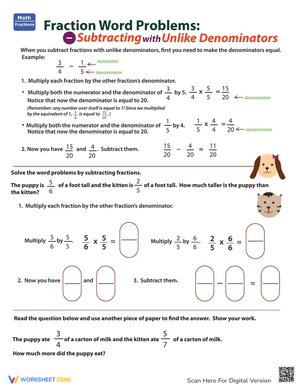
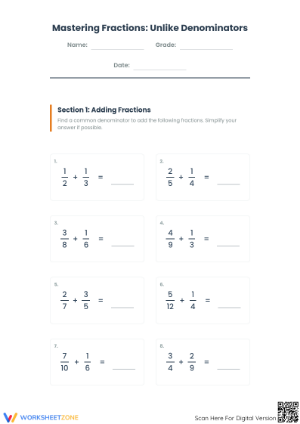
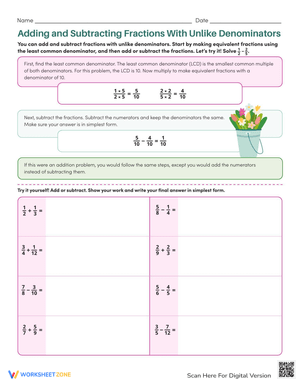
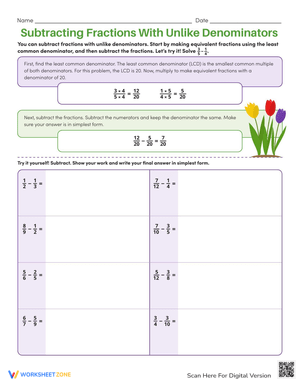
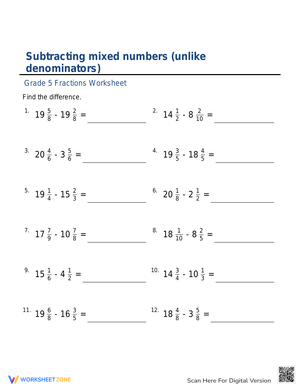
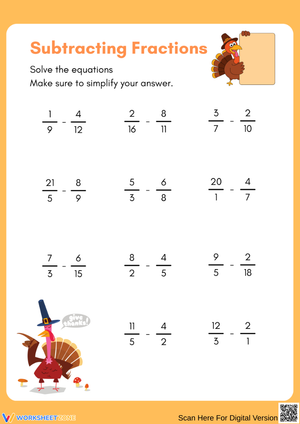
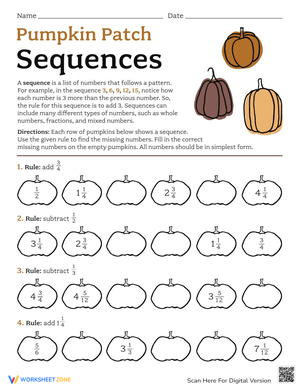
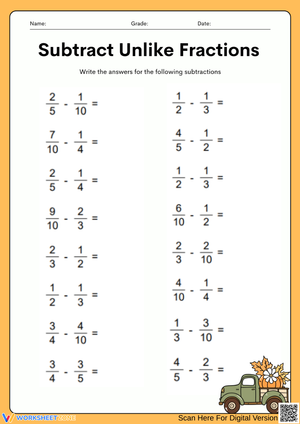
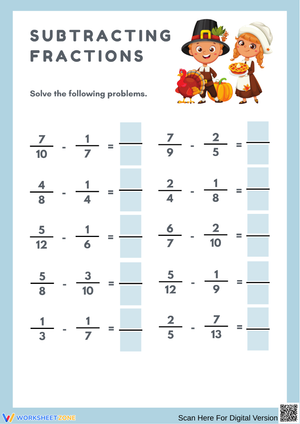
These subtracting fractions with unlike denominators printable worksheets for 5th grade give teachers a targeted set of resources for one of the most error-prone procedures in upper elementary math. The work asks students to hold several steps in sequence — identifying unlike denominators, finding a shared multiple, rewriting both fractions as equivalent forms, and then subtracting — and having that process written out on paper lets both students and teachers see exactly where the thinking breaks down.
The Specific Skills Targeted
Each worksheet in the set addresses a different piece of the fraction subtraction process rather than drilling one narrow computation type repeatedly. That variety matters because students who solve 3/4 − 1/6 fluently in a column of equations often stumble the moment the same subtraction appears inside a word problem or a visual model.
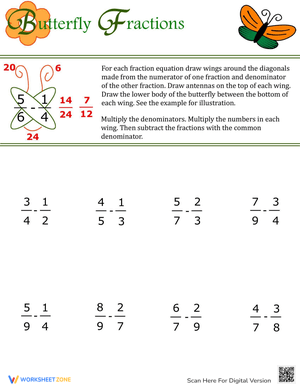
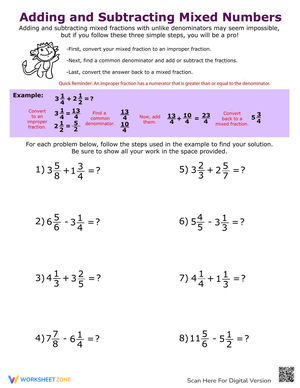
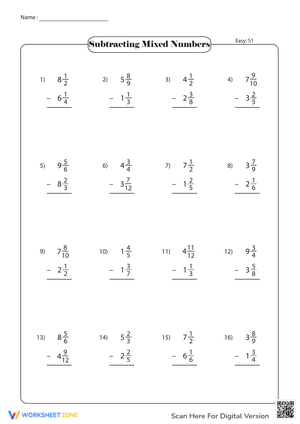
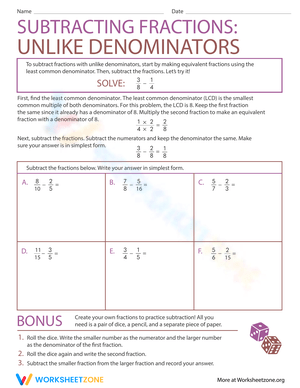
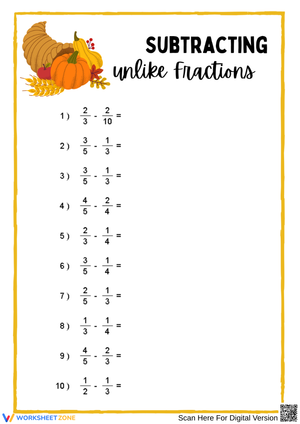
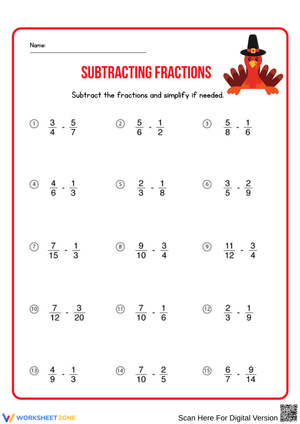
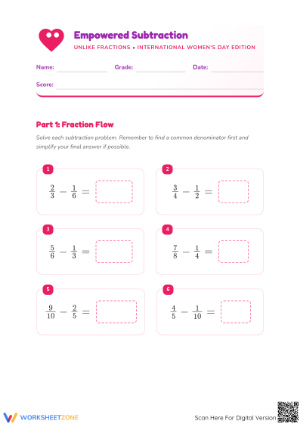
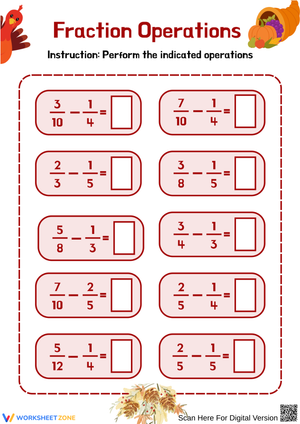
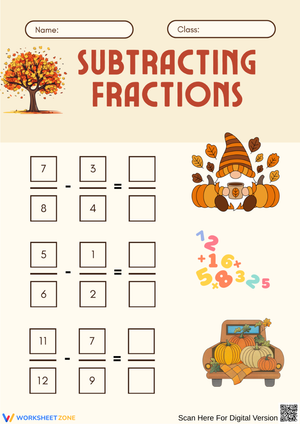
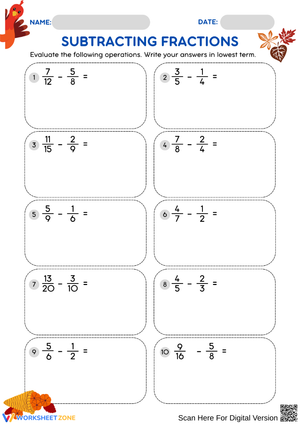
- Straight computation items that build procedural fluency with denominator pairs — beginning with factors that share an obvious relationship such as halves and fourths or thirds and sixths, then moving to pairs like fifths and sevenths that require more deliberate thinking
- Visual fraction strip and number line tasks where students mark equivalent fractions before subtracting, anchoring the procedure to a concrete representation of fraction size
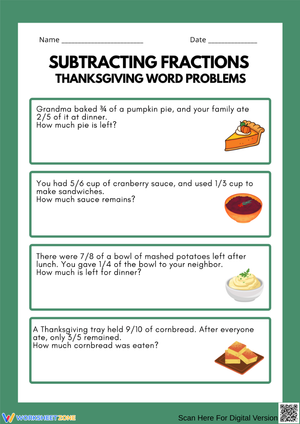
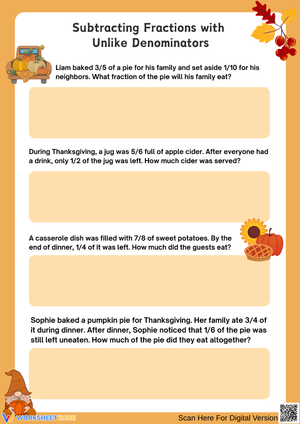
- Word problems set in classroom-familiar contexts — splitting ribbon, measuring ingredients, comparing walking distances — that require students to identify that subtraction is even needed before any computation begins
- Mixed practice sets that present all three formats together, so students cannot rely on format cues to decide what operation or strategy to use
Each worksheet also includes a simplification step, so students practice deciding whether the answer is in lowest terms rather than treating that reduction as optional or someone else's responsibility.
Mistakes Students Make That These Worksheets Help You Catch
The most stubborn mistake in fraction subtraction is subtracting straight across both numerator and denominator: a student writes 3/4 − 1/6 = 2/2, treating the fractions the way they would treat whole numbers. That error is not carelessness. It reflects a genuine overgeneralization from prior subtraction experience, and it tends to reappear under time pressure even after direct instruction. The subtracting fractions with unlike denominators printable worksheets for 5th grade in this set expose that pattern early because the three-step format — find a common denominator, rewrite, subtract — makes the error visible at the exact stage where it occurs rather than only in the final wrong answer.
A second mistake is subtler. Students will sometimes find a valid common denominator but convert only one fraction, then attempt to subtract the resulting mismatch. A student who rewrites 1/4 as 3/12 but leaves 1/3 unchanged will try to compute 3/12 − 1/3 as though the denominators now match. That mistake lives in the rewriting step, not in the subtraction itself, and catching it there saves significant reteaching time later in the unit.
Simplification errors also surface regularly. Students who arrive at a correct intermediate answer of 4/8 often leave it unreduced — not because they do not know the equivalence rule, but because attention was spent by the time they reached that final step. When that pattern shows up in multiple students' work, it usually signals that a brief standalone review of equivalent fractions is worth scheduling before moving the unit forward.
Standard Alignment
These worksheets address Common Core State Standards for Mathematics 5.NF.A.1, which requires Grade 5 students to add and subtract fractions with unlike denominators by replacing the original fractions with equivalent fractions that share a common denominator. The standard sits at Grade 5 for a specific developmental reason: students worked with equivalent fraction recognition in Grade 4 under 4.NF.A.1, and they are now expected to use that understanding as an operational tool — not just a comparison skill. Practice at this level asks students to articulate why the rewritten fractions are equivalent, not only to carry out the conversion procedure. Worksheets that skip the reasoning step and move straight to the answer do not fully address what the standard requires.
Building These Worksheets Into Your Weekly Lesson Plans
The set fits multiple points in a Grade 5 math block without requiring any restructuring of the unit sequence. During the first days of a fraction subtraction unit, a computation-only worksheet works well as a brief pre-assessment. Look at where student work breaks down — wrong common denominator, incorrect equivalent fraction, or a subtraction error in the numerator — and you know which step to prioritize during the first mini-lesson.
Mid-unit, the mixed-format worksheets suit the 10-to-12-minute guided practice window that follows direct instruction. Word-problem worksheets are better held until later, after the procedure is stable. Assigning story problems while students are still uncertain about common denominators splits cognitive attention in the wrong direction and produces work that reflects confusion rather than genuine understanding of the concept.
The subtracting fractions with unlike denominators printable worksheets for 5th grade also circulate well in math centers. A group that has reached procedural fluency on the computation items works through word problems independently while the teacher pulls a small group to address equivalent fraction conversion errors directly. For end-of-week review, a short computation worksheet gives a quick retrieval check before the weekend gap without eating into new instruction time.
Adjusting the Set for a Range of Learners
The range of formats makes differentiation possible without pulling materials from a separate source. Students who need more structure start on worksheets that include dedicated lines for writing the common denominator and each rewritten fraction before the subtraction step — those built-in spaces reduce the chance of losing track mid-problem and build the habit of showing work in sequence. Once those students complete the supported format with reasonable consistency, the move to worksheets without pre-formatted lines is a natural next step.
Students ready to push further benefit most from the word problems and from a simple writing extension: ask them to explain in one or two sentences why they chose a particular common denominator. That brief explanation reveals whether the choice rests on an understanding of multiples or on a guess that happened to produce a workable number.
The visual model worksheets deserve a note about placement. They are not simpler than the computation items — they are differently demanding, and some students who move through equations quickly find the number line tasks more challenging because those tasks require connecting the abstract answer to a visible representation of fraction size. Teachers sometimes reserve those worksheets specifically for students who have stopped making computational errors but have not yet connected the procedure to what the subtraction actually means.
Frequently Asked Questions
What does subtracting fractions with unlike denominators mean at the 5th grade level?
It means students subtract two fractions that do not start with the same denominator. Before subtracting, they rewrite both fractions as equivalent fractions that share a common denominator, then subtract numerators. At Grade 5, the expectation is that students understand why the rewriting is necessary — the fractions must represent equal-sized parts before the subtraction is valid — not only that they can follow the steps in order.
How do these worksheets fit into an existing fraction unit?
Most Grade 5 fraction units spend several lessons on equivalent fraction fluency before introducing subtraction with unlike denominators. These worksheets fit best after that foundational work is in place. The computation-focused worksheets suit the early practice days of the subtraction unit; the word-problem and visual-model worksheets work better a few lessons in, once students have the procedure under reasonable control and attention is free for the contextual reasoning the story problems require.
Can teachers use this set for homework as well as in-class practice?
The computation worksheets work well for homework because the steps are visible — families can follow the written work even if fraction subtraction is not fresh in their memory. The word-problem worksheets are better kept for class, where a student can ask a clarifying question if the context is confusing. Assigning the subtracting fractions with unlike denominators printable worksheets for 5th grade as take-home practice on computation nights and reserving the richer formats for guided class time tends to produce more useful student work in both settings.














 Interactive Worksheet Maker
 Quiz Maker
 Word Search Maker
 Crossword Puzzle Maker
 Word Scramble Generator
 Sentence Scramble Generator
 Handwriting Worksheet Generator
 Name Tracing Generator
 Fill In The Blank Generator




 BACK TOSCHOOL