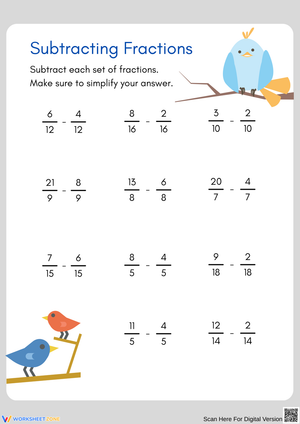
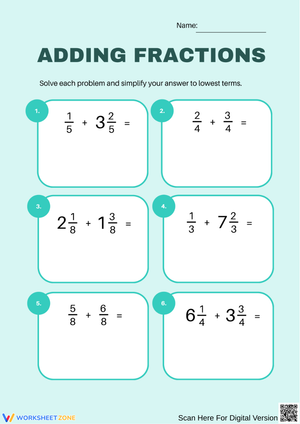
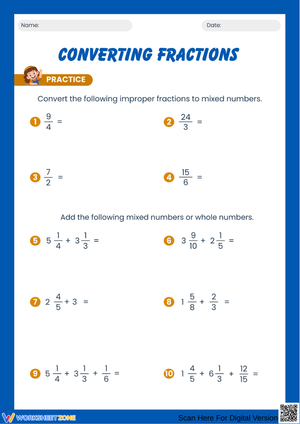
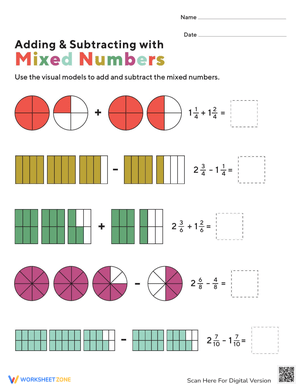
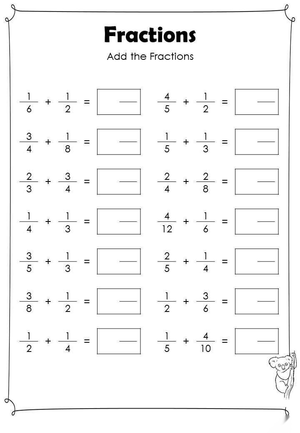
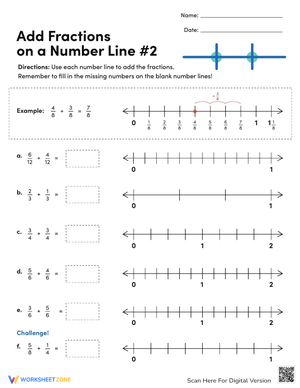
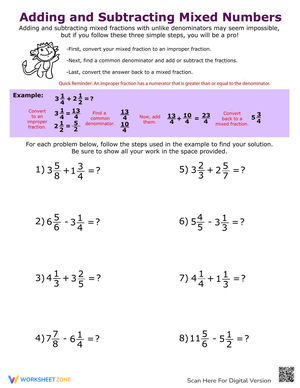
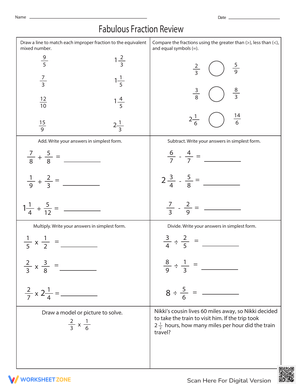
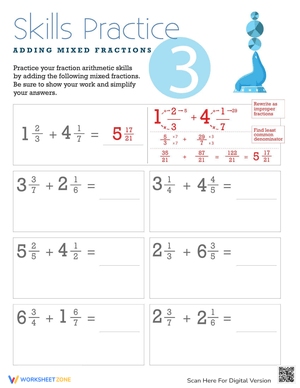
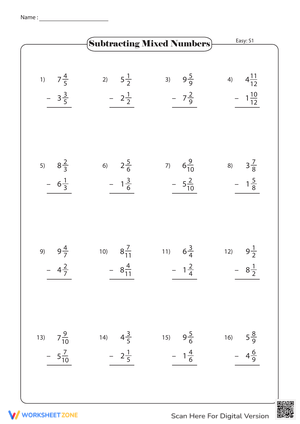
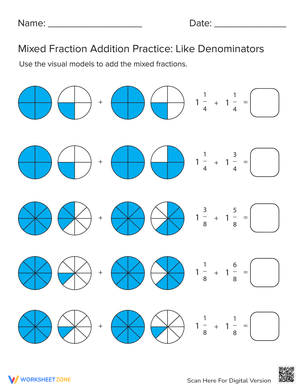
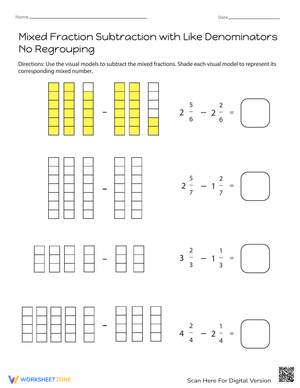
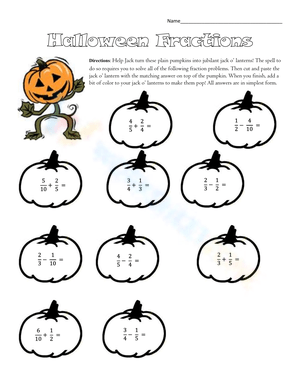
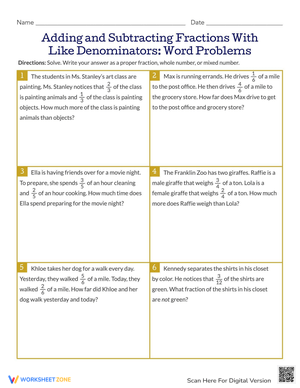
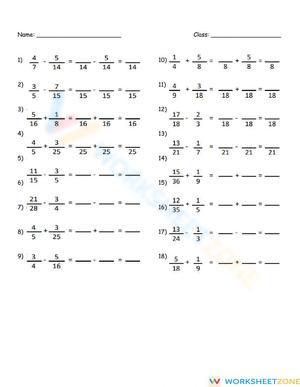
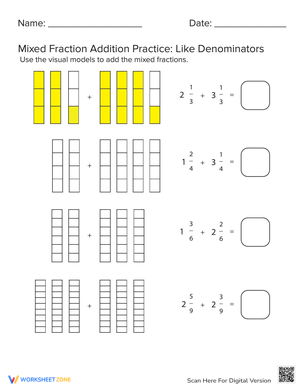
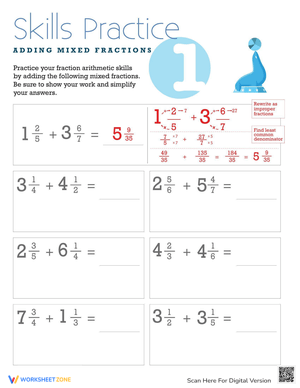
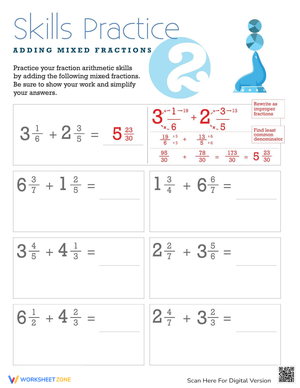
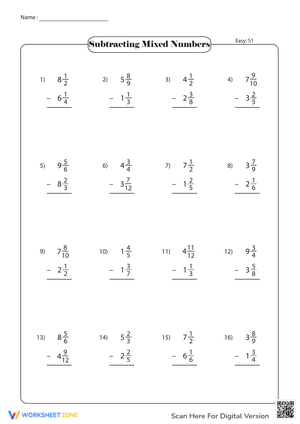
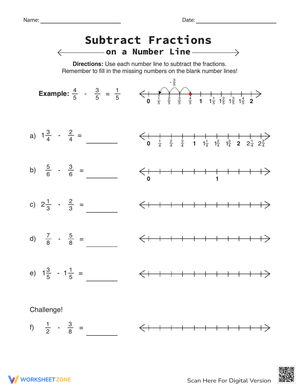
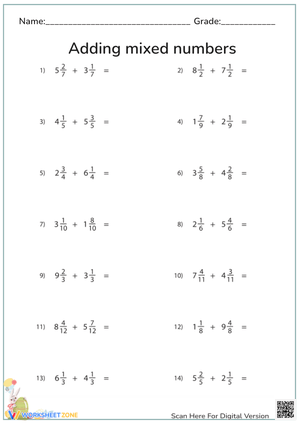
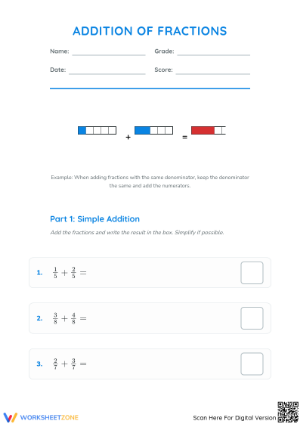
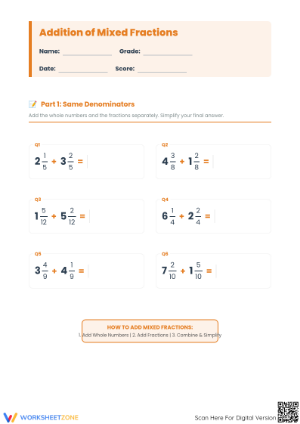
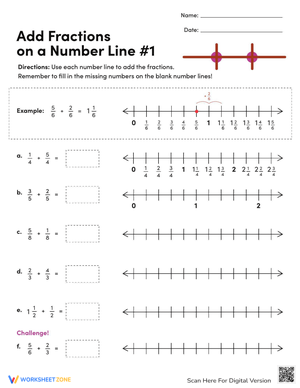
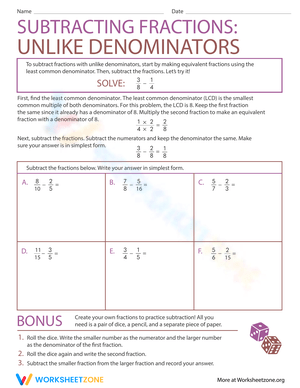
These adding and subtracting fractions worksheets for 5th grade give teachers a ready-to-print set that spans same-denominator addition through unlike denominators, mixed numbers with regrouping, and word problems — each worksheet targeting a specific step in the Grade 5 fraction sequence rather than blending every skill into one undifferentiated review. Most classrooms need resources that hold up across whole-group instruction, partner work, small-group reteach, and homework, and this set covers that range without requiring teachers to piece together separate materials for each sub-skill.
Skills These Worksheets Build
The set covers the six major moves students need to reach fluency with fraction operations at Grade 5. The skill order matters — problems that mix unlike denominators with mixed-number regrouping before students are solid on equivalent fractions produce confusion rather than practice. Each worksheet stays inside a narrow skill band so teachers can match it precisely to the lesson objective.
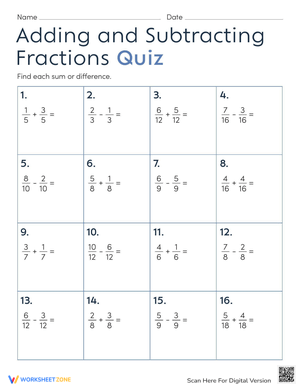
- Adding fractions with like denominators, keeping the focus on what the numerator counts and what the denominator names
- Generating equivalent fractions — the conversion step that makes unlike-denominator work possible
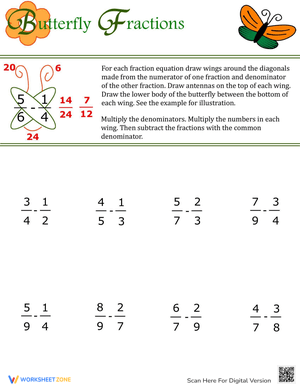
- Adding and subtracting fractions with unlike denominators by rewriting both fractions with a common denominator first
- Simplifying answers to lowest terms and recognizing when an improper fraction should be rewritten as a mixed number
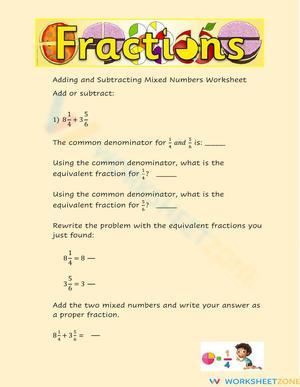
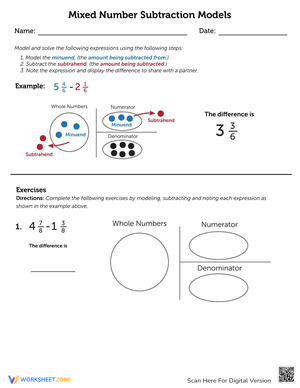
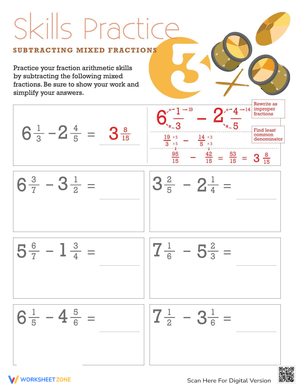
- Subtracting mixed numbers that require regrouping when the fraction in the subtrahend is greater than the fraction in the minuend
- Applying all of the above in word problems, which require students to identify the operation before computing rather than following a visible template
The word problems earn their place in the set. Students who execute unlike-denominator subtraction cleanly on a computation worksheet often stall when the same operation appears in a sentence. Including application items alongside computation problems helps teachers see whether a student understands the operation or has only memorized the steps from yesterday's example.
Frequent Student Errors Worth Watching and Correcting
The most persistent error in 5th grade fraction addition is the whole-number shortcut: adding numerators and adding denominators separately. A student writing 1/2 + 1/3 = 2/5 is not being careless — that answer reflects a coherent but wrong generalization from whole-number addition. Students who identify this error during a Monday lesson will often revert to it on an independent worksheet by Thursday, especially when the problem format changes slightly or the numbers are unfamiliar. Worksheets that present unlike-denominator problems in varied arrangements — horizontal, vertical, with and without the equivalent fraction shown — surface that reversion before the unit assessment does.
Mixed-number subtraction with regrouping produces a different and equally predictable error. When students encounter 4 1/4 minus 2 3/4, many subtract the whole-number parts (4 minus 2 equals 2) and then try to compute the fraction parts as 1/4 minus 3/4. Some write a negative fraction appended to the whole number. Others flip the fractions and subtract the smaller from the larger. Both versions reveal the same gap: students do not yet recognize that the whole number can be broken apart to make the fraction subtraction workable. Catching that pattern on a worksheet before the unit test gives teachers time to address it in a small group — far more efficient than discovering it during review.
Working These Worksheets Into a Lesson Plan Without Extra Prep
The narrower, skill-specific worksheets fit naturally into the first 8 to 10 minutes of a math period — the block after morning meeting ends and before direct instruction begins. A like-denominator worksheet on Monday and an equivalent-fraction worksheet on Tuesday give students low-stakes repetition of each prerequisite before the unlike-denominator lesson arrives midweek. That daily warm-up also functions as informal formative data: if most of the class is still making conversion errors by Wednesday, the teacher has reason to slow the pace before moving forward.
For the adding and subtracting fractions worksheets for 5th grade that cover mixed numbers and word problems, whole-group use works best after the concept has been introduced. Students work independently for 10 to 12 minutes, then the class compares strategies on two or three problems rather than reviewing every answer. That short discussion often produces more insight than a full debrief, because students hear how their classmates handled the regrouping step or identified the operation in a word problem context.
Substitute days are another strong use case. A substitute covering math does not need to understand the full fraction progression — the worksheet directions are self-contained, the task type is familiar to students, and the teacher can specify in the sub plans which worksheet matches the day's pacing. That kind of structure is hard to replicate with video resources or open-ended tasks when coverage is unplanned.
Standard Alignment
The operative standard for this work is 5.NF.A.1, which asks students to add and subtract fractions with unlike denominators by replacing given fractions with equivalent fractions that produce a common denominator. In classroom terms, denominator reasoning is not a warmup step — it is part of the operation itself, and students who skip it are not meeting the standard even when they occasionally arrive at a correct answer. Teachers building adding and subtracting fractions worksheets for 5th grade into their weekly planning can anchor progress monitoring and small-group goals directly to this standard number.
The related standard 5.NF.A.2 extends the work into word problems and estimation, asking students to judge the reasonableness of fraction sums and differences using benchmark fractions. Worksheets that include short application problems alongside computation give teachers a natural connection between the two standards without requiring a separate resource for each.
Adapting the Set for Different Student Levels
For students still developing fluency with equivalent fractions, start with worksheets that limit the denominators to multiples of each other — thirds and sixths, fourths and twelfths — before introducing pairs like thirds and fifths that share no obvious common factor. That progression keeps the cognitive demand on the operation rather than on prime factorization, which is a genuinely separate skill and easy to conflate with fraction fluency at this stage.
Students who move through unlike-denominator addition quickly are usually ready for mixed-number subtraction with regrouping as the next challenge, not simply more unlike-denominator computation. The jump in difficulty is significant enough that most students need at least two worksheet passes — one for recognition, one for fluency — before that operation becomes reliable. For students working ahead, requiring every answer to be simplified and expressed as a mixed number when applicable keeps the work demanding without inventing a new task type.
For students who freeze when a word problem follows a computation worksheet, try using the application problems as oral discussion starters before written practice. A student who can talk through what a problem is asking will often write the solution correctly once the verbal processing has already happened. That approach works especially well during the small-group intervention block, where the teacher can ask questions and the student does not have to commit anything to paper until the operation makes sense.
Frequently Asked Questions
What prerequisite skills should students have before tackling unlike denominators?
Students need to generate equivalent fractions reliably — multiplying both numerator and denominator by the same factor and understanding why the value stays the same. They should also add and subtract fractions with like denominators without difficulty. Without those two entry skills, unlike-denominator problems carry too many new demands at once and tend to produce procedural guessing rather than genuine understanding.
Can these worksheets work for both classwork and homework?
Yes. The narrower skill worksheets — equivalent fraction generation and like-denominator computation — work well as classwork because teachers can circulate and address errors before they solidify. Longer or mixed-skill worksheets hold up for homework because the directions are clear and the task structure is predictable. Families who do not remember the exact procedure can still support a student when the layout is clean and the problem type is familiar.
How do the worksheets handle mixed-number subtraction with regrouping?
The set includes worksheets that isolate mixed-number subtraction, including problems that require regrouping — where the fractional part of the minuend is less than the fractional part of the subtrahend and the student must borrow from the whole number. That isolation matters because regrouping in mixed-number subtraction is harder than unlike-denominator addition for most 5th graders, and it benefits from focused practice before students encounter it inside a cumulative review set.
How should teachers use these worksheets for intervention?
In intervention, narrow the task before adding volume. A student struggling with unlike denominators benefits more from a worksheet that practices only the conversion step — rewriting both fractions with a shared denominator — than from a broader collection of adding and subtracting fractions worksheets for 5th grade that combines equivalent fractions, simplification, and mixed numbers all at once. Once the conversion is accurate and consistent, layering the full operation back in rarely takes long.














 Interactive Worksheet Maker
 Quiz Maker
 Word Search Maker
 Crossword Puzzle Maker
 Word Scramble Generator
 Sentence Scramble Generator
 Handwriting Worksheet Generator
 Name Tracing Generator
 Fill In The Blank Generator




 BACK TOSCHOOL