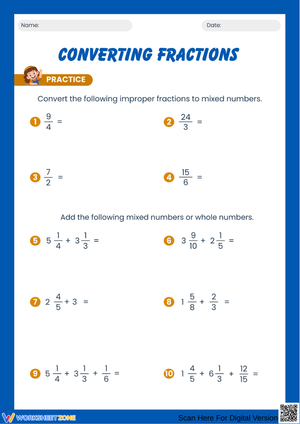
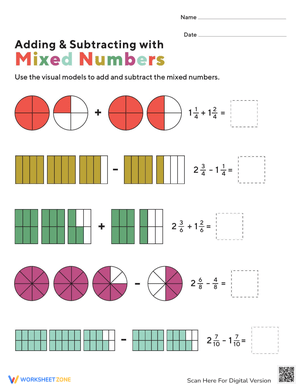
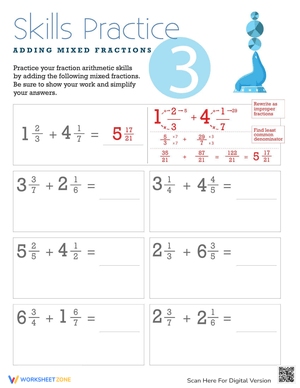
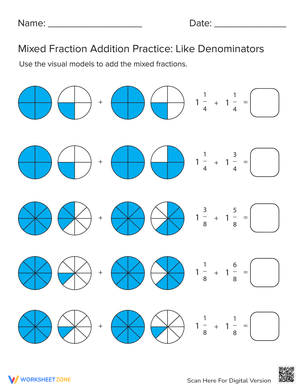
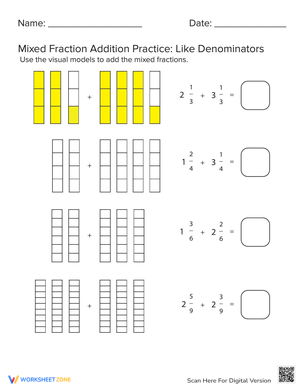
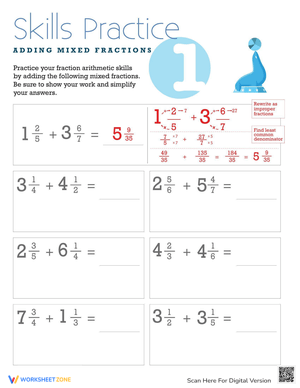
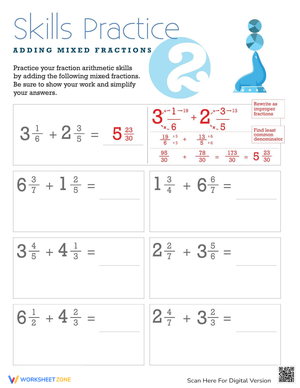
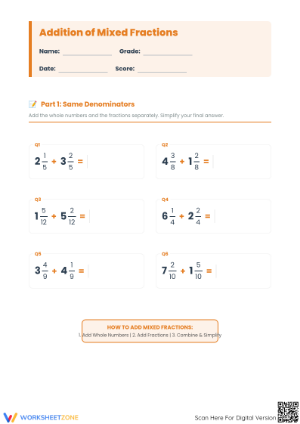
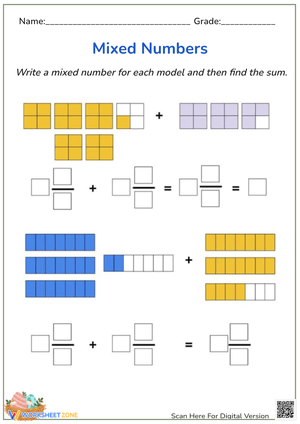
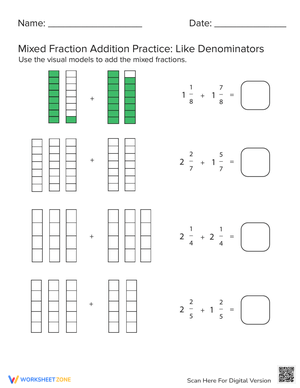
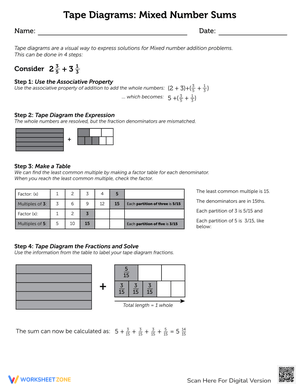
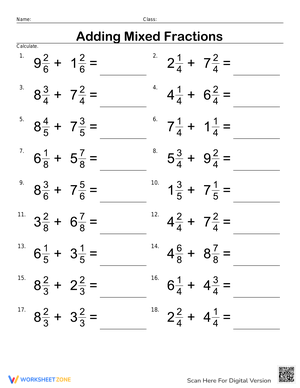
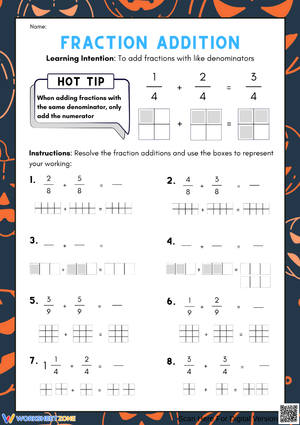
5th grade adding mixed numbers worksheets work best when they're sequenced to surface the decision points students avoid — not just the problems they get wrong. Each worksheet in this set targets a specific layer of the skill: adding with like denominators, moving to unlike denominators, handling sums that require regrouping, and finally applying the operation in word problems where students determine the approach before calculating.
The Specific Skills Each Worksheet Targets
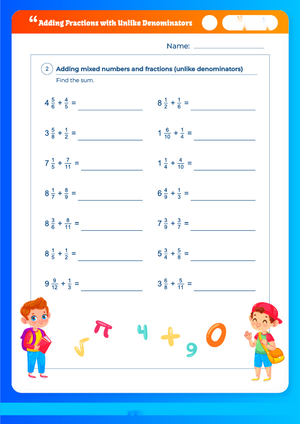
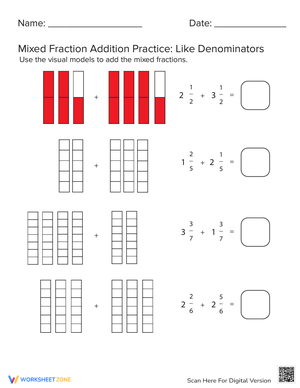
The sequence opens with like denominators so students can focus on the structure of a mixed number — separating the whole-number part from the fractional part, adding each correctly — before denominator conversion enters the picture. From there, worksheets shift to unlike denominators and require finding a common denominator before combining. The final group addresses regrouping: fractional sums greater than one whole that must be renamed before the answer is in simplest form. Estimation prompts run throughout, asking whether a sum should land near 3, near 5, or another benchmark, which keeps reasonableness checking connected to computation rather than treated as a separate step.
- Like-denominator mixed numbers — whole-number and fractional parts added separately
- Unlike denominators requiring equivalent fractions before combining
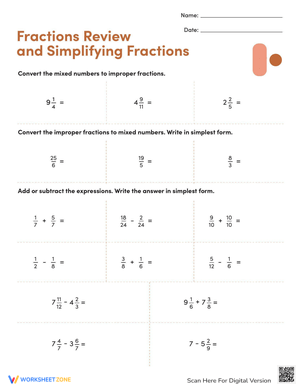
- Regrouping when the fractional sum is greater than one whole
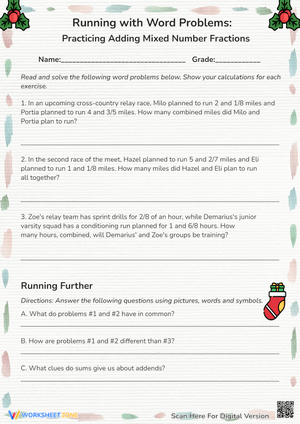
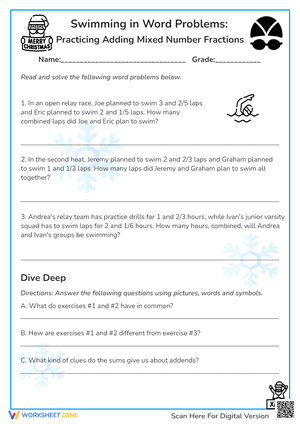
- Measurement and recipe word problems with mixed-number addends
Mistakes Students Make That These Worksheets Help You Catch
The most invisible error happens after students do nearly everything correctly. A student finds a common denominator, adds the fractions, and produces a fractional sum greater than one — then writes the answer as something like 3 9/8 and stops. The improper fraction goes unaddressed because the student doesn't register it as a regrouping signal. This error almost never surfaces during classroom discussion; it shows up on paper, which is one reason these worksheets are useful for diagnosis. The evidence is sitting right there before the next lesson begins.
A second pattern is denominator blindness — adding denominators straight across alongside the numerators and whole numbers, arriving at something like 3 8/12 for the problem 2 3/4 + 1 5/8. Three separate wrong moves performed with complete apparent confidence. That problem is worth keeping in the rotation specifically because it forces four decisions at once: estimating that the sum is near 5, converting to eighths, recognizing 11/8 as something that needs renaming, and combining the result with the whole-number sum. A student who writes 3 11/8 is making a different error than one who writes 3 8/12, and what each student needs next is entirely different.
Standard Alignment
These worksheets align to CCSS.MATH.CONTENT.5.NF.A.1, which requires adding fractions with unlike denominators — including mixed numbers — by replacing them with equivalent fractions that share a common denominator. The paired standard, 5.NF.A.2, extends this to word problems and asks students to assess whether answers are reasonable through estimation. In classroom terms, this means computation and application belong in the same instructional sequence. When 5th grade adding mixed numbers worksheets include both item types within a unit, they reflect the standard's actual intent rather than splitting calculation and context across separate weeks as if they were unrelated skills.
Where These Worksheets Fit Inside a Math Block
As an exit check, four to six problems — two unlike-denominator items and two regrouping items — give clear evidence of who needs a small-group pull the next morning. That information is more specific than a show of hands and more actionable than a whole-class discussion, because written work shows exactly where each student's process broke down. For spiral review, a short set works well as a Monday warm-up during a geometry or data unit; fraction fluency fades without occasional practice, and four problems take less than eight minutes.
In guided practice, one worksheet functions as a "we do" section after modeling: teacher completes the first item aloud, students work the second with a partner, the third independently. 5th grade adding mixed numbers worksheets organized this way remove the need for separate materials at each release stage. For small-group instruction, pulling only the regrouping problems — or only the word problems — keeps the group focused on one issue without revisiting the full lesson.
Adjusting the Work for a Range of Learners
For students still shaky on equivalent fractions, start with the like-denominator worksheets and provide a fraction equivalency strip at the top of the workspace. That reference reduces the demand of the conversion step so attention stays on the mixed-number structure itself — identifying parts, combining, recognizing when regrouping is needed. Once a student is consistently accurate with that support in place, remove it. What happens next is usually informative about how much of the procedure has actually been internalized versus borrowed from the reference.
For students who are ready for something harder, ask them to write a word problem that matches a given number sentence, or present a completed sum and have them work backward to find one of the addends. Both tasks shift the work from executing a procedure to reasoning about structure. 5th grade adding mixed numbers worksheets that include open-ended extension prompts alongside standard computation are especially practical in mixed-readiness classes where some students move through procedural items quickly and need a conceptual push rather than more problems of the same type.
Frequently Asked Questions
Do students need to convert mixed numbers to improper fractions before adding?
No, and starting there often adds confusion at this grade level. Adding whole-number parts and fractional parts separately is more transparent and makes the regrouping step visible. The improper-fraction method is worth teaching as a second approach once students are solid on the part-by-part procedure — not as the entry point for students still building a sense of mixed-number structure.
How many problems per worksheet is enough at Grade 5?
Eight to twelve problems give enough evidence for instructional decisions without exhausting students who are still building fluency. Fewer than six may not reveal consistent error patterns. More than fifteen tends to function as a stamina test rather than a skill check. Exit checks benefit from fewer, tighter items; mixed review before an assessment can reasonably go longer.
Should computation and word problems appear on the same worksheet?
For most lessons, yes — 5.NF.A.1 and 5.NF.A.2 are paired standards, and treating computation and application as separate units creates a false divide. In intervention, though, separating them is useful: if a student handles the computation correctly but misses every word problem, the breakdown is likely in reading and problem comprehension rather than fraction knowledge. That distinction matters when planning what to address next.














 Interactive Worksheet Maker
 Quiz Maker
 Word Search Maker
 Crossword Puzzle Maker
 Word Scramble Generator
 Sentence Scramble Generator
 Handwriting Worksheet Generator
 Name Tracing Generator
 Fill In The Blank Generator




 BACK TOSCHOOL