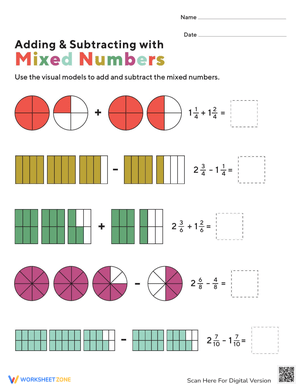
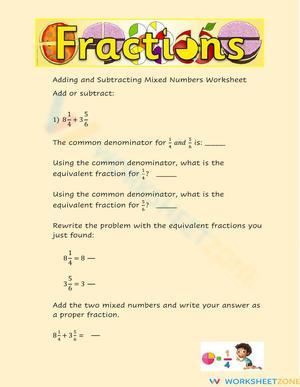
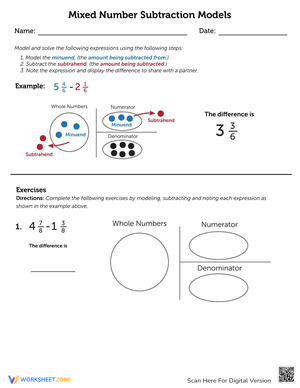
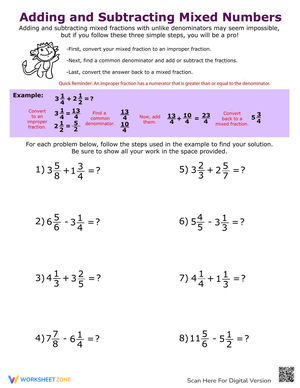
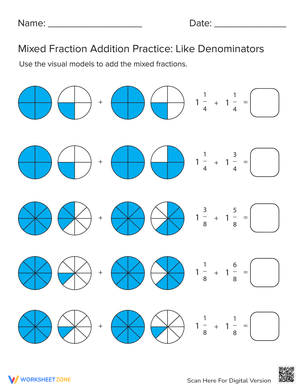
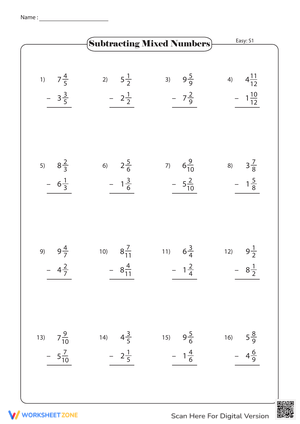
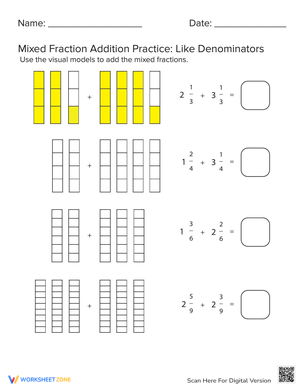
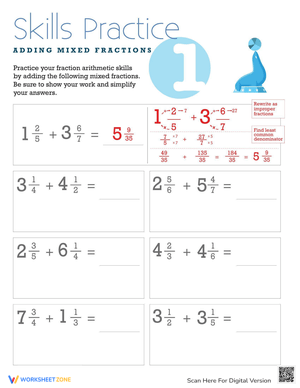
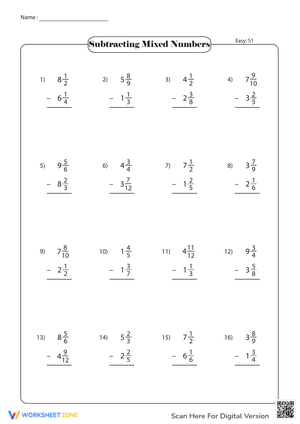
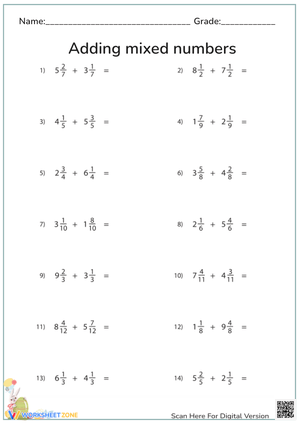
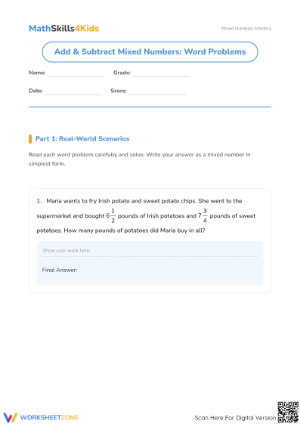
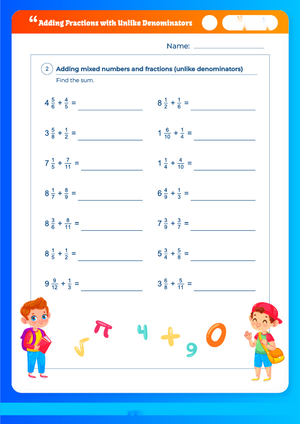
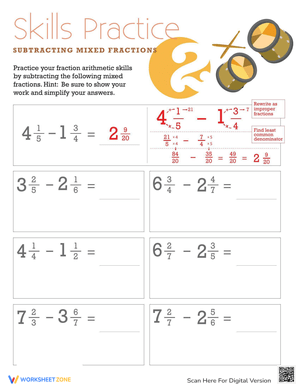
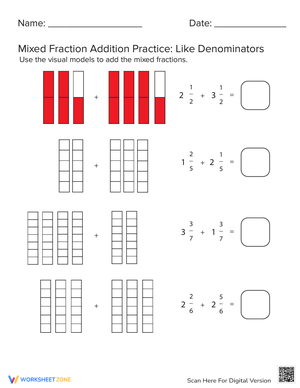
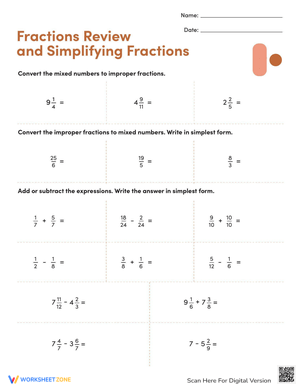
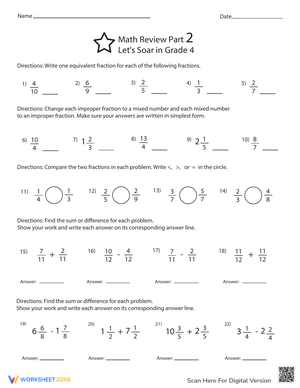
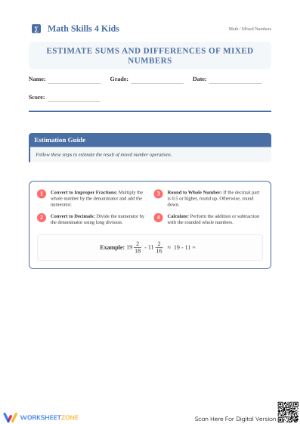
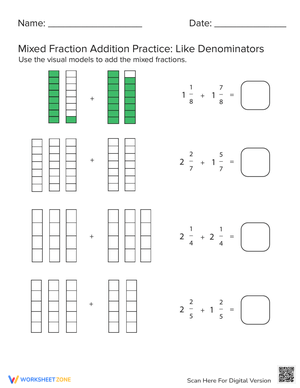
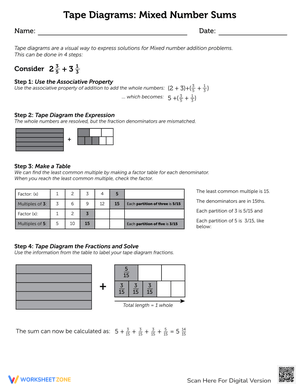
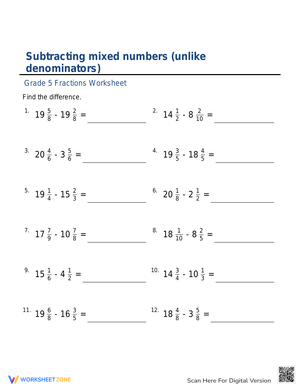
These adding and subtracting mixed numbers pdf worksheets for 5th grade give teachers a set of standalone printable resources that follows a real skill progression — like denominators first, then unlike denominators, then subtraction with regrouping — so each worksheet can be assigned by need rather than by calendar date. Each one stands alone, which means a teacher can pull the regrouping worksheet for a small intervention group on Tuesday without touching the rest of the set.
Mixed numbers are where Grade 5 fraction work gets genuinely harder, and not just because of the added procedures. Students face two separate demands at once: the procedural work of finding equivalent fractions and combining whole-number and fractional parts, and the conceptual understanding of why unlike denominators cannot simply be combined as written. Most computation errors in this unit trace back to one of those two gaps. A well-sequenced worksheet set makes it much easier to tell which one is the real problem in a given student's work.
What the Set Covers, Problem Type by Problem Type
Each worksheet targets a distinct piece of the mixed-number computation chain, so teachers can assign by skill gap rather than working through the set in order.
- Adding mixed numbers with like denominators
- Adding mixed numbers with unlike denominators — students write equivalent fractions before combining
- Subtracting mixed numbers with like denominators
- Subtracting mixed numbers with unlike denominators
- Subtraction with regrouping, covering problems where the fractional part being subtracted is greater than the one in the minuend
- Mixed operation sets that require students to identify the operation before computing
- Word problems with a reasonableness check — students verify whether the answer makes sense given the quantities in the problem
The word problem worksheet earns its place in Grade 5 instruction specifically because of standard 5.NF.A.2, which asks students not just to compute but to assess whether answers are reasonable. A worksheet that builds that check into the task itself — asking students to decide whether a result should be greater than or less than the larger starting quantity — develops a habit that bare computation practice does not.
Each worksheet also includes visible work space for equivalent fractions. In Grade 5, the written steps are evidence of thinking. A wrong final answer with correct equivalent fractions shown tells a different instructional story than a wrong final answer with nothing written — one points to an arithmetic slip, the other to a missing conceptual step.
Where Student Thinking Breaks Down in Mixed-Number Work
The error patterns in student work with mixed numbers are consistent enough that teachers who know them in advance can address them during instruction rather than after the fact.
The first and most common error is treating the denominators like whole numbers being added. A student working on 2 and 3/4 plus 1 and 1/3 will sometimes write 3 and 4/7 — adding the numerators and the denominators separately. This surfaces in students who learned a surface-level procedure but never understood that the denominator names the size of the parts. Catching it on a worksheet is straightforward because the denominator in the answer is wrong in a very specific, predictable way. Correcting it requires going back to what the denominator actually means, not restating the steps.
The second error is regrouping in the wrong direction. When a subtraction problem requires borrowing from the whole number — for example, 5 and 1/8 minus 2 and 7/8 — students sometimes subtract the fractional parts in reverse order and write 6/8 instead of renaming the 5 as 4 and 8/8 first. This parallels the multi-digit subtraction error where students flip digits to avoid borrowing. Visual modeling of the whole-number-to-fraction trade is usually the fastest path to correction.
A third error appears specifically in word problems: students choose the wrong operation. A student who reads "how much wire is left after cutting" may still add the two given lengths together, especially when the numbers look like they belong in a combination. A worksheet that asks students to write one sentence about whether the answer should be greater than or less than the larger starting quantity gives them a self-check before they finalize their work.
Getting the Most From These Worksheets in Daily Instruction
Teachers get clearer results when they decide a worksheet's role before assigning it, because warm-up use, independent practice, intervention, and homework each call for a slightly different approach to the same problems.
For warm-ups, four problems from the like-denominator or common-denominator worksheet work well as the first task when students arrive. Keep the equivalent fraction work visible — projected or written on the board — so students are not guessing at denominators during the opening eight minutes of class. The completed problems give the teacher a fast temperature check on whether yesterday's strategy held overnight, which for fraction work in fifth grade it often does not without that repetition.
In math workshop, two worksheets pair effectively: one where students write only the equivalent fractions for each problem and stop, and a second where they complete the full computation. Separating those stages into two physical tasks forces students to treat the conversion step as its own stage rather than collapsing the whole process into one rushed attempt. Students who skip this separation almost always produce regrouping errors that are actually denominator errors in disguise.
These adding and subtracting mixed numbers pdf worksheets for 5th grade also hold up well as homework because the format is predictable enough for families to follow without additional explanation. When a worksheet comes back the next morning, the visible work tells the teacher more than the final answer alone — and the patterns that show up across a class set often shape what goes on the board the following day.
Standard Alignment
Standard 5.NF.A.1 in the Common Core State Standards for Mathematics requires students to add and subtract fractions with unlike denominators, including mixed numbers, by replacing the original fractions with equivalent fractions that share a common denominator. Standard 5.NF.A.2 extends that work into applied contexts, asking students to solve fraction word problems and assess reasonableness. These adding and subtracting mixed numbers pdf worksheets for 5th grade address both standards directly — the computation worksheets build 5.NF.A.1 fluency, and the word problem worksheet targets the applied reasoning required by 5.NF.A.2.
One instructional implication of those standards is worth naming: many mixed-number errors in student work are not actually mixed-number errors — they are equivalent-fraction errors made visible by the added complexity of the computation. When the worksheet set keeps unlike-denominator practice and regrouping practice on separate worksheets, teachers can identify the real error source more quickly and avoid reteaching the wrong concept to the whole group.
How to Modify These Worksheets for a Mixed-Ability Class
For students who need more support, reduce the problem count assigned from a given worksheet rather than replacing it. Six problems done carefully — with equivalent fractions written out and whole numbers tracked separately — reveal more about student thinking than twenty problems completed carelessly. Teachers can also pre-select problems that use small, familiar denominators like halves, thirds, fourths, and sixths before introducing common multiples that require more calculation to find, such as twelfths or twentieths.
Students ready for additional challenge can work from the same worksheets with a layer of reasoning added on top. After solving, they write one sentence explaining why they chose the common denominator they did. Or they are given a fictional student solution with a single embedded error and asked to identify and correct it. Error analysis at that level keeps the practice grounded in 5.NF.A.1 reasoning while raising the cognitive demand — without sending students off to unrelated content they may not be ready for.
Frequently Asked Questions
What do students need to know before these worksheets are productive?
Students need a working understanding of fraction equivalence and common denominators. If a student cannot reliably rename 1/2 as 3/6 or explain why 2/3 and 3/4 cannot be added as written, mixed-number computation will feel like guesswork. Most Grade 5 teachers get better results from a brief equivalence review at the start of the unit — even just one or two warm-up sets — than from assigning mixed-number practice and discovering mid-worksheet that the denominator foundation is not there.
Do the worksheets include space for students to show their work?
Each worksheet includes space for writing equivalent fractions before computing. That structure matters for both students and teachers — students have a place to organize multi-step work, and teachers gain visible evidence of exactly where thinking broke down when an answer is wrong. A final answer line alone tells you a student got it wrong; the work space tells you which step produced the error.
Are these resources suited for intervention groups?
Because each worksheet targets one skill in the progression, teachers can isolate a specific error pattern — unlike denominators, regrouping, or word-problem operation choice — and assign one worksheet that addresses it directly. These adding and subtracting mixed numbers pdf worksheets for 5th grade are particularly well-suited for the 15-to-20 minute pull-out window where staying focused on a single skill type produces clearer gains than cycling through mixed practice.














 Interactive Worksheet Maker
 Quiz Maker
 Word Search Maker
 Crossword Puzzle Maker
 Word Scramble Generator
 Sentence Scramble Generator
 Handwriting Worksheet Generator
 Name Tracing Generator
 Fill In The Blank Generator




 BACK TOSCHOOL