




























0
Views
0
Downloads

0.0
0
Save
0 Likes
Share
Explore Onomatopoeia: Sound Words Activity
0 Views
0 Downloads

Paste this activity's link or code into your existing LMS (Google Classroom, Canvas, Teams, Schoology, Moodle, etc.).
Students can open and work on the activity right away, with no student login required.
You'll still be able to track student progress and results from your teacher account.
Information
Description
What It Is:
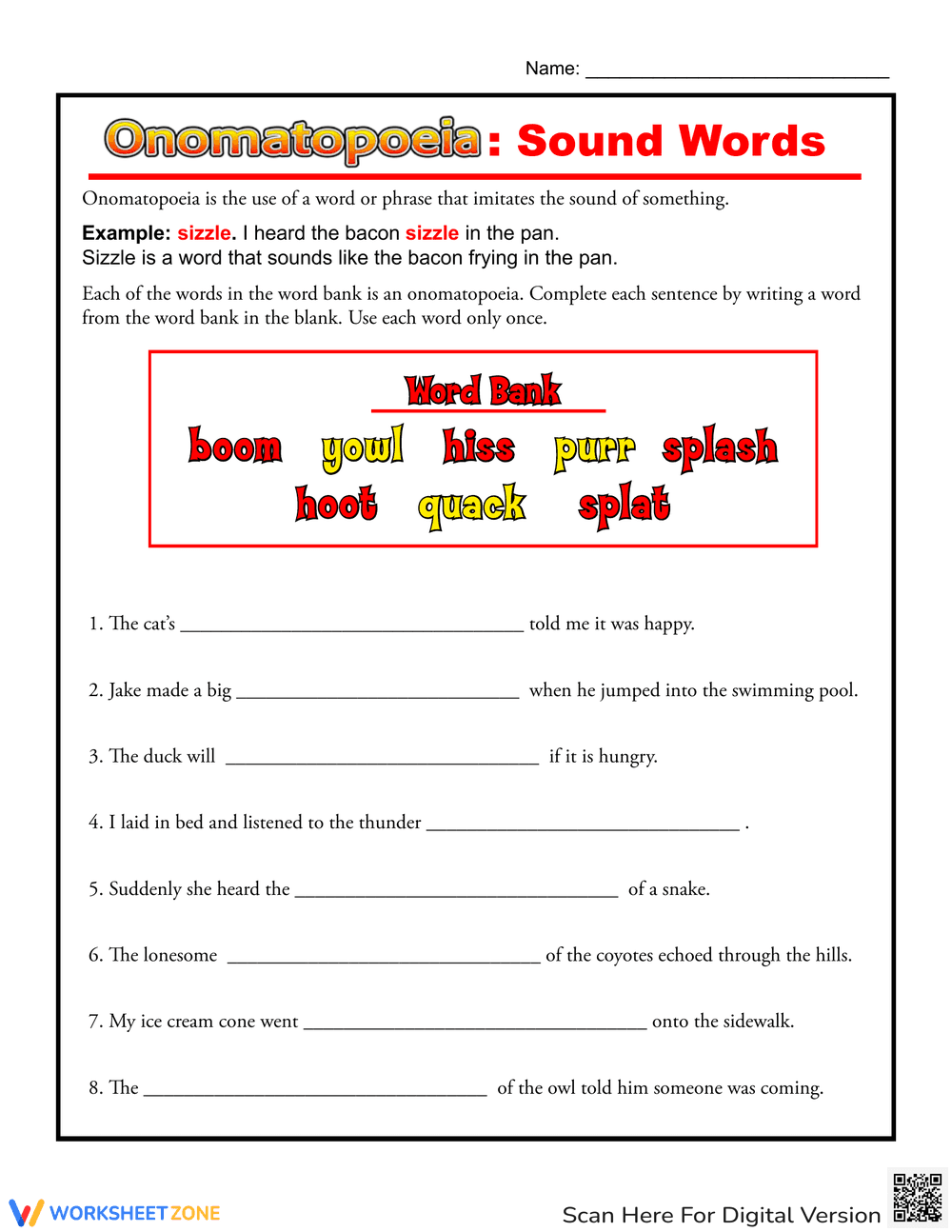
This is an educational worksheet focusing on onomatopoeia, or sound words. It includes a definition and example of onomatopoeia. Students are provided with a word bank containing words like 'boom,' 'yowl,' 'hiss,' 'purr,' 'splash,' 'hoot,' 'quack,' and 'splat.' They must complete eight sentences by selecting the appropriate onomatopoeia from the word bank to fill in the blanks.
Grade Level Suitability:
This worksheet is suitable for grades 5-8. The sentences are relatively simple, and the word bank provides support. It helps introduce or reinforce the concept of onomatopoeia in a fun and engaging way.
Why Use It:
This worksheet helps students understand and identify onomatopoeia. It improves vocabulary, reading comprehension, and the ability to connect sounds with words. It reinforces the concept through practical application.
How to Use It:
First, read the definition and example of onomatopoeia. Then, carefully read each sentence. Choose the word from the word bank that best fits the sentence and makes sense in the context of the sound being described. Write the chosen word in the blank. Use each word only once.
Target Users:
This worksheet is ideal for elementary school students learning about language arts, particularly vocabulary and figurative language. It is suitable for classroom activities, homework assignments, or homeschooling.
This is an educational worksheet focusing on onomatopoeia, or sound words. It includes a definition and example of onomatopoeia. Students are provided with a word bank containing words like 'boom,' 'yowl,' 'hiss,' 'purr,' 'splash,' 'hoot,' 'quack,' and 'splat.' They must complete eight sentences by selecting the appropriate onomatopoeia from the word bank to fill in the blanks.
Grade Level Suitability:
This worksheet is suitable for grades 5-8. The sentences are relatively simple, and the word bank provides support. It helps introduce or reinforce the concept of onomatopoeia in a fun and engaging way.
Why Use It:
This worksheet helps students understand and identify onomatopoeia. It improves vocabulary, reading comprehension, and the ability to connect sounds with words. It reinforces the concept through practical application.
How to Use It:
First, read the definition and example of onomatopoeia. Then, carefully read each sentence. Choose the word from the word bank that best fits the sentence and makes sense in the context of the sound being described. Write the chosen word in the blank. Use each word only once.
Target Users:
This worksheet is ideal for elementary school students learning about language arts, particularly vocabulary and figurative language. It is suitable for classroom activities, homework assignments, or homeschooling.


