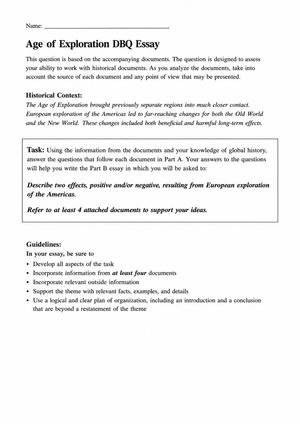
What 5th Graders Should Learn About the Age of Exploration
In most grade 5 classrooms, the Age of Exploration is introduced as a 15th-16th century period when European countries sponsored major sea voyages. Students do not need a college-level survey. They need a clear framework that answers a few essential questions: Why did people explore? Who were the major explorers? Where did they travel? What changed because of those voyages?
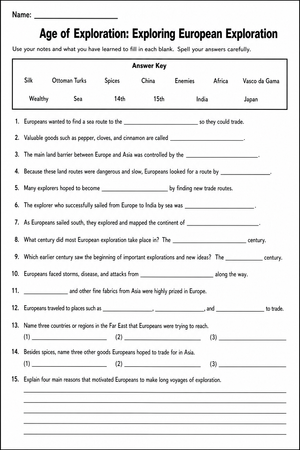
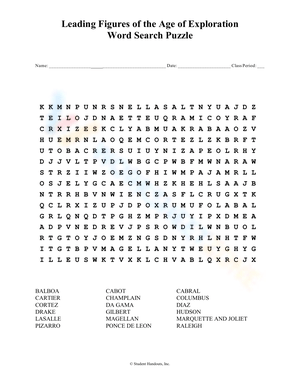
A strong worksheet set keeps those questions visible. Students should see that exploration was driven by several factors at once, including trade, wealth, power, and improved navigation. They should also practice naming major figures commonly taught at this grade level, such as Christopher Columbus, Vasco da Gama, and Ferdinand Magellan. When the worksheet asks students to connect each explorer to a route or destination, the lesson becomes easier to remember.
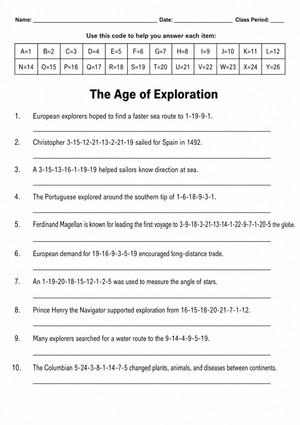
Just as important, grade 5 materials should move beyond a heroes-and-ships version of history. Students are ready to discuss that exploration brought colonization, disease spread, and long-term harm to Indigenous peoples. They can also begin to understand the Columbian Exchange as a major transfer of plants, animals, goods, and diseases across continents. When worksheets include those consequences, the unit becomes more accurate and more useful for later history study.
Worksheet Features That Match Grade 5 Social Studies Skills
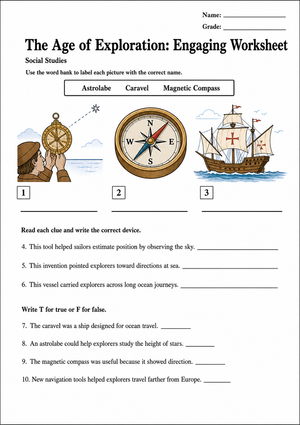
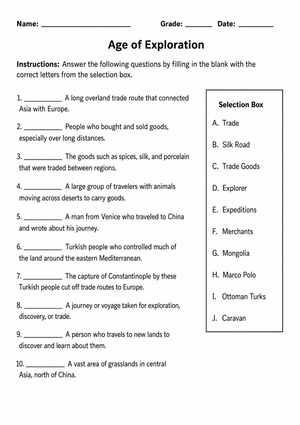
The most effective age of exploration worksheets are not only about recall. They help students practice the social studies skills that teachers are expected to build across the year. A well-designed printable can support:
- Cause and effect: Students explain why nations looked for sea routes and what happened after voyages began.
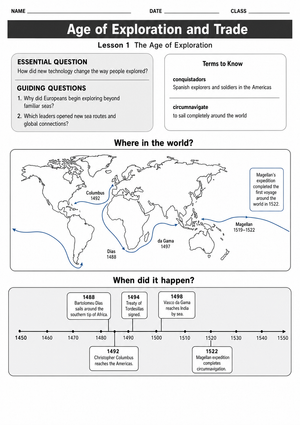
- Timeline thinking: Students place voyages in sequence and notice how exploration expanded over time.
- Map reading: Students trace oceans, continents, and travel paths tied to specific explorers.
- Compare and contrast: Students study how two explorers had different goals, sponsors, or outcomes.
- Short written response: Students answer prompts with evidence from a reading passage or map.
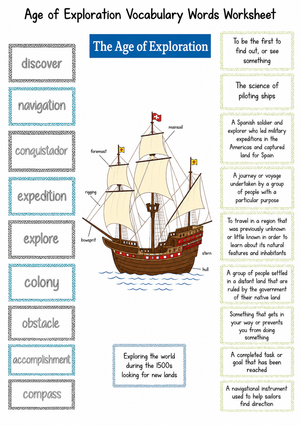
For busy classrooms, that variety matters. One worksheet may work as guided practice after a mini-lesson, while another can be used as an independent check for understanding. If you are planning intervention or review, a simple progression also helps: start with vocabulary and reasons for exploration, move to map and timeline tasks, then end with a short response about consequences.
How to Choose the Right Worksheet for Your Lesson Goal
If your lesson objective is basic understanding, choose a reading-and-questions format. If your goal is geography, pick a route map or labeling page. If you want stronger discussion, use a worksheet with comparison prompts or consequences of exploration.
For a one-day lesson, a simple sequence works well:
- Start with a short reading on motives for exploration.
- Move to a map that traces key voyages.
- End with written reflection on effects on Indigenous peoples and global exchange.
For multi-day instruction, mix worksheet types so students revisit the topic from more than one angle. That keeps the unit from feeling repetitive and gives you more than one form of evidence when you assess understanding. It also makes it easier to support students who may struggle with reading but show stronger understanding through maps, charts, or oral discussion.
Classroom Implementation
In a full-class lesson, start with a short anchor question such as, Why would a country risk a long sea voyage in the 1400s or 1500s? Students can jot predictions before reading. Then use the worksheet to move from motivation to evidence. A route map, short passage, and compare-the-explorers chart fit well in one period because each task builds on the last.
For centers, split the topic into stations. One group reads a short explorer summary, one works on a route map, and one completes a cause-and-effect organizer about trade, colonization, and exchange. In intervention settings, reduce the writing load and keep the focus on vocabulary, visuals, and sentence frames. For enrichment, ask students to defend which worksheet evidence best explains why the Age of Exploration changed world history.
These printables also work well for sub plans and review days because directions can stay visible on the page. Students know whether they are reading, labeling, sorting, or answering. That independence matters in grade 5, especially when you need a resource that stays academically focused without requiring constant reteaching.
Frequently Asked Questions
1. What should 5th graders learn about the Age of Exploration?
They should learn why European nations explored, identify major explorers and routes, and explain major consequences such as colonization, disease spread, and the Columbian Exchange. In grade 5, the goal is clear understanding of causes, routes, and impacts rather than heavy memorization of every voyage.
2. Which explorers are usually included in grade 5 Age of Exploration worksheets?
Many grade 5 resources focus on Christopher Columbus, Vasco da Gama, and Ferdinand Magellan because those names connect well to common route-mapping and comparison activities. Teachers may also use related figures, but those three are a practical core for introductory lessons.
3. How can teachers use printable PDF worksheets in a social studies lesson?
Teachers can use them for warm-ups, independent practice, centers, homework, sub plans, early finisher work, and quick formative checks. The PDF format is especially helpful when you need a resource that students can complete with minimal setup and clear directions.
4. Should Age of Exploration worksheets address Indigenous perspectives and the Columbian Exchange?
Yes. A complete grade 5 lesson should include both the voyages and their consequences. Students should understand that exploration affected Indigenous peoples in serious ways and also led to major exchanges of goods, crops, animals, and diseases across regions.












 Interactive Worksheet Maker
 Quiz Maker
 Word Search Maker
 Crossword Puzzle Maker
 Word Scramble Generator
 Sentence Scramble Generator
 Handwriting Worksheet Generator
 Name Tracing Generator
 Fill In The Blank Generator