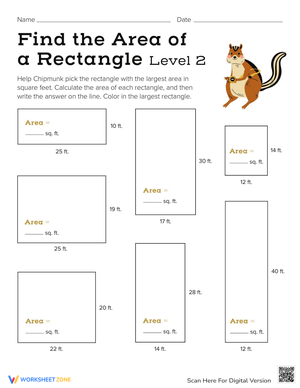
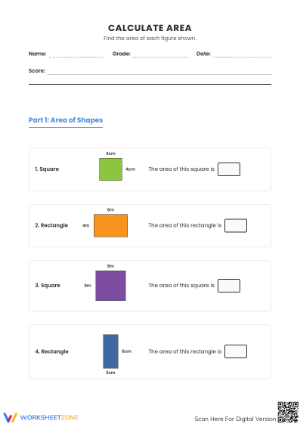
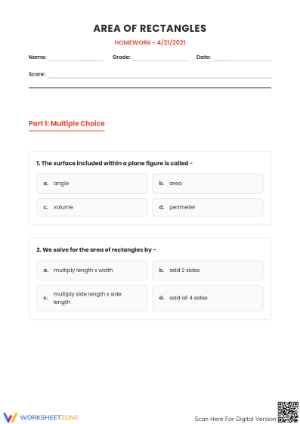
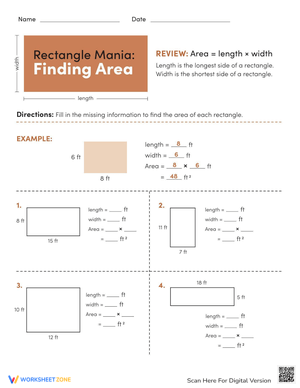
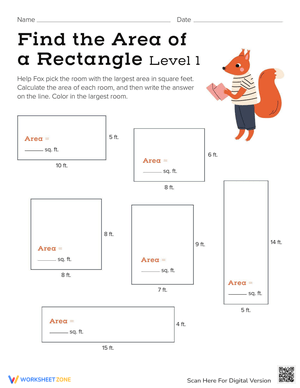
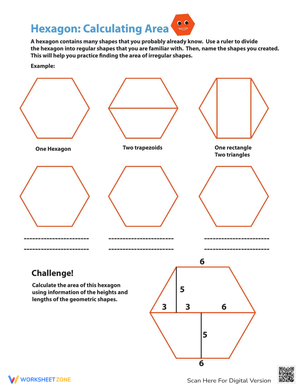
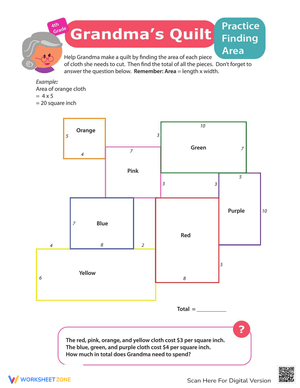
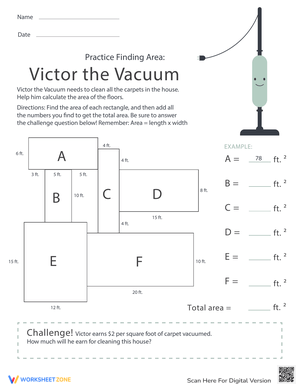
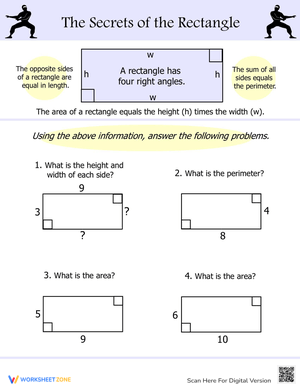
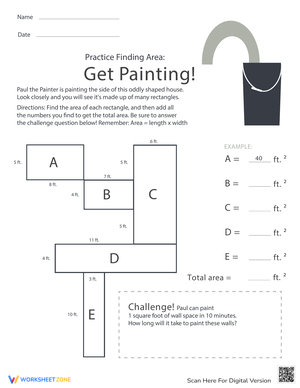
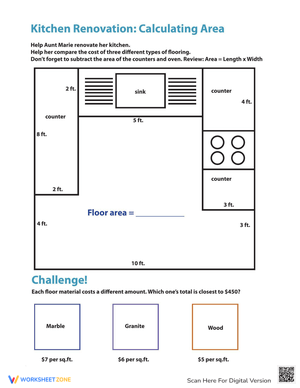
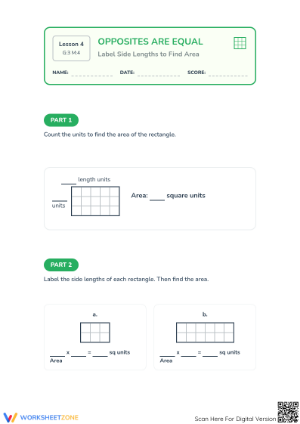
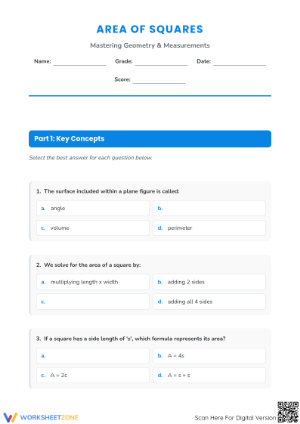
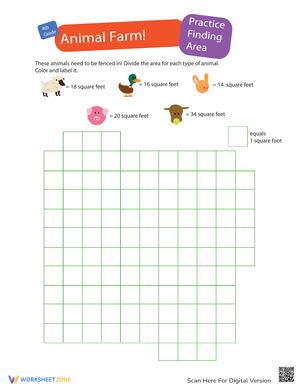
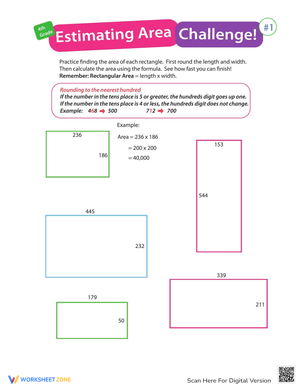
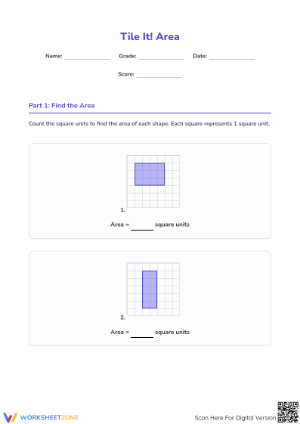
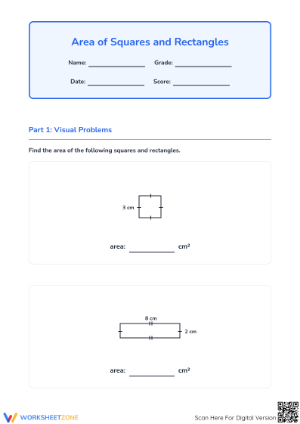
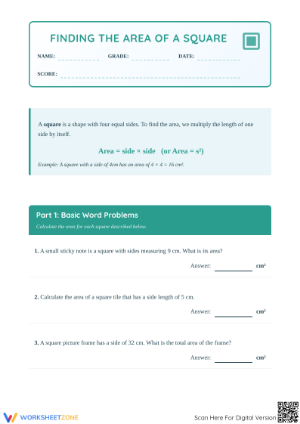
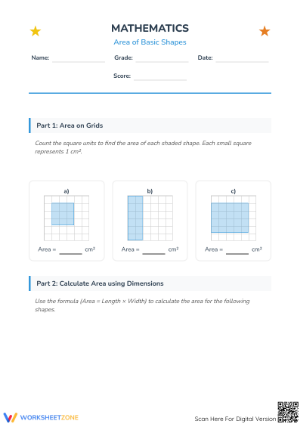
When your students walk into a room and need to figure out how much carpet covers the floor, they are doing real math, not just filling in a worksheet. Area of a rectangle worksheets give 4th graders repeated, structured practice at multiplying length by width so the formula becomes automatic rather than something they have to re-derive every time. For a grade 4 classroom, this practice needs to move past simply counting squares and into applying a formula fluently and flexibly.
These worksheets work well for whole-class instruction, small-group intervention, and independent review because the skill scales: you can adjust the number size, the context, or the missing piece of information without changing the underlying concept. That flexibility makes area of a rectangle one of the easiest 4th grade math topics to differentiate.
What CCSS 4.MD.A.3 Asks Students to Do
The core standard behind this skill is CCSS.MATH.CONTENT.4.MD.A.3, which asks students to apply area and perimeter formulas for rectangles in real world and mathematical problems. This standard sits inside the grade 4 Measurement and Data domain, which groups area work together with other measurement conversions and data interpretation skills that build on each other across the year.
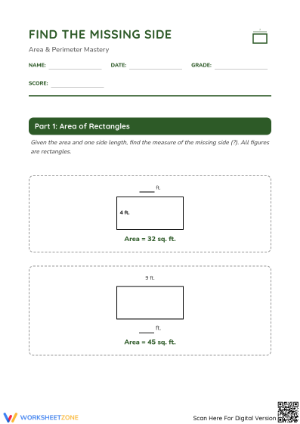
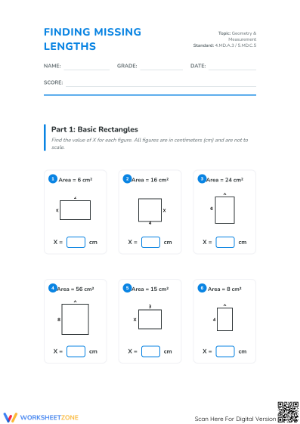
A key detail teachers often overlook is that 4.MD.A.3 does not stop at finding area when both dimensions are known. It explicitly asks students to find an unknown factor, such as determining a missing side length when the area and one dimension are given. This turns the area formula into an algebraic thinking task, not just a multiplication fact, and worksheet sets that skip this variation leave a real gap in standard coverage.
Real-World Rectangle Area Problems for Grade 4
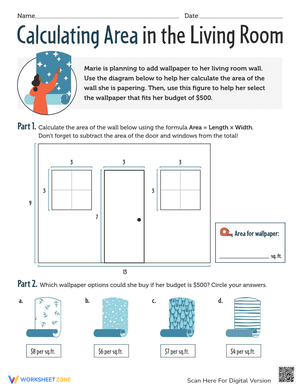
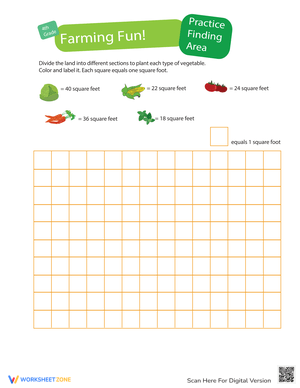
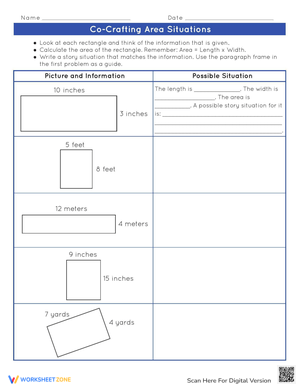
Word problems make area concrete for students who otherwise see it as an abstract rule. Classroom-friendly contexts include figuring out how many square tiles are needed to cover a reading corner, how much space a garden bed takes up, or how many square feet of bulletin board paper a display needs. These situations mirror the kind of real world and mathematical problems named directly in the standard.
Strong worksheet sets rotate through several contexts rather than repeating the same story problem with different numbers. Variety keeps students reading carefully instead of pattern-matching the numbers without thinking about what the question is actually asking.
Solving for a Missing Side Length
Once students are comfortable multiplying length by width, the next step is reversing the process. A worksheet might state that a rectangular rug has an area of 48 square feet and a length of 8 feet, then ask students to find the width. This requires students to treat the area formula as a multiplication equation with an unknown factor and use division or fact families to solve it.
This missing-dimension work is where many worksheet sets fall short, since it is easier to write straightforward multiplication problems than problems that require working backward. Prioritizing this problem type gives students a more complete picture of what 4.MD.A.3 actually expects.
Avoiding the Area vs Perimeter Mix-Up
One of the most common 4th grade errors is confusing area with perimeter, especially on problems that give both length and width and do not specify which measurement is needed. Students also frequently forget to label their answers in square units, writing 48 instead of 48 square feet.
Worksheets that mix area and perimeter questions in the same set, rather than isolating each skill, help students build the habit of checking which formula and which unit label a problem calls for. A short reminder at the top of a page, such as circle the word that tells you whether this is an area or perimeter problem, can reduce this error significantly over time.
Classroom Implementation
For whole-class instruction, start with a worksheet that uses simple whole-number dimensions so students can focus on the formula itself before adding real-world context. Move to word problems once the basic multiplication step is automatic, then introduce missing-side problems last, since they demand the most flexible thinking.
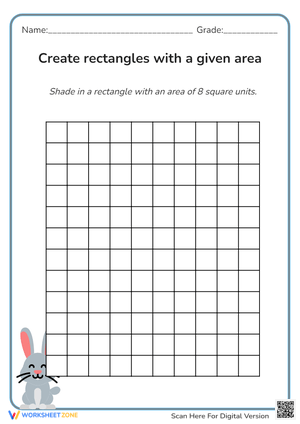
For small-group intervention, pull students who mix up area and perimeter and give them a worksheet with side-by-side comparison problems. For enrichment, offer problems where students design a rectangular space under a fixed area constraint, such as planning a classroom reading corner that must equal exactly 24 square feet, which pushes them to test multiple factor pairs.
Frequently Asked Questions
1. What CCSS standard covers area of a rectangle in 4th grade?
CCSS.MATH.CONTENT.4.MD.A.3 covers this skill. It asks students to apply area and perimeter formulas for rectangles in real world and mathematical problems, including finding a missing side length when the area and one dimension are known.
2. How is area of a rectangle different from perimeter for 4th grade students?
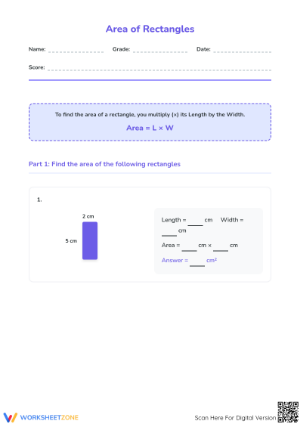
Area measures the space covered by a rectangle and is found by multiplying length by width, with answers labeled in square units. Perimeter measures the distance around the outside of the rectangle and is found by adding all four sides, with answers labeled in linear units like feet or inches.
3. How can teachers use area worksheets for small-group intervention?
Group students who consistently confuse area and perimeter and give them worksheets that present both problem types side by side. This forces students to identify which formula applies before calculating, rather than defaulting to whichever formula they remember most easily.
4. What real-world examples help 4th graders understand rectangle area?
Contexts like covering a floor with tile, sizing a garden bed, or planning a bulletin board display work well because students can picture the space and understand why square units make sense as the answer.













 Interactive Worksheet Maker
 Quiz Maker
 Word Search Maker
 Crossword Puzzle Maker
 Word Scramble Generator
 Sentence Scramble Generator
 Handwriting Worksheet Generator
 Name Tracing Generator
 Fill In The Blank Generator