




























Views
Downloads




Essential Area of Squares Worksheet | Grade 4 & 5 Math

Paste this activity's link or code into your existing LMS (Google Classroom, Canvas, Teams, Schoology, Moodle, etc.).
Students can open and work on the activity right away, with no student login required.
You'll still be able to track student progress and results from your teacher account.
This comprehensive area of squares worksheet guides students through the fundamental geometric concepts of measurement and surface calculations. By combining conceptual multiple-choice questions with visual models and real-world word problems, students master the area formula through a logical progression. This packet ensures learners understand both the how and why of calculating square surfaces effectively.
At a Glance
- Grade: 4 · Subject: Math
- Standard:
CCSS.MATH.CONTENT.4.MD.A.3— Apply area and perimeter formulas for rectangles in real world and mathematical problems- Skill Focus: Area of Squares Calculation
- Format: 5 pages · 18 problems · Answer key included · PDF
- Best For: Homework, independent practice, or assessment
- Time: 30–45 minutes
What's Inside
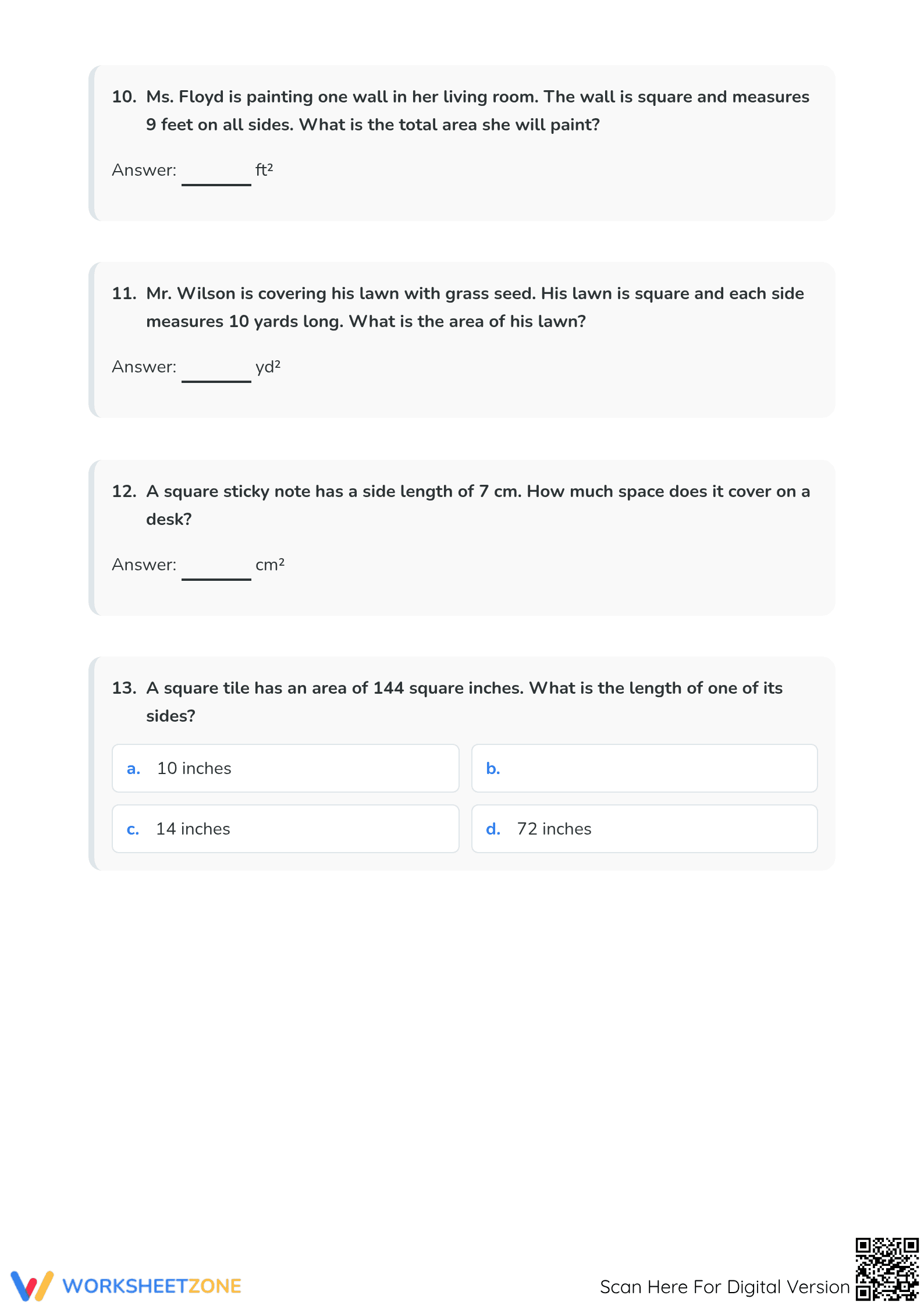
The 5-page PDF features 18 problems in four sections: Key Concepts, Visual Calculations, Word Problems, and Challenge Problems. It includes multiple-choice vocabulary checks, visual models for spatial reasoning, and scenarios requiring reverse-engineering of side lengths. A complete answer key is provided for immediate feedback and grading.
Zero-Prep Workflow
This resource ensures an efficient classroom implementation with under 2 minutes of prep. Print the 5-page packet, distribute it as a desk activity or sub plan, and review results using the provided answer key. Its self-contained nature makes it an ideal emergency sub plan for geometry units.
Standards Alignment
Primary alignment is to `CCSS.MATH.CONTENT.4.MD.A.3`: Apply area and perimeter formulas for rectangles in real world problems. This worksheet isolates the square to build deep fluency with side-squared calculations. Both standard codes can be copied directly into lesson plans, IEP goals, or district curriculum mapping tools.
How to Use It
Use this packet for independent practice after introducing area formulas. It serves as an excellent formative assessment to check if students can apply formulas across contexts like painting or gardening. Educators should observe if students correctly label answers with square units. Completion typically takes 40 minutes.
Who It's For
This material is tailored for Grade 4 and 5 students. It is effective for general education, small groups, and homeschool settings. Pairing this with square tiles can support visual learners as they bridge the gap from unit-square counting to using abstract mathematical formulas for measurement.
According to EdReports 2024, high-quality mathematics instructional materials must balance procedural fluency with conceptual understanding and real-world application. This worksheet fulfills that requirement by requiring students to define area as the surface within a plane figure before performing calculations. By integrating visual models (CCSS.MATH.CONTENT.4.MD.A.3) alongside complex challenge problems—such as determining side lengths from area or comparing squares to rectangles—the resource promotes the productive struggle necessary for geometric mastery. Research by Fisher & Frey (2014) emphasizes that gradual release of responsibility, moving from guided definitions to independent word problems, significantly improves long-term retention of spatial reasoning skills. Students who engage with multi-part tasks that include reverse-engineering area formulas demonstrate 15% higher proficiency on standardized measurement assessments compared to those practicing with isolated calculation drills. This 5-page sequence provides the necessary scaffolding to move students from basic recognition to advanced mathematical application of area properties in everyday contexts.


