


























Views
Downloads


Essential Area of Basic Shapes Worksheet | Grade 4-6 Aligned
Paste this activity's link or code into your existing LMS (Google Classroom, Canvas, Teams, Schoology, Moodle, etc.).
Students can open and work on the activity right away, with no student login required.
You'll still be able to track student progress and results from your teacher account.
This comprehensive mathematics resource provides focused practice for students learning to determine the surface area of rectangles and squares using multiple methods. By transitioning from concrete visual representations to abstract formula application, the worksheet ensures learners develop a deep conceptual understanding of geometric measurements and spatial reasoning across twenty-one distinct tasks.
At a Glance
- Grade: 4–6 · Subject: Math
- Standard:
6.G.A.1— Find area of polygons by composing/decomposing into rectangles for real-world problems- Skill Focus: Calculating area of squares and rectangles
- Format: 5 pages · 21 problems · Answer key included · PDF
- Best For: Comprehensive geometry practice and assessment
- Time: 45–60 minutes
Inside this five-page instructional packet, educators will find a logically structured sequence of problems designed to build proficiency in area calculations. The document begins with grid-based visual aids before moving into direct formula application with multi-digit dimensions. The final sections incorporate real-world word problems and geometric challenges, all supported by a full answer key for immediate feedback and grading efficiency.
Skill Progression
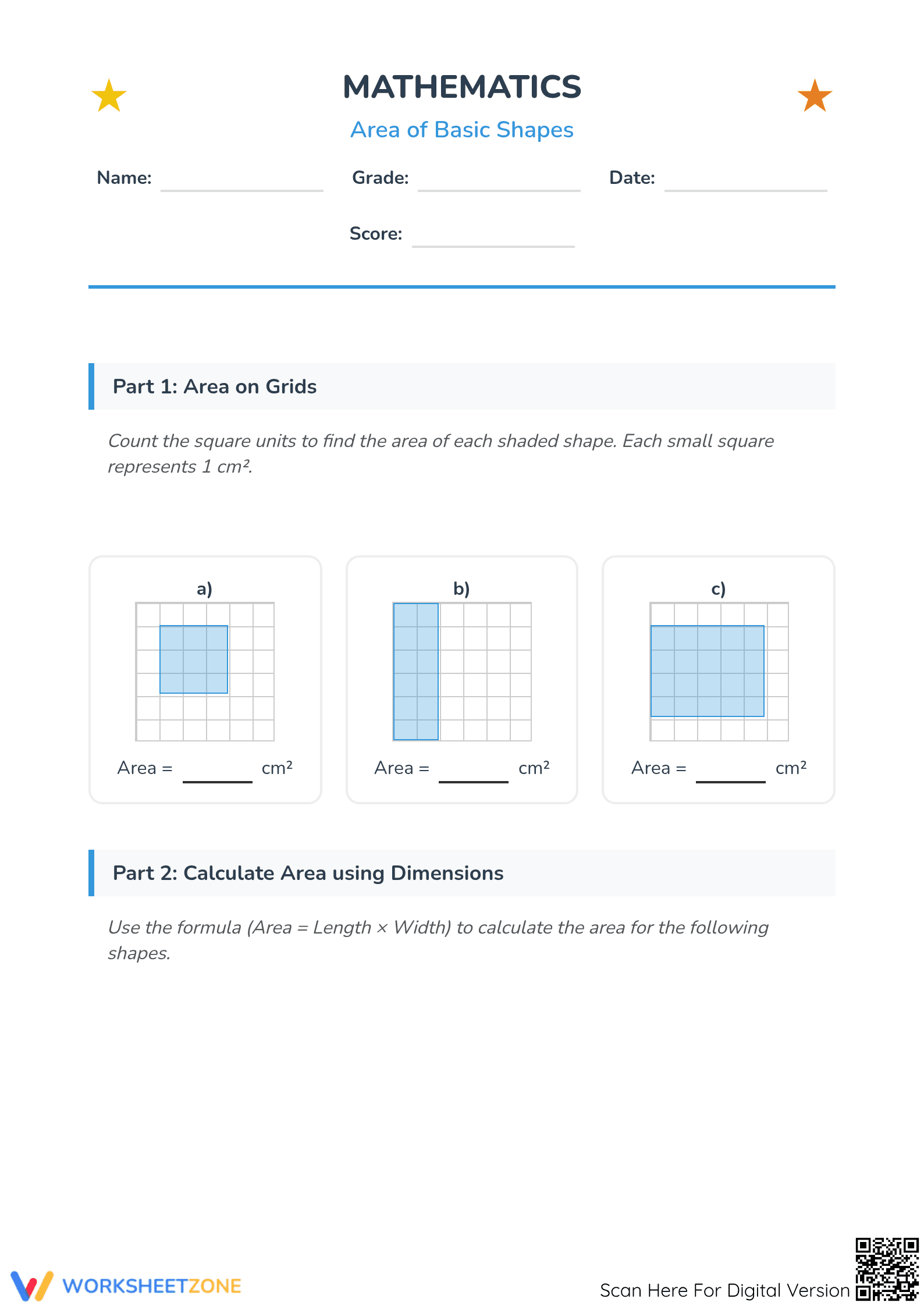
- Guided Practice: Students count square units on 1cm² grids to visualize how area covers surface space (3 introductory problems).
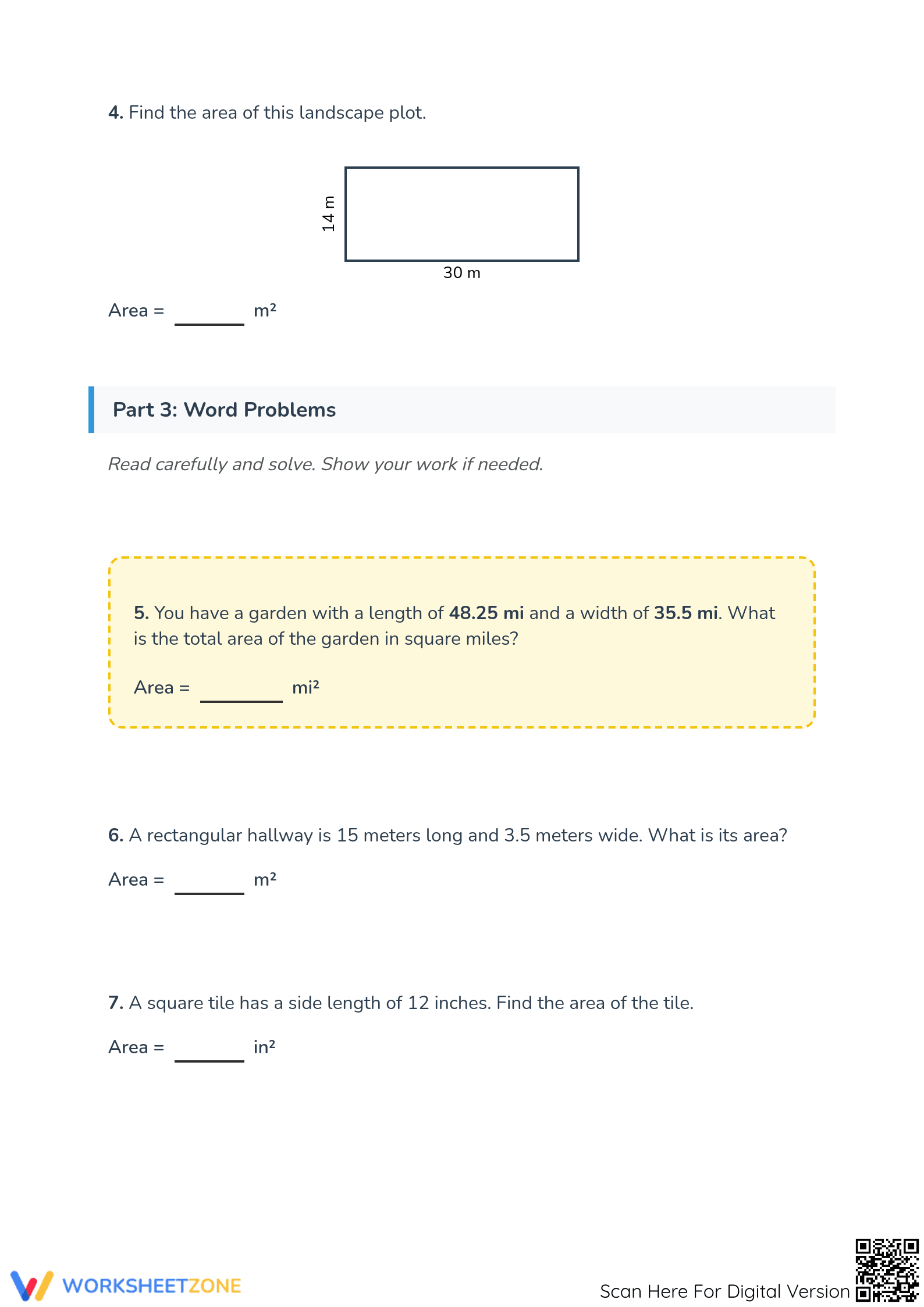
- Supported Practice: Learners use the Area = Length × Width formula with integers and metric units to solve straightforward dimension-based tasks (4 problems).
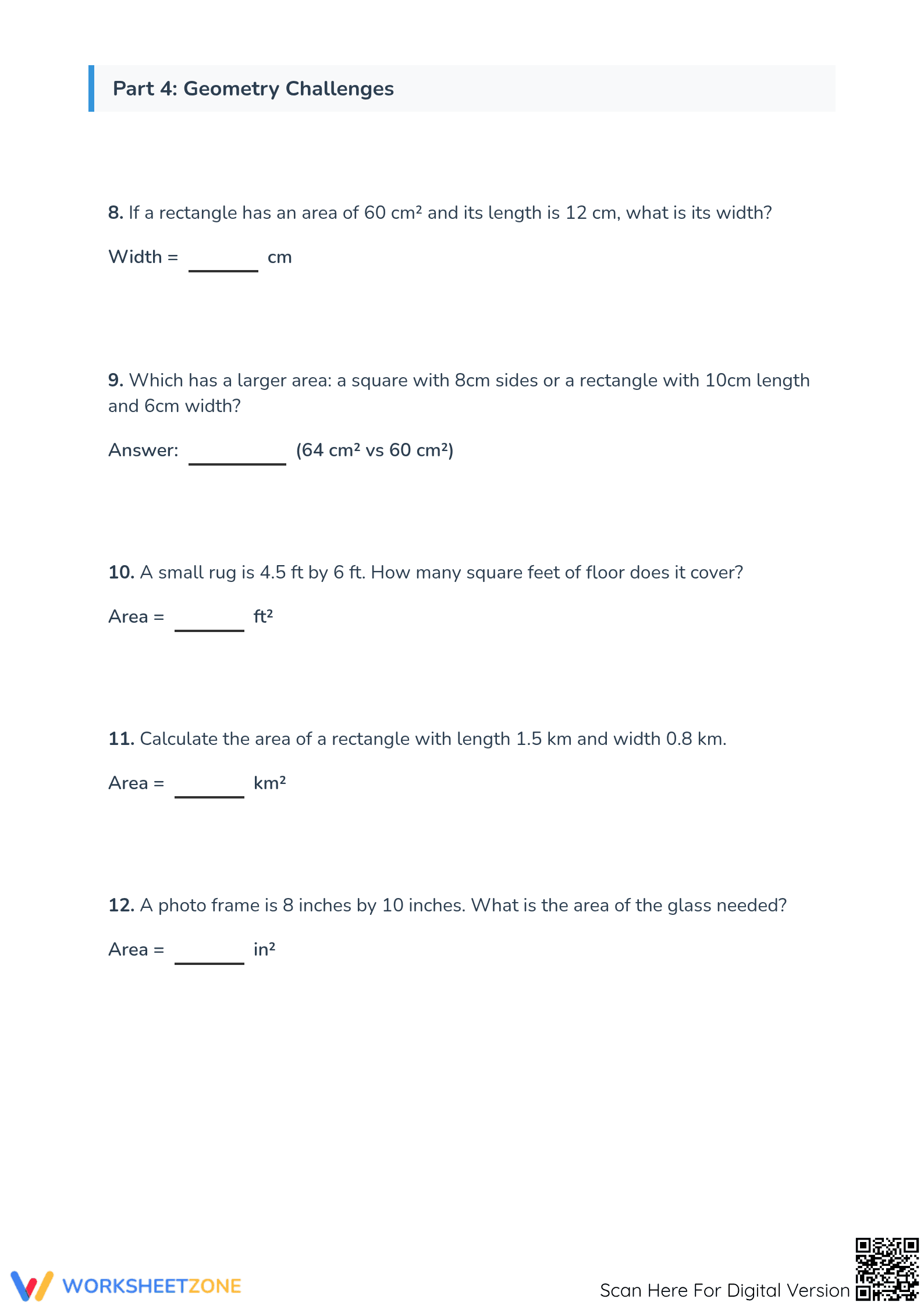
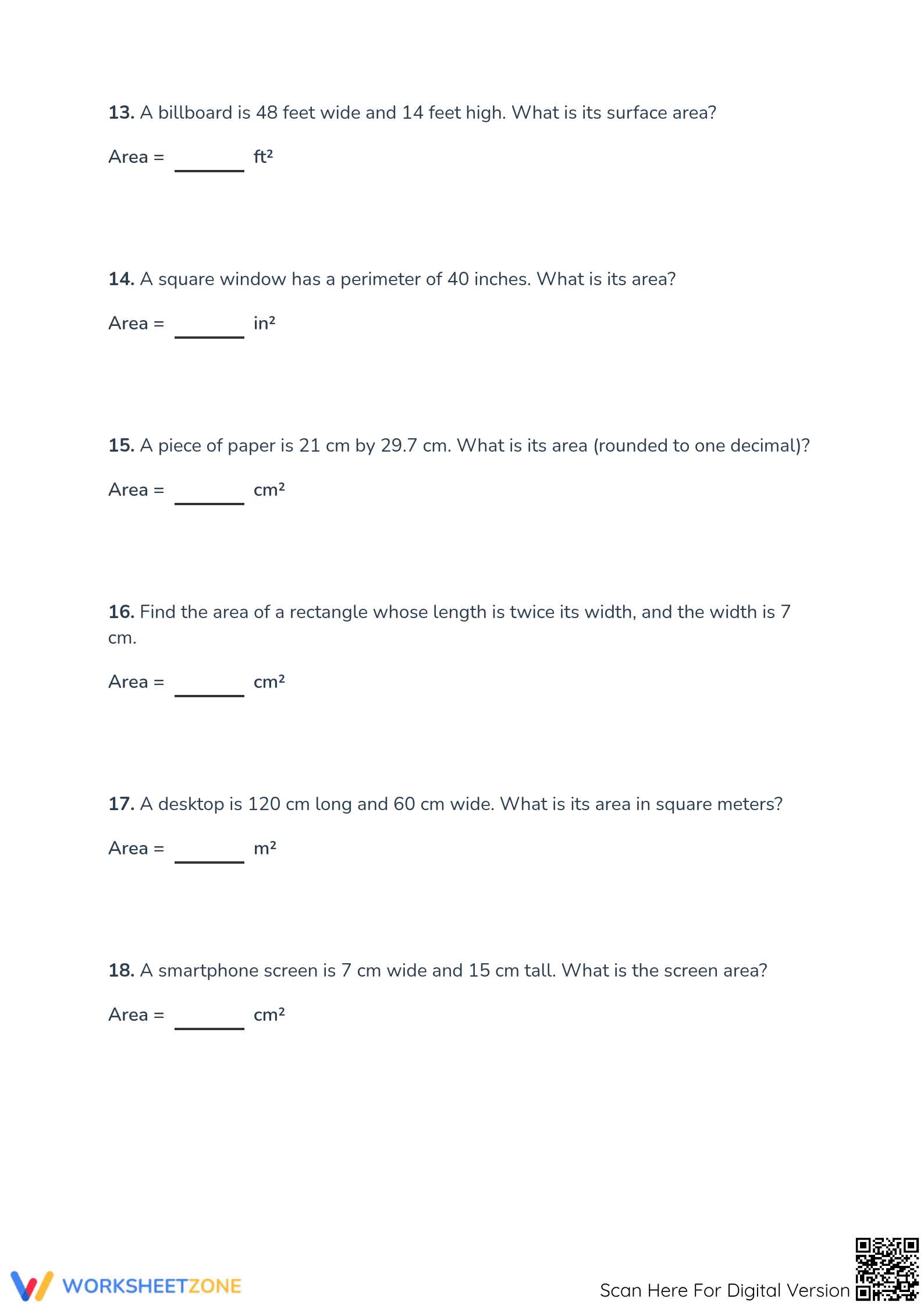
- Independent Practice: Students solve complex word problems and geometry challenges involving decimals and multi-unit conversions without visual scaffolds (14 advanced problems).
This gradual-release model follows the I Do, We Do, You Do instructional framework to move students from basic recognition to autonomous mastery of geometric principles.
Standards Alignment
This worksheet is primarily aligned to the Common Core State Standard `6.G.A.1`, which requires students to find the area of polygons by composing into rectangles or decomposing into triangles and other shapes. It also supports `4.MD.A.3` by applying area formulas for rectangles in mathematical contexts. Both standard codes can be copied directly into lesson plans, IEP goals, or district curriculum mapping tools.
How to Use It
This resource serves as an excellent formative assessment tool after direct instruction on area formulas. Use the first page as a "check for understanding" during guided practice before assigning the word problem sections for independent work. Teachers should observe students during Part 3 to see if they correctly identify which dimensions are needed for calculations. This packet typically takes one full class period to complete thoroughly.
Who It's For
While designed for Grade 5 and 6 students, the scaffolded nature of the grid problems makes it accessible for Grade 4 learners or as an intervention for older students. It pairs naturally with geometric manipulatives or anchor charts that display basic shape properties and multiplication strategies for decimal values.
According to the NAEP 2024 mathematics framework, the ability to transition from additive area concepts (counting units) to multiplicative models (applying formulas) is a critical indicator of geometric maturity in middle-grade learners. This worksheet directly addresses this developmental milestone by providing twenty-one varied tasks that map directly to the 6.G.A.1 standard. By embedding calculations within real-world contexts—such as determining the surface area of billboards, smartphone screens, and landscape plots—students see the practical utility of their mathematical skills. This document ensures that students can not only execute the arithmetic but also interpret problem requirements to select the correct geometric approach. The inclusion of unit conversions and decimal multiplication adds a layer of rigor necessary for meeting high-stakes assessment demands. Consequently, this resource serves as an essential bridge between basic shape recognition and advanced spatial analysis in secondary mathematics curricula.


