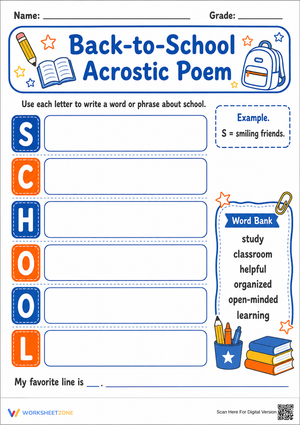
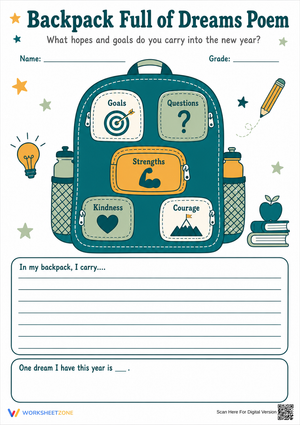
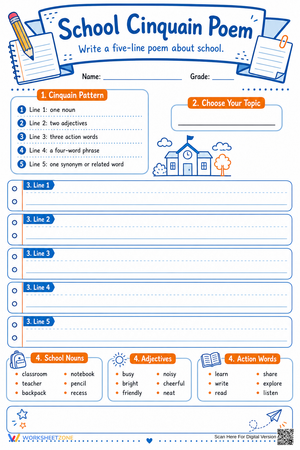
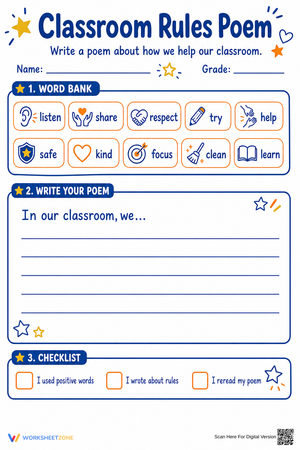
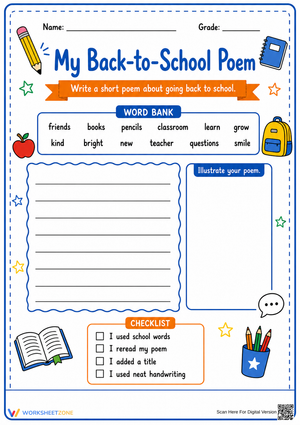
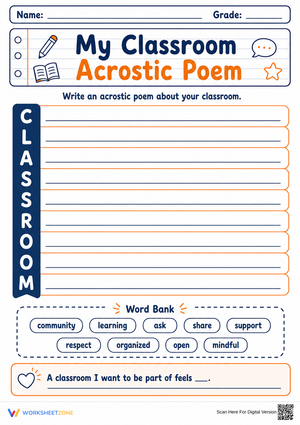
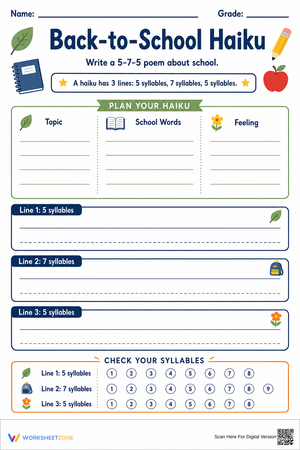
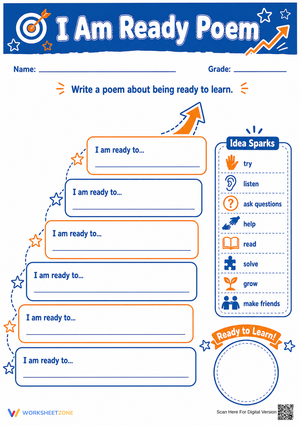
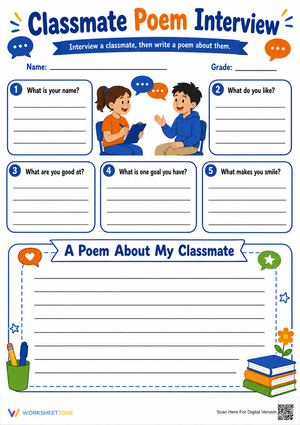
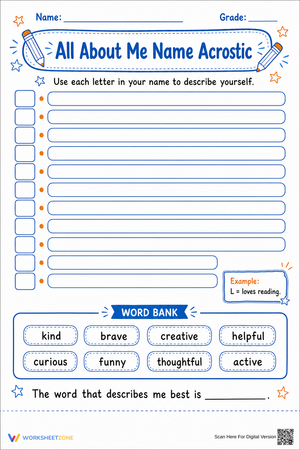
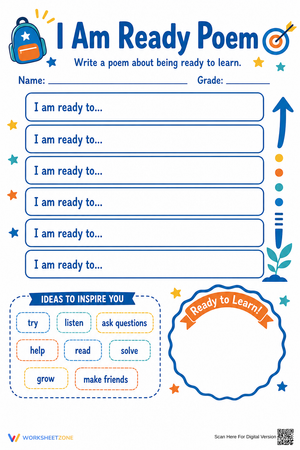
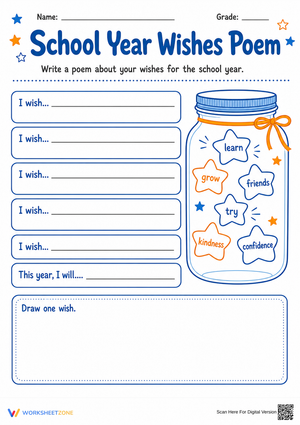
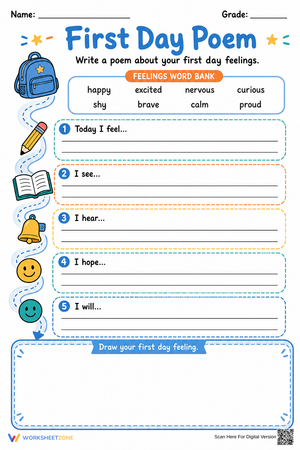
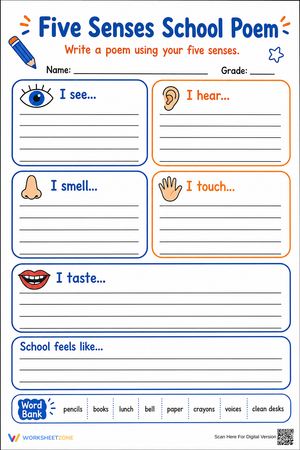
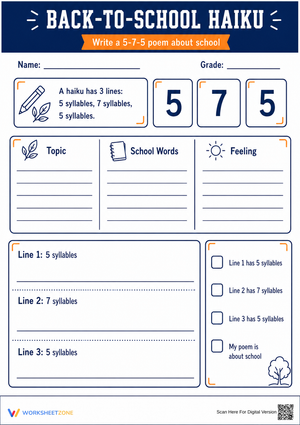
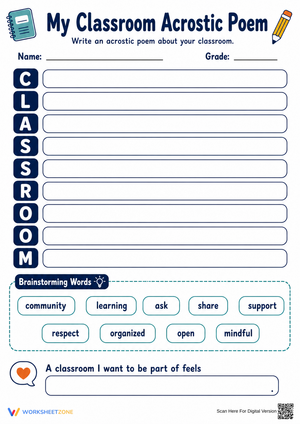
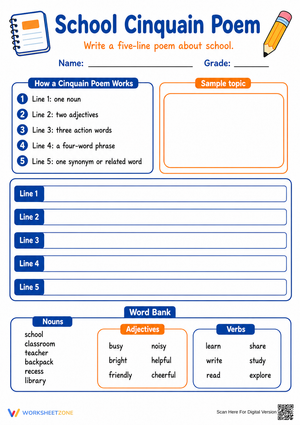
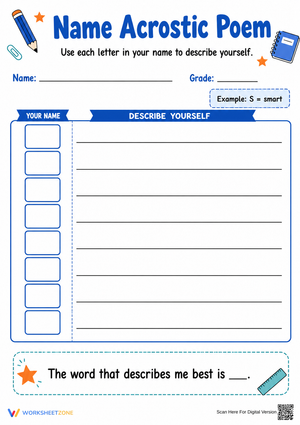
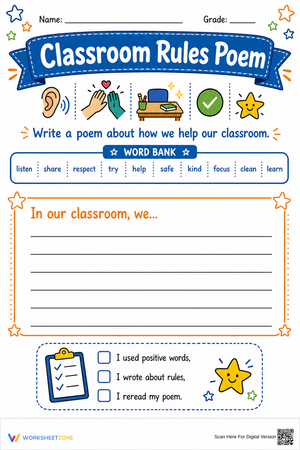
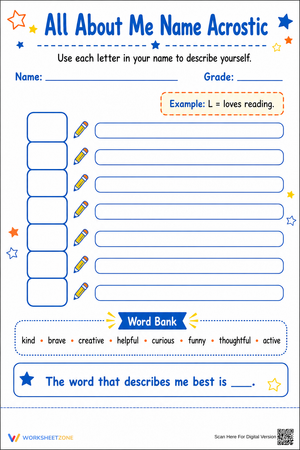
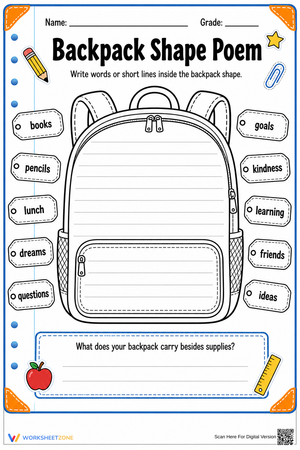
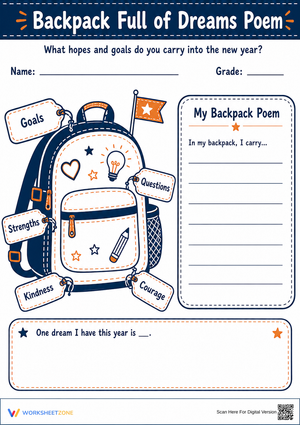
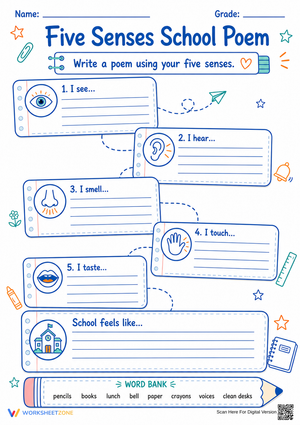
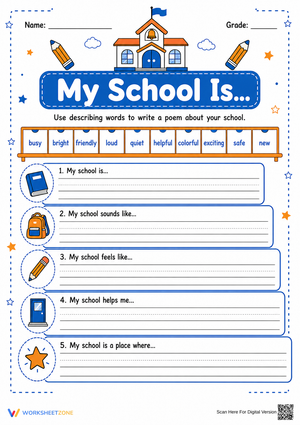
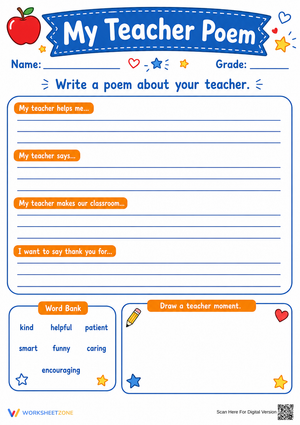
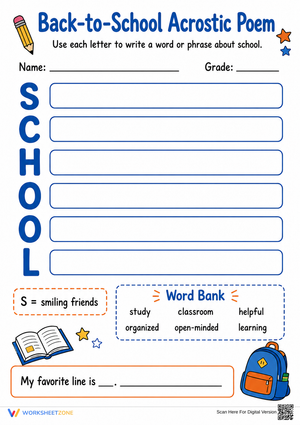
These 4th grade poetry printable worksheets resources give teachers a contained reading-and-writing task that fits inside a normal literacy block without requiring a dedicated unit setup. Students read a short poem, annotate it, answer text-based questions, and write a brief original response — all on the same worksheet — so a single class session produces both comprehension evidence and a writing sample.
What's Inside the Set
Fourth grade is the point where poetry instruction shifts from identifying rhyming words to actually interpreting what a poem does. Students are expected to explain how word choice affects mood, describe what figurative language contributes to meaning, and support reading responses with text evidence. These worksheets target that interpretive layer directly, not just the labeling layer underneath it.
Skills covered across the worksheets include:
- Marking rhyme scheme using letter notation and explaining how the sound pattern affects the reading experience
- Identifying lines and stanzas and describing how a poem is organized
- Distinguishing simile from metaphor in context — not just recognizing that a comparison is present, but categorizing it correctly
- Locating imagery and naming the specific sense it targets
- Explaining the speaker's mood or attitude and supporting the claim with lines from the poem
- Writing a stanza that imitates the model poem's structure, imagery, or both
- Comparing two short poems on the same topic and explaining which is more effective and why
What makes 4th grade poetry printable worksheets worth using across the school year — not just during a spring unit — is that each worksheet stays focused on one objective. A worksheet built around imagery includes a poem with dense sensory detail and prompts that ask students to name what they see, hear, or feel and then explain how those images connect to the poem's mood. A worksheet targeting rhyme scheme asks students to annotate the poem with letter labels and write a sentence explaining how the sound pattern changes — or holds steady — across stanzas. That single-skill focus makes student responses easier to read and specific errors easier to address.
Errors That Show Up Consistently in Fourth-Grade Poetry Work
The most predictable misconception is simile-versus-metaphor confusion, and it surfaces even after direct instruction. Students who correctly identify "the fog crept in like a gray cat" as a simile will turn to the next poem, find "the classroom was a storm," and call it a simile too — because they're checking for comparison without checking for "like" or "as." A useful addition to any figurative language worksheet is a step that asks students to rewrite the comparison in their own words before labeling it. That forces genuine engagement with the actual language rather than pattern-matching to the concept of comparison.
A second pattern worth anticipating: students conflate the speaker of the poem with the poet. When a worksheet asks "How does the speaker feel about winter?", fourth graders frequently write "The author feels..." and justify it with something they believe about the poet's biography rather than anything the poem says. Worksheets that explicitly define the speaker as a separate concept in the directions help, but this distinction usually needs verbal front-loading before independent work — the printed directions alone don't catch it every time.
On the writing side, when students are asked to write a stanza in the same pattern as the model, they tend to do one of two things: preserve the rhyme scheme and produce flat, literal lines, or write vivid imagery while ignoring the structural pattern entirely. Both errors are useful to see in student work because they tell you which element the student actually internalized. Worksheets with a two-part writing prompt — "First, match the pattern. Then, add one image that creates a strong picture." — help students hold both requirements at once rather than trading one off against the other.
Fitting These Worksheets Into the Teaching Week
The natural home for 4th grade poetry printable worksheets is the first 15 minutes of a literacy block used as shared reading. Project the poem, read it aloud twice without stopping to explain it, then release students to annotate and respond independently. The annotation work typically takes about 8 minutes; the written response takes 5 to 7 more. That's a complete mini-lesson with a written product to collect.
Centers are another reliable slot. A poetry station with two or three worksheets sorted by skill can rotate weekly. Students who finish early move to the extension writing section; students who need support work through the comprehension questions with the teacher during a pull-aside. Friday blocks are often the most practical recurring time — the shorter text length means students can read, annotate, respond, and discuss before end-of-week pack-up, and it gives teachers a close-reading moment that doesn't compete with heavier tested-genre work earlier in the week.
One organizing move that saves real planning time: file the worksheets by skill rather than by season. A folder labeled figurative language and one labeled theme are faster to pull from on a Tuesday afternoon than a folder labeled April poems. It also makes poetry feel like a standing instructional tool rather than a unit that appears once a year.
Standard Alignment
These worksheets align primarily to CCSS.ELA-LITERACY.RL.4.5, which expects fourth graders to explain major differences between poems, drama, and prose, and to refer to structural elements — verse, rhythm, meter — when writing or speaking about a text. That standard is what classroom teachers usually need most from a poetry worksheet: it gives the reading work a documented instructional purpose. The figurative language tasks also address RL.4.4, covering the meaning of words and phrases as used in a text, including figurative language in context.
The written response section connects to W.4.9, which asks students to draw evidence from literary texts to support analysis and reflection. In practical terms, one worksheet can generate formative data on both reading interpretation and written explanation — useful when teachers want documented standards coverage without administering a separate formal assessment.
Making the Set Work Across a Mixed-Ability Class
Students who need extra support benefit most from worksheets that include a word bank of key terms (simile, metaphor, speaker, imagery), sentence starters for the response section such as "The speaker feels ___ because the poem says ___," and a labeled example showing what a completed annotation looks like. These additions reduce the blank-page problem without removing the interpretive thinking — students still have to decide where and how the terms apply.
On-level work moves through the full worksheet: read the poem, answer two or three text-dependent questions, complete one guided writing prompt. Extension students can push further — revising a line from the poem for stronger imagery, writing a follow-up stanza that sustains the mood, or arguing in writing which of two poems uses figurative language more effectively.
One honest limitation worth naming: the imitation-writing task frustrates students who have very limited exposure to poetry outside school. They understand the model poem when it's discussed aloud, but they freeze when asked to generate original lines even with a structural pattern to follow. A fill-in-the-blank version of the stanza — where key nouns and adjectives become blanks and a small bank of word choices is provided — gets those students through the task. It's not a permanent structure; it's a way to give them one experience of success before asking them to work with less support next time.
Frequently Asked Questions
What types of poems work best with these worksheets?
Short poems with clear structure, accessible figurative language, and at least one moment of strong imagery are the most effective. Poems running between 8 and 16 lines give students enough to analyze without overwhelming a 30-minute block. Lyric poems tend to work better than narrative poems for skill-focused work because the language density is higher relative to the length — there's more to notice per line.
Can these worksheets support formative assessment?
Yes, and they're better suited to formative than summative use. The written response section tells teachers quickly whether students can apply a concept in context — without a rubric-heavy grading process. Collecting the worksheets twice a week during a focused poetry stretch gives a clear picture of which students have internalized a skill and which need small-group follow-up before the concept shows up on a formal assessment.
How do these worksheets fit alongside a published poetry anthology?
The best 4th grade poetry printable worksheets resources pair naturally with an anthology — the anthology provides the experience of reading poetry widely while each worksheet provides the structure for close analytical work on a single poem. Teachers often use the anthology for read-aloud and discussion, then choose a thematically connected worksheet for independent practice. The two formats reinforce each other: wide reading builds familiarity with the genre, and the worksheet asks students to slow down and examine how one specific poem works.












 Interactive Worksheet Maker
 Quiz Maker
 Word Search Maker
 Crossword Puzzle Maker
 Word Scramble Generator
 Sentence Scramble Generator
 Handwriting Worksheet Generator
 Name Tracing Generator
 Fill In The Blank Generator




 BACK TOSCHOOL