


























Views
Downloads

Classroom Rules Poem Worksheet | Essential Grade 3 ELA
Paste this activity's link or code into your existing LMS (Google Classroom, Canvas, Teams, Schoology, Moodle, etc.).
Students can open and work on the activity right away, with no student login required.
You'll still be able to track student progress and results from your teacher account.
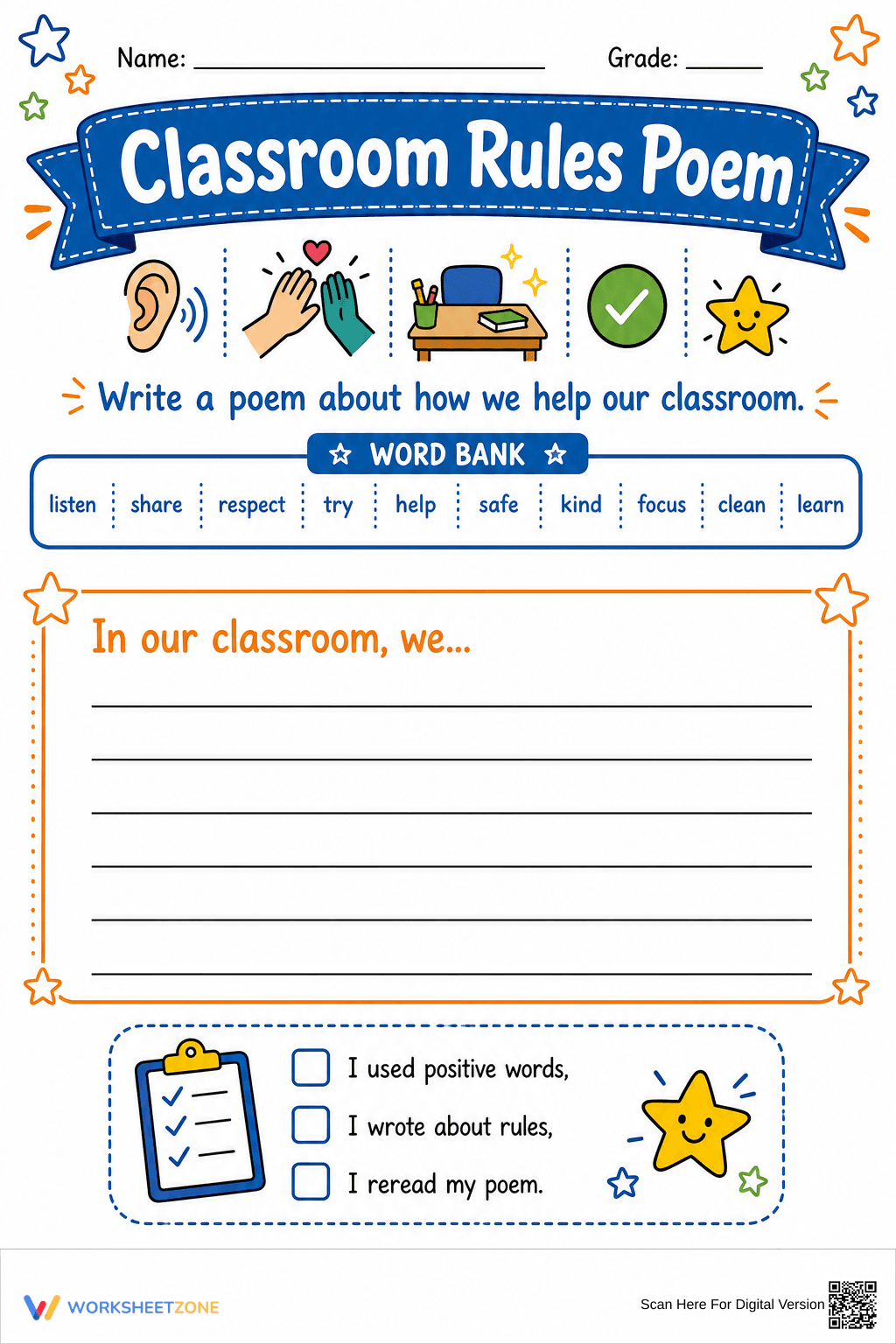
This Grade 3 classroom rules poem worksheet helps students internalize community expectations through creative expression. By using a structured writing frame and a curated word bank, learners produce a meaningful poem about positive behavior. This activity fosters a sense of belonging while strengthening foundational writing skills and vocabulary application in a real-world context.
At a Glance
- Grade: 3 · Subject: ELA / Writing
- Standard:
CCSS.ELA-LITERACY.W.3.4— Produce writing where development and organization are appropriate to the task- Skill Focus: Creative Writing & Social-Emotional Learning
- Format: 1 page · 1 writing task · Word bank included · PDF
- Best For: Back-to-school community building and writing practice
- Time: 15–25 minutes
What's Inside: This single-page PDF features a vibrant, student-friendly layout designed for immediate engagement. It includes a 10-word bank with essential vocabulary like "respect," "focus," and "kind." The central writing area provides an "In our classroom, we..." sentence starter followed by 6 lined spaces for poetic composition. A three-point self-reflection checklist ensures students review their work for positive tone and rule alignment.
Zero-Prep Workflow: This resource is designed for maximum efficiency in busy classrooms. First, print the single-page PDF (30 seconds). Next, distribute the sheets to students as a morning work activity or a follow-up to a class meeting (1 minute). Finally, review the poems as a whole group or display them on a bulletin board to reinforce community standards (5 minutes). It is an ideal sub-plan addition.
Standards Alignment: The primary standard addressed is `CCSS.ELA-LITERACY.W.3.4`, which requires students to produce writing in which the development and organization are appropriate to the task, purpose, and audience. By focusing on classroom expectations, students practice purposeful writing. This standard code can be copied directly into lesson plans, IEP goals, or district curriculum mapping tools.
How to Use It: Use this worksheet during the first week of school as a formative assessment of student writing levels and their understanding of class norms. It works well after a group discussion about "The Golden Rule." Teachers should observe if students can independently select words from the bank to complete their thoughts. Expect completion within 20 minutes for most third-grade learners.
Who It's For: This resource is tailored for Grade 3 students but is adaptable for Grade 2 or Grade 4 learners needing a structured writing frame. It is particularly effective for English Language Learners (ELLs) who benefit from the visual icons and word bank support. Pair this with a read-aloud of a classroom-themed picture book for a complete lesson.
According to Fisher & Frey (2014), providing students with scaffolds like word banks and sentence frames is essential for developing writing fluency and confidence in the elementary grades. This worksheet applies these evidence-based strategies to the specific domain of classroom management and social-emotional learning. By aligning the task with `CCSS.ELA-LITERACY.W.3.4`, the resource ensures that creative expression remains grounded in academic rigor. Research from the NAEP indicates that students who engage in routine writing tasks across various subjects, including social-emotional topics, demonstrate higher overall literacy proficiency. This worksheet provides a structured 1-page environment where students can practice these skills without the cognitive load of starting from a blank page. The inclusion of a self-check rubric further supports metacognitive development, a key factor in long-term academic success and self-regulation within the primary classroom environment.


