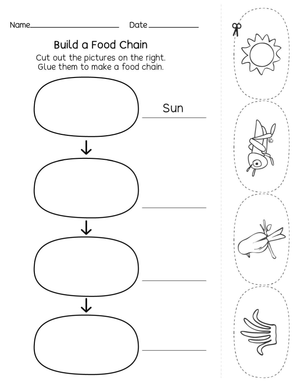
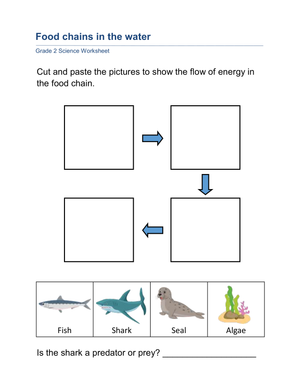
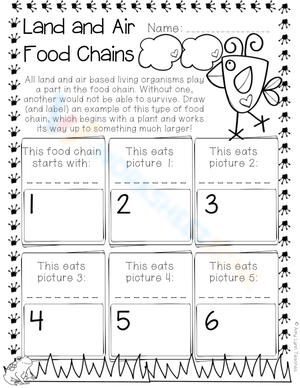
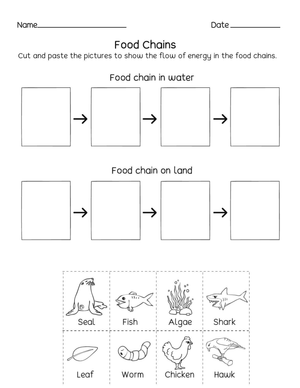
These food webs and food chains worksheets for 3rd grade give teachers a ready set of printable resources covering the vocabulary, diagram conventions, and ecological reasoning students need before they can think confidently about what happens when one species disappears from a habitat. The resources span producer-consumer-decomposer sorting, arrow-direction practice, food web interpretation, and short constructed-response tasks — enough format variety to support several different lesson structures without extra planning overhead.
What Students Practice Across the Set
Each worksheet targets a defined slice of the ecosystem content rather than asking students to handle everything at once. The skills covered across the set include:
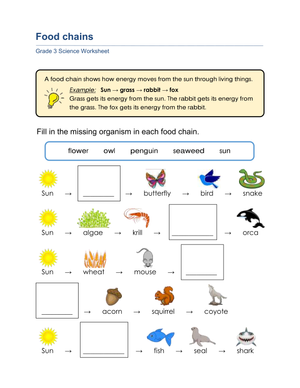
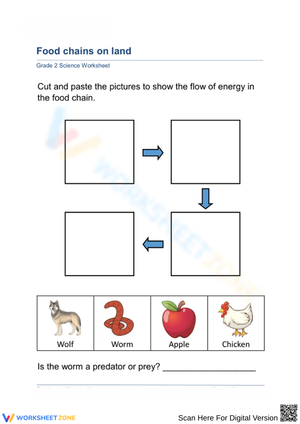
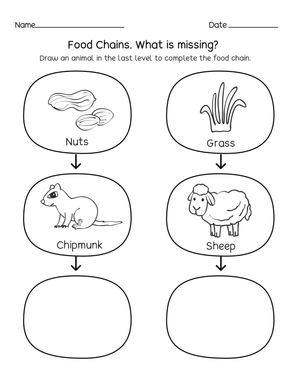
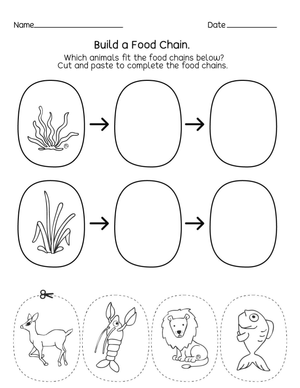
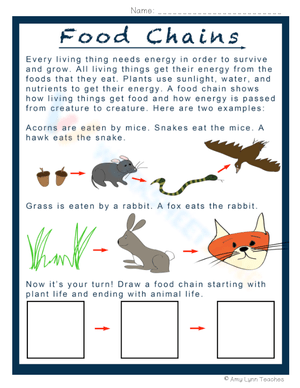
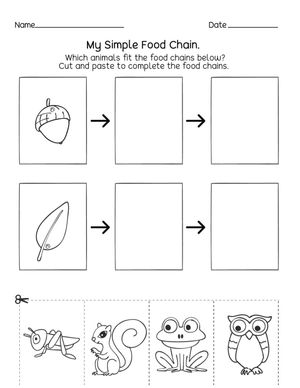
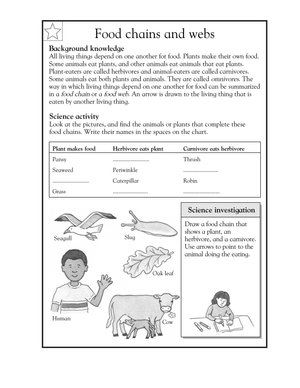
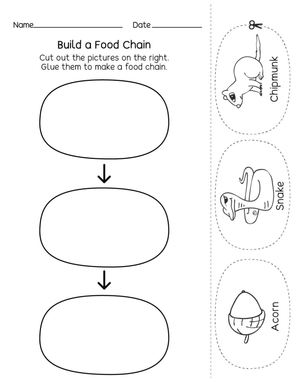
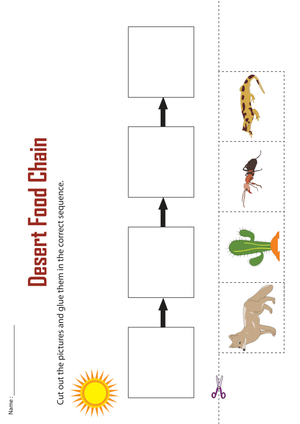
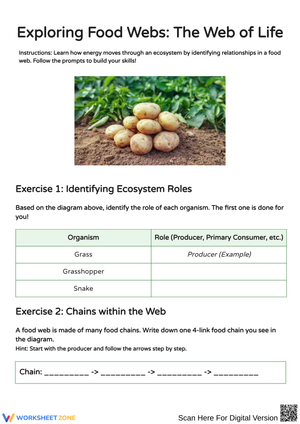
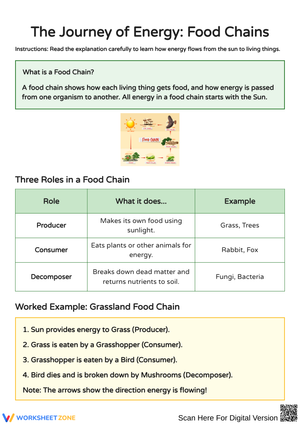
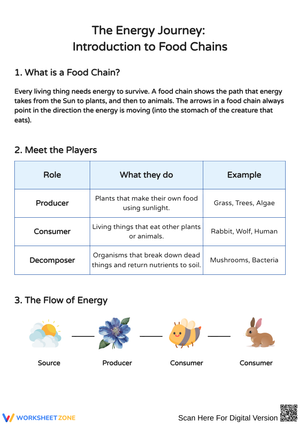
- Linear food chain construction — students arrange organisms into a sequence, always anchoring the chain at the Sun before moving through producers, consumers, and apex predators.
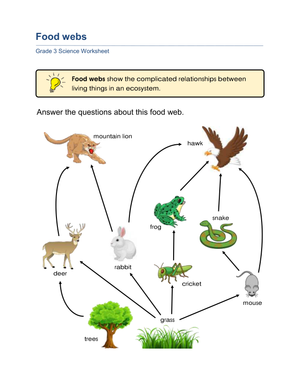
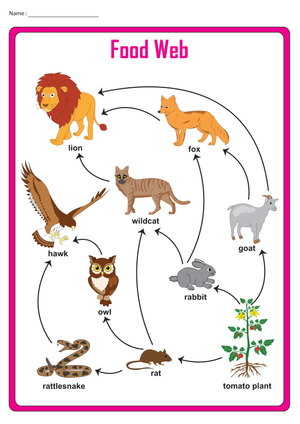
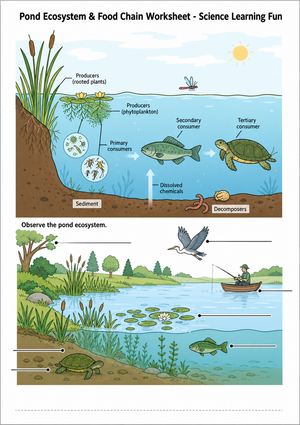
- Food web interpretation — students read a labeled habitat diagram and identify which organisms share a food source, which appear in more than one chain, and how a population shift in one organism ripples through the rest of the web.
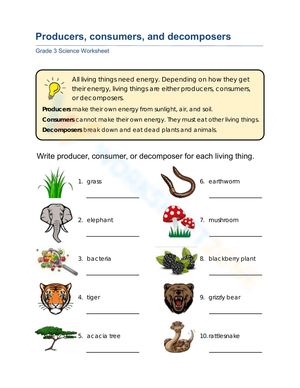
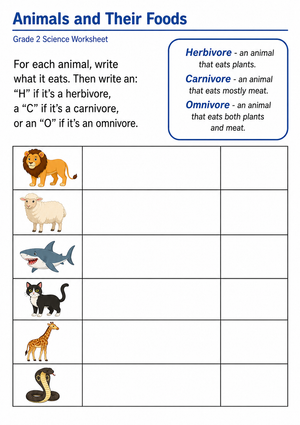
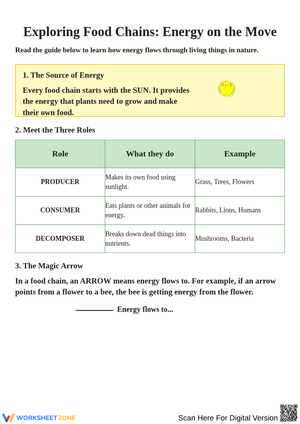
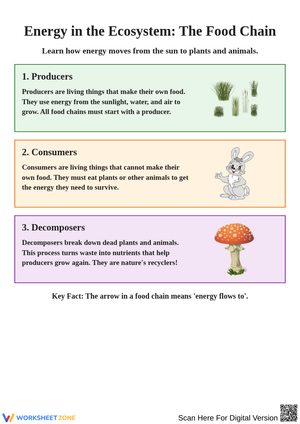
- Producer, consumer, and decomposer sorting — cut-and-paste tasks where students assign organisms to roles. Omnivores generate the most debate; students reliably want to place a bear or raccoon in two columns simultaneously, which is a productive error to work through in real time.
- Arrow-direction practice — partially completed diagrams requiring students to draw arrows showing the direction energy travels, not the direction of predation.
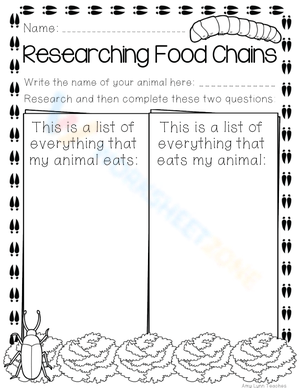
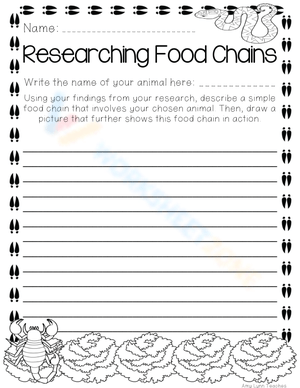
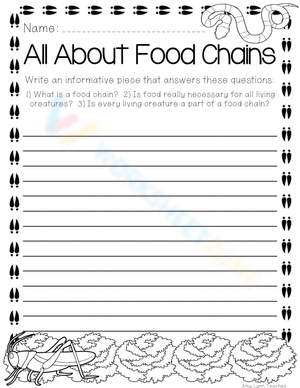
- Constructed-response prompts — short written tasks asking students to explain what would change in a food web if all the plants died or if a new predator arrived.
Third grade is the right developmental moment for this content. Students this age can follow a linear sequence reliably but are still building the mental flexibility to track branching networks — which is why the set introduces food chains before layering in food webs. A solid single-path model gives students something to anchor against before the diagram grows more complex.
The Arrow-Direction Error — And Why It Persists
The most consistent mistake in 3rd-grade ecology work is the arrow drawn from predator to prey. A student who correctly labels hawk, frog, and grasshopper will often draw the hawk's arrow pointing back down toward the frog, reading the diagram as "this animal eats that one, so the arrow shows the action." But arrows in food chain diagrams mark the direction energy travels — from organism eaten to organism eating — and that convention runs opposite to most students' first instinct. Several worksheets in the set isolate this skill entirely, presenting only partially completed chains and asking students to add arrows with no other variables in play. Pairing those worksheets with a quick verbal check — students say aloud "energy travels from ___ to ___" while pointing at their own diagram — surfaces residual confusion that written work alone misses. Students who skip the verbal step will occasionally self-correct their writing without actually correcting their mental model, and it shows on the unit test.
Building These Worksheets Into Your Lesson Plans
A fill-in-the-blank food chain works as a five-minute bell-ringer while attendance runs. A food web labeling worksheet holds up as the main activity during a 15-minute guided block, especially when the teacher projects the same diagram and models the reasoning aloud while students mark their own printed copy. The cut-and-paste sorting worksheets work best as partner tasks — two students negotiating over whether a bear belongs under "carnivore" or "omnivore" builds more durable understanding than silent independent work for this particular classification decision.
For classes that meet science twice a week, the sequence spreads naturally: food chains and sorting on day one, food webs and arrow direction on day two, with the constructed-response worksheet held as a Friday exit task or a final check before the unit assessment. The food webs and food chains worksheets for 3rd grade also work well as a morning review on test day — students who revisit the arrow-direction worksheet briefly before the formal assessment show measurably fewer diagram errors than those who go in cold.
Adapting the Set for Different Student Levels
For students who need additional support, adding a labeled word bank — organism names alongside small illustrations — is the most targeted move. Students who can match a picture to a word can participate in sorting and chain-building without hitting a vocabulary barrier that stops their thinking before the science begins. This keeps them working on the same conceptual tasks as their peers, just with a different entry point into the material.
Advanced students benefit from the blank food web template: they build their own web using at least six organisms from a chosen habitat, must include a decomposer, and write two sentences explaining what would change if one species were removed. English language learners are best served by starting with picture-heavy labeling worksheets, where organism images carry meaning even when the English vocabulary is still forming. Handing an ELL student a text-only constructed-response worksheet as their first encounter with this content stacks two demanding cognitive tasks — language processing and ecological reasoning — simultaneously, and neither tends to go well under those conditions.
Standard Alignment
The food webs and food chains worksheets for 3rd grade address NGSS disciplinary core idea LS2.A: Interdependent Relationships in Ecosystems, which at the 3rd-grade band asks students to understand that organisms depend on their living and nonliving environment to meet their needs and that changes in one part of a system affect other parts. The performance expectation most directly served is 3-LS4-3, which requires students to construct an argument with evidence that in a particular habitat some organisms can survive well, some survive less well, and some cannot survive at all. The constructed-response worksheets ask exactly that kind of reasoning. The arrow-direction and labeling tasks serve the NGSS science and engineering practice of developing and using models — students are constructing and revising representations of ecosystems, not just reading descriptions of them.
Frequently Asked Questions
Do these worksheets include decomposers, or just producers and consumers?
Decomposers — fungi and soil bacteria specifically — appear in both the sorting worksheets and the food web diagrams. Their inclusion matters because it closes the energy cycle for students and prevents the persistent misconception that energy simply disappears when an organism dies. The set treats decomposers as a full third category rather than an optional footnote, which matters for students who will encounter nutrient cycling again in 5th and middle school science.
What habitats appear in the food web diagrams?
The set covers three habitat types: a grassland, a freshwater pond, and a deciduous forest. Using multiple habitats prevents students from memorizing one diagram and then freezing when an assessment shows an unfamiliar ecosystem. It also gives teachers a natural sequencing tool — use the grassland web during initial instruction, then move to the pond and forest webs for independent practice and review without repeating the same visual.
Can these worksheets serve as assessment tools rather than just practice?
The constructed-response worksheets function well as formative assessments. A prompt like "What would happen to the hawk population if all the frogs disappeared from this food web?" requires students to apply their understanding rather than recall a label — that distinction marks the line between practice-level and assessment-level thinking. The food webs and food chains worksheets for 3rd grade that include these open-ended prompts give teachers real evidence of whether students understand energy flow or are simply pattern-matching without comprehension. The labeling and sorting worksheets are better suited to guided practice and review than to formal assessment use.
How long does each worksheet take to complete?
Most students finish a food chain fill-in or a sorting task in 8 to 12 minutes. The food web labeling worksheets with multiple questions run closer to 15 minutes for on-grade-level students. Constructed-response worksheets vary more — a student who has internalized the concepts will write quickly, while a student still uncertain about arrow direction will pause and erase repeatedly. That hesitation is itself useful data for a teacher moving through the room during independent work time.












 Interactive Worksheet Maker
 Quiz Maker
 Word Search Maker
 Crossword Puzzle Maker
 Word Scramble Generator
 Sentence Scramble Generator
 Handwriting Worksheet Generator
 Name Tracing Generator
 Fill In The Blank Generator