


























Views
Downloads

Printable Food Chain Worksheet | Grade 3 Science
Paste this activity's link or code into your existing LMS (Google Classroom, Canvas, Teams, Schoology, Moodle, etc.).
Students can open and work on the activity right away, with no student login required.
You'll still be able to track student progress and results from your teacher account.
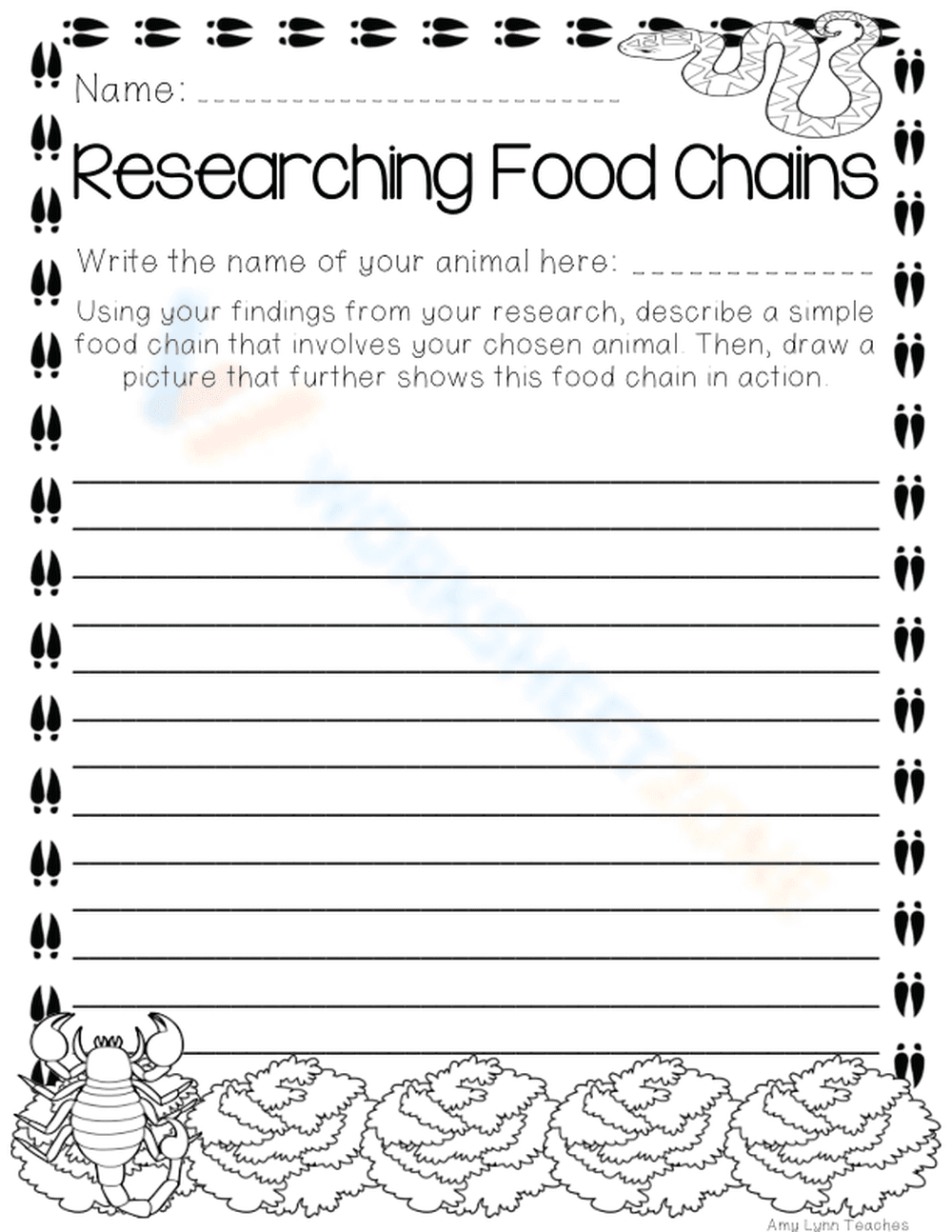
This printable science worksheet guides students through researching and describing a specific animal's food chain. By combining informational writing with scientific illustration, learners solidify their understanding of energy flow in ecosystems. The open-ended format allows students to explore an animal of their choice while demonstrating core ecological concepts.
At a Glance
- Grade: 3 · Subject: Science
- Standard:
3-LS4-3— Describe how animals interact within their specific habitats.- Skill Focus: Researching food chains
- Format: 1 page · 2 tasks · No answer key · PDF
- Best For: Independent research projects
- Time: 20–30 minutes
Educators will find a single-page graphic organizer for independent research. The page features space to name an animal, followed by wide-ruled lines for writing a descriptive paragraph about its food chain. The bottom section provides room for a supplementary illustration, complete with engaging border clip art. Because this is an open-ended prompt, an answer key is not included, allowing maximum flexibility.
This resource is designed for a smooth, zero-prep classroom experience.
- Print (1 minute): Simply download the PDF and print a class set. The black-and-white design is highly ink-friendly.
- Distribute (1 minute): Hand out the sheets along with library books or digital devices for student research.
- Review (Ongoing): Circulate the room to monitor student writing and drawing progress.
Total teacher preparation time is under two minutes. The straightforward instructions make this an excellent option for emergency sub plans or independent science centers.
This activity aligns with 3-LS4-3, asking students to construct an argument with evidence that in a particular habitat some organisms can survive well, some survive less well, and some cannot survive at all. By mapping out a specific food chain, students provide concrete evidence of these ecological relationships. Both standard codes can be copied directly into lesson plans, IEP goals, or district curriculum mapping tools.
This worksheet functions as an independent extension activity after direct instruction on ecosystems. Teachers can assign it during a science block, allowing students to use classroom texts to find animal facts. As a formative assessment tip, observe whether students correctly identify the flow of energy from producers to consumers in their writing. Expected completion time is 20 to 30 minutes.
This material is primarily designed for third-grade science students, though it easily adapts to grades 1 through 4 depending on writing expectations. For differentiation, teachers can provide pre-selected animal books for students who need more scaffolding, or challenge advanced learners to include secondary and tertiary consumers. It pairs naturally with an introductory lesson on producers, consumers, and decomposers, or alongside an anchor chart detailing local habitat food webs.
Integrating structured writing into science instruction significantly enhances student retention of complex ecological concepts. When students articulate the relationships within a food chain, they move beyond rote memorization into active sense-making. According to Fisher & Frey (2014), providing students with clear, purpose-driven writing tasks in the content areas increases both engagement and subject-matter comprehension. This resource supports that pedagogical approach by requiring learners to synthesize their research into a cohesive paragraph and a corresponding visual model. By aligning with 3-LS4-3, the activity ensures students are actively describing how animals interact within their specific habitats. The combination of textual and visual representation accommodates multiple learning modalities, allowing students to demonstrate their understanding of energy flow in a format that builds both scientific literacy and foundational writing skills.


