


























Views
Downloads
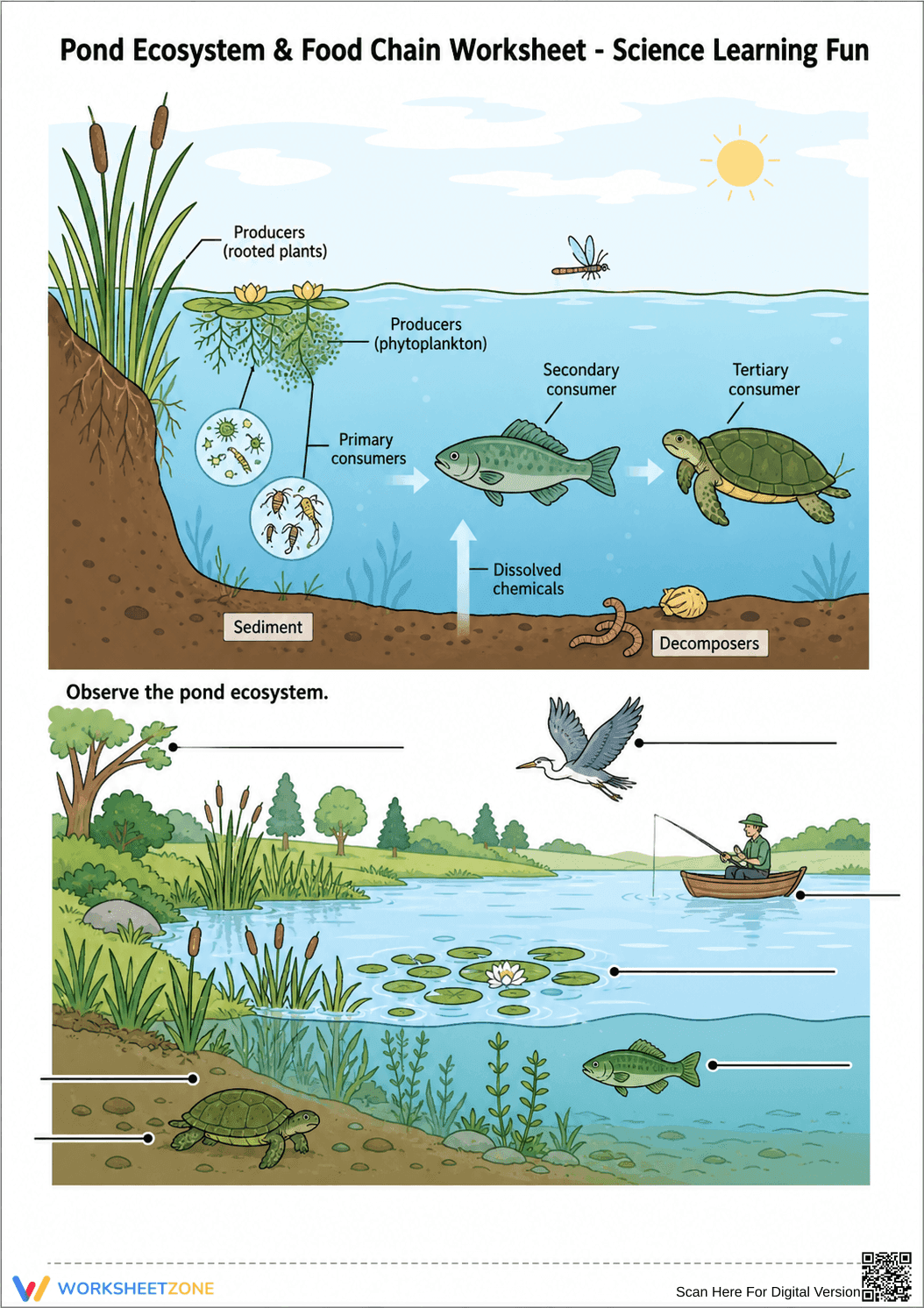

Grade 3 Pond Ecosystem — Printable No-Prep Worksheet
Paste this activity's link or code into your existing LMS (Google Classroom, Canvas, Teams, Schoology, Moodle, etc.).
Students can open and work on the activity right away, with no student login required.
You'll still be able to track student progress and results from your teacher account.
This Grade 3 science worksheet helps students visualize and identify the components of a pond ecosystem and food chain. By analyzing a detailed diagram and completing a labeling activity, learners will understand the roles of producers, consumers, and decomposers while observing how organisms interact within their natural habitat.
At a Glance
- Grade: 3 · Subject: Science
- Standard:
3-LS4-3— Identify how organisms survive in specific habitats- Skill Focus: Ecosystems and Food Chains
- Format: 1 page · 7 problems · Answer key included · PDF
- Best For: Independent practice or review
- Time: 15–20 minutes
This resource features a two-part layout on a single page. The top half provides a labeled reference diagram illustrating a pond food chain, including producers, consumers, and decomposers. The bottom half challenges students with seven fill-in-the-blank labeling tasks to identify ecosystem components based on visual cues. An answer key is provided.
Designed for immediate classroom implementation, this resource requires zero teacher setup.
- Print (1 minute): Generate enough copies for the class directly from the PDF file.
- Distribute (1 minute): Hand out the worksheet alongside pencils or colored markers.
- Review (3 minutes): Briefly read the instructions and point out the reference diagram at the top.
With a total teacher prep time of under two minutes, this activity is highly effective for busy mornings, quick science centers, or as a reliable emergency sub plan.
This activity is aligned to primary standard 3-LS4-3: Construct an argument with evidence that in a particular habitat some organisms can survive well, some survive less well, and some cannot survive at all. It also supports foundational knowledge for understanding energy flow in ecosystems. Both standard codes can be copied directly into lesson plans, IEP goals, or district curriculum mapping tools.
Deploy this worksheet during direct instruction as a visual aid, or assign it after a lesson on habitats for independent reinforcement. As students complete the seven labeling tasks, teachers can use this as a formative assessment by observing whether learners correctly distinguish between producers and consumers. The activity has an expected completion time range of 15 to 20 minutes.
This resource is designed for third-grade general education students, though it serves as an excellent review for fourth graders. To support students who need accommodations, teachers can provide a word bank on the board to assist with spelling and vocabulary recall during the labeling section. It pairs perfectly with an introductory anchor chart on food chains or a nonfiction reading passage about wetland habitats.
Understanding how organisms interact within their environment is a critical component of early science education. This worksheet directly targets 3-LS4-3, helping students identify how organisms survive in specific habitats by mapping out producers, consumers, and decomposers in a pond ecosystem. According to a recent ScienceDirect TpT Analysis, providing students with clear, integrated visual models significantly improves their ability to comprehend complex ecological relationships compared to text-based instruction alone. By combining a detailed reference diagram with an active, hands-on labeling task, this resource effectively reduces cognitive load. This instructional design allows young learners to focus entirely on the structural connections between different species rather than struggling with abstract definitions. Mastery of these foundational concepts not only builds immediate science literacy but also prepares students for more advanced studies of energy flow, food webs, and environmental conservation in upper elementary grades.


