


























Views
Downloads

Printable Food Chains Worksheet | Grade 2 Science
Paste this activity's link or code into your existing LMS (Google Classroom, Canvas, Teams, Schoology, Moodle, etc.).
Students can open and work on the activity right away, with no student login required.
You'll still be able to track student progress and results from your teacher account.
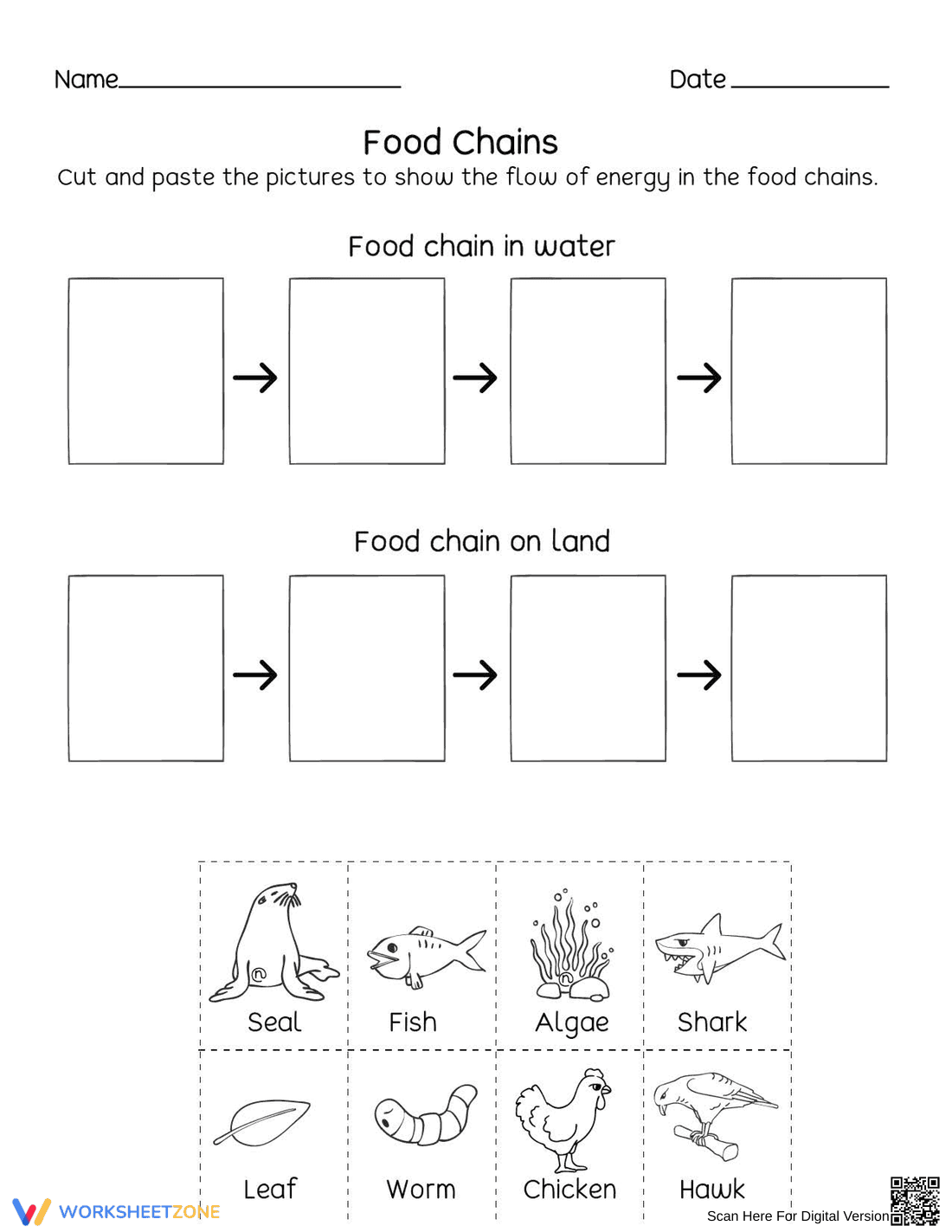
This foundational science worksheet helps early elementary students visualize the flow of energy in ecosystems by constructing simple food chains. By cutting and pasting organisms into the correct sequential order, learners actively demonstrate their understanding of how plants and animals depend on one another for survival in different habitats.
At a Glance
- Grade: 2 · Subject: Science
- Standard:
K-LS1-1— Describe patterns of what plants and animals need to survive- Skill Focus: Constructing food chains
- Format: 1 page · 2 problems · Answer key included · PDF
- Best For: Independent practice or centers
- Time: 15–20 minutes
Inside this resource, educators will find a single-page, highly visual activity focused on energy transfer. The worksheet features two distinct ecosystem scenarios: a water habitat and a land habitat. Students are provided with a bank of eight illustrated organisms—including a seal, shark, algae, leaf, and hawk—which they must cut out and sequence correctly into four-part chains. A complete answer key is provided to ensure quick and accurate grading.
- Print (1 minute): Simply download the PDF and print a class set.
- Distribute (1 minute): Hand out the sheets along with scissors and glue sticks. The instructions are straightforward enough for young learners to follow immediately.
- Review (3 minutes): Use the included answer key to quickly check student work or project it on the board for self-correction.
With a total teacher preparation time of under two minutes, this activity is an excellent addition to any emergency sub plan or last-minute science center.
This activity aligns with K-LS1-1, requiring students to use observations to describe patterns of what plants and animals need to survive. By sequencing the organisms, students model the fundamental concept that animals obtain their food from plants or other animals. Both standard codes can be copied directly into lesson plans, IEP goals, or district curriculum mapping tools.
Use this worksheet after a whole-group lesson on ecosystems. It serves as an excellent independent practice task while the teacher pulls small groups. Alternatively, it functions perfectly as a hands-on science center activity. As a formative assessment tip, observe students while they sort the pictures before gluing; ask them to explain why they placed the algae or the leaf at the beginning of the chain to check for understanding of producers. Expected completion time is 15 to 20 minutes.
This worksheet is ideal for Kindergarten through 2nd-grade students who are just beginning to explore life science concepts. The cut-and-paste format supports kinesthetic learners and fine motor development. The clear, recognizable illustrations also support English Language Learners by reducing the reading load. Pair this activity with an anchor chart showing the sun's role in energy transfer or a read-aloud book about animal diets to reinforce the core concepts.
Understanding the flow of energy through ecosystems is a critical stepping stone in early science education. When students engage with materials aligned to K-LS1-1, they learn to describe patterns of what plants and animals need to survive. According to a ScienceDirect TpT Analysis, incorporating tactile elements like cut-and-paste tasks into science instruction significantly improves retention of abstract concepts for early elementary learners. By physically moving the organisms into the correct sequence, students build a stronger mental model of predator-prey relationships and the foundational role of producers. Providing structured, visual models at this stage fosters long-term scientific literacy and prepares students for more complex ecological studies in upper grades.


