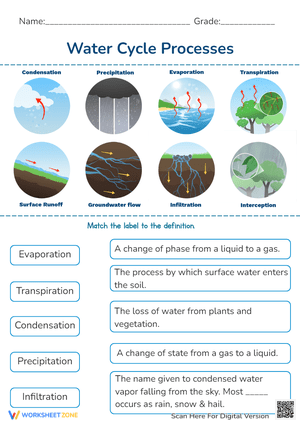
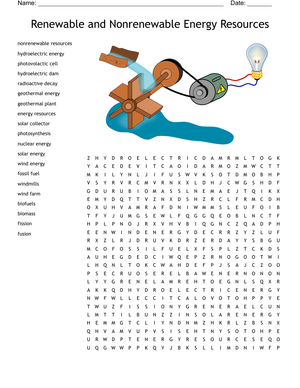
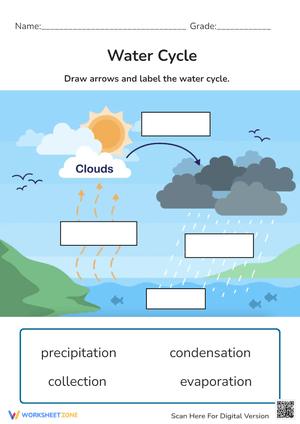
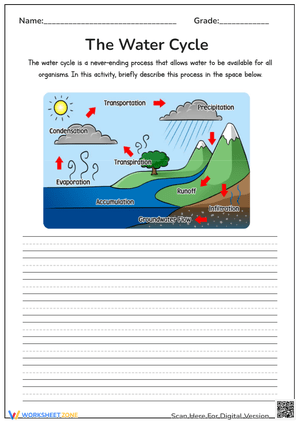
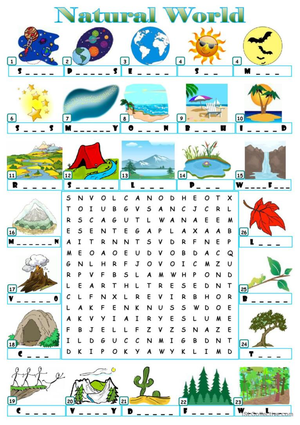
These environment printable worksheets for 3rd grade give teachers a structured path from whole-group instruction to independent student practice — covering ecosystems, habitat relationships, human impact, natural resources, and conservation in one cohesive set. Each worksheet targets the specific analytical work the Grade 3 science curriculum requires: predicting how organisms respond to habitat changes, categorizing human activities by their environmental effects, and distinguishing between resources the Earth replenishes quickly and those it cannot. The resources are built around concrete, visual tasks because 8- and 9-year-olds anchor abstract concepts like "ecosystem" most reliably when they are sorting, labeling, or drawing connections directly on the page.
What's Inside the Set
Five content areas make up the Grade 3 environmental science core, and the worksheets address each one directly:
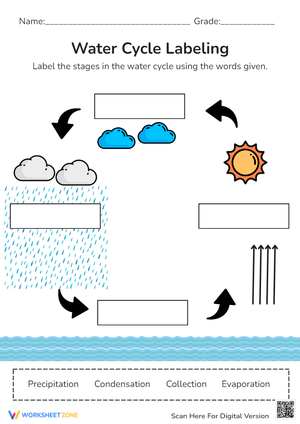
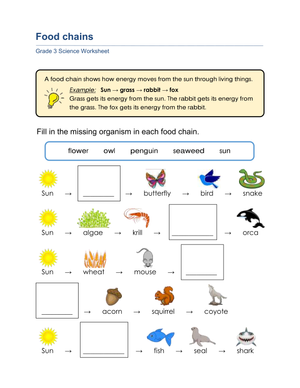
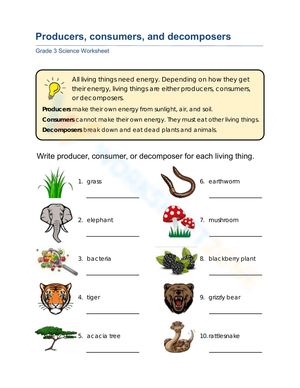
- Habitat and organism relationships — students match animals and plants to their required biome conditions and write a sentence explaining why a mismatched organism would struggle to survive.
- Ecosystem disruption scenarios — a habitat change (a wetland cleared for development, a forest floor after a fast-moving wildfire) prompts students to classify which resident species survive well, which survive poorly, and which cannot survive at all.
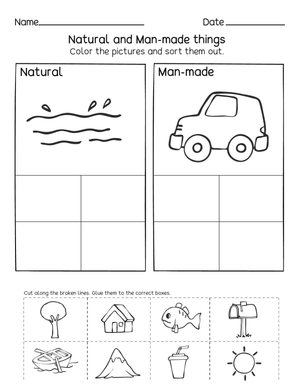
- Human impact sorting — students receive a set of illustrated activities and classify each as beneficial, harmful, or mixed in its effect on local land and water.
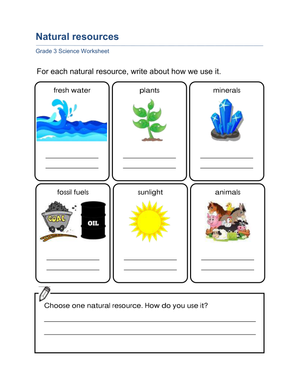
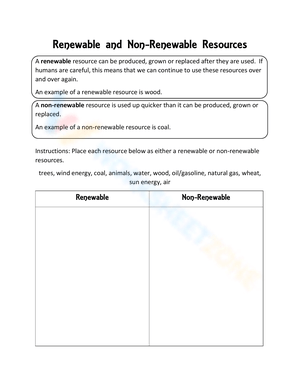
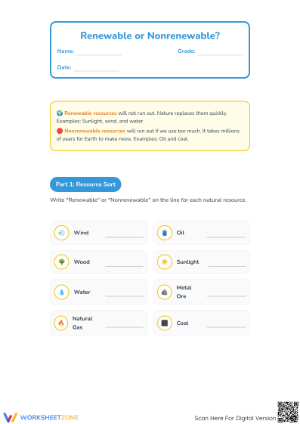
- Natural resources — close-reading passages anchor the distinction between resources the Earth restores within a human lifetime and those that took millions of years to form, using real fuel sources and real alternatives rather than abstract labels.
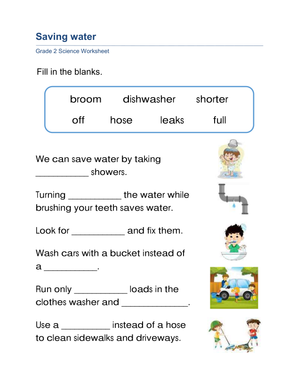
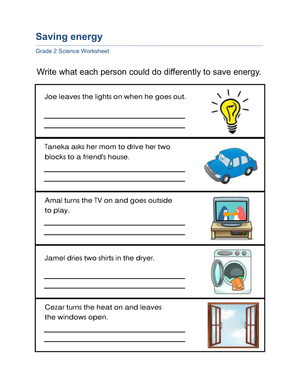
- Conservation and the Three Rs — waste audits, recycling sorters, and household energy checklists, including activities students complete with a family member at home.
The ecosystem disruption task is the most analytically demanding in the set. It requires students to hold two causal steps in mind simultaneously — what changed in the environment, and what that change means for a specific organism — which is the reasoning move at the center of NGSS 3-LS4-4.
Mistakes Students Make That These Worksheets Help You Catch
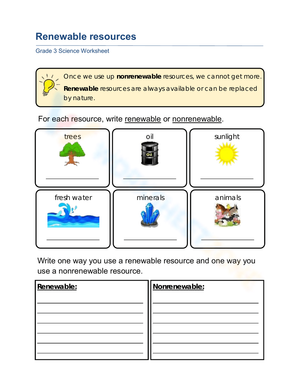
The renewable-versus-non-renewable distinction produces a predictable error. Students who correctly mark sunlight and wind as renewable will still circle a plastic bottle as renewable because it can be washed and reused — they are applying the logic of reusability rather than the geological reality of resource replenishment. Catching this before the unit assessment means having a brief but explicit conversation about timescale: renewable means the Earth restores it within a human lifetime; coal and oil do not meet that standard no matter how carefully you use them. Watching for this error on the sorting worksheet is faster than waiting for a test result to flag it.
The human-impact sorting tasks reveal a different pattern. Farming almost always lands in the "helpful" column without qualification — students think food production, not pesticide runoff or topsoil loss. That response is incomplete rather than wrong, and it opens one of the most productive discussions in the unit: that the same human activity can protect and harm simultaneously, depending on scale and method. The worksheet surfaces this tension rather than resolving it cleanly, which is exactly what you want at Grade 3.
Standard Alignment
The set aligns most directly to NGSS 3-LS4-4 (Interdependent Relationships in Ecosystems), which requires students to make and support a claim about solutions when environments change and the organisms living there are affected. The habitat disruption scenario tasks map directly to this performance expectation. Several worksheets also address NGSS 3-LS2-1, which covers how organisms within an ecosystem depend on one another and on their environment for survival. The natural resources content connects to Earth Science expectations at this grade — specifically, that students understand how humans use Earth materials and what responsible use requires. These standards appear at Grade 3 because students at this age are ready to follow a two-step causal chain: the environment changes, therefore an organism's survival prospects change. Earlier grades center on observation; Grade 3 introduces prediction and evidence-based claim-making, and that cognitive shift is what the worksheets are built to support.
How to Build These Worksheets Into Your Lesson Plans
The most consistent pattern that works: anchor each worksheet with a short observation before students sit down to complete it. A worksheet on soil health runs better after five minutes in the schoolyard comparing the dark, loose soil under a tree with the packed, pale soil near the blacktop. That concrete sensory reference cuts down significantly on the number of students who stall because the concept feels too abstract on its own.
In a station rotation, one station dedicated to environment printable worksheets for 3rd grade runs cleanly alongside a hands-on experiment station — a simple water filtration test using gravel, sand, and a coffee filter, for instance — and a paired reading station. The worksheet station runs independently without you there, which frees you to manage the messier experiment side of the room.
Several teachers use completed worksheets as science journal pages: students finish the activity and glue it into a composition notebook alongside their own sketches and written observations. By the end of the unit, the journal is a review tool they actually built themselves, which tends to be more useful than a photocopied study guide because students remember the decisions they made while completing each one. The conservation checklists and home energy audits pull families into the curriculum without much coordination overhead — a student who surveys which lights stay on in empty rooms returns the next morning with real household data, and that data makes the follow-up discussion considerably more grounded.
Adjusting the Worksheets for a Range of Learners
The full range of environment printable worksheets for 3rd grade spans from heavily visual, word-bank-supported tasks to open-ended written response prompts — which means you can match individual students to the right entry point without hunting for supplemental materials. Students who need more structured support do best with the habitat-matching tasks and the resource-sorting activities, where the cognitive demand centers on categorization rather than language generation. Avoid assigning the scenario-based written explanation tasks to students who are not yet confident writers; that format tends to produce a frozen blank rather than a productive attempt.
For students working above grade level, the ecosystem disruption tasks become considerably stronger with one added constraint: instead of simply predicting which species survive a habitat change, ask them to propose one realistic human intervention that could support a struggling species and identify a specific trade-off the intervention involves. That modification pushes toward the evidence-based argumentation NGSS 3-LS4-4 actually calls for, and it requires no additional printing — same worksheet, extended prompt written on the board.
Frequently Asked Questions
Can these worksheets be used outside the science block?
Yes, and some of the strongest uses happen outside dedicated science time. The conservation checklist lends itself to math integration when students tally results and compare household totals as a class data set. The human-impact sorting task anchors a social studies conversation about land use in your region or state. Environment printable worksheets for 3rd grade move across subject areas more naturally than most science materials because the content connects to real places and real decisions students already encounter outside school.
What do students do when they finish a worksheet faster than expected?
A standing extension prompt keeps early finishers thinking rather than idle: "Write one question this worksheet did NOT answer for you." Those student questions are often worth using as the next day's warm-up discussion starter. It takes thirty seconds to write on the board and produces better thinking than a word search or a coloring extension.
How do I use these for formative assessment without turning them into a test?
The written explanation sections are where the most useful formative information lives — not the sort-and-match sections. A student who correctly places coal in the non-renewable column but writes "because it is dirty" in the explanation has shown you a gap worth addressing before any summative measure. Sorting answers tell you what students circled; the written prompts tell you what they actually understood.












 Interactive Worksheet Maker
 Quiz Maker
 Word Search Maker
 Crossword Puzzle Maker
 Word Scramble Generator
 Sentence Scramble Generator
 Handwriting Worksheet Generator
 Name Tracing Generator
 Fill In The Blank Generator