


























Views
Downloads

Grade 4 Food Chains — Printable No-Prep Science Worksheet
Paste this activity's link or code into your existing LMS (Google Classroom, Canvas, Teams, Schoology, Moodle, etc.).
Students can open and work on the activity right away, with no student login required.
You'll still be able to track student progress and results from your teacher account.
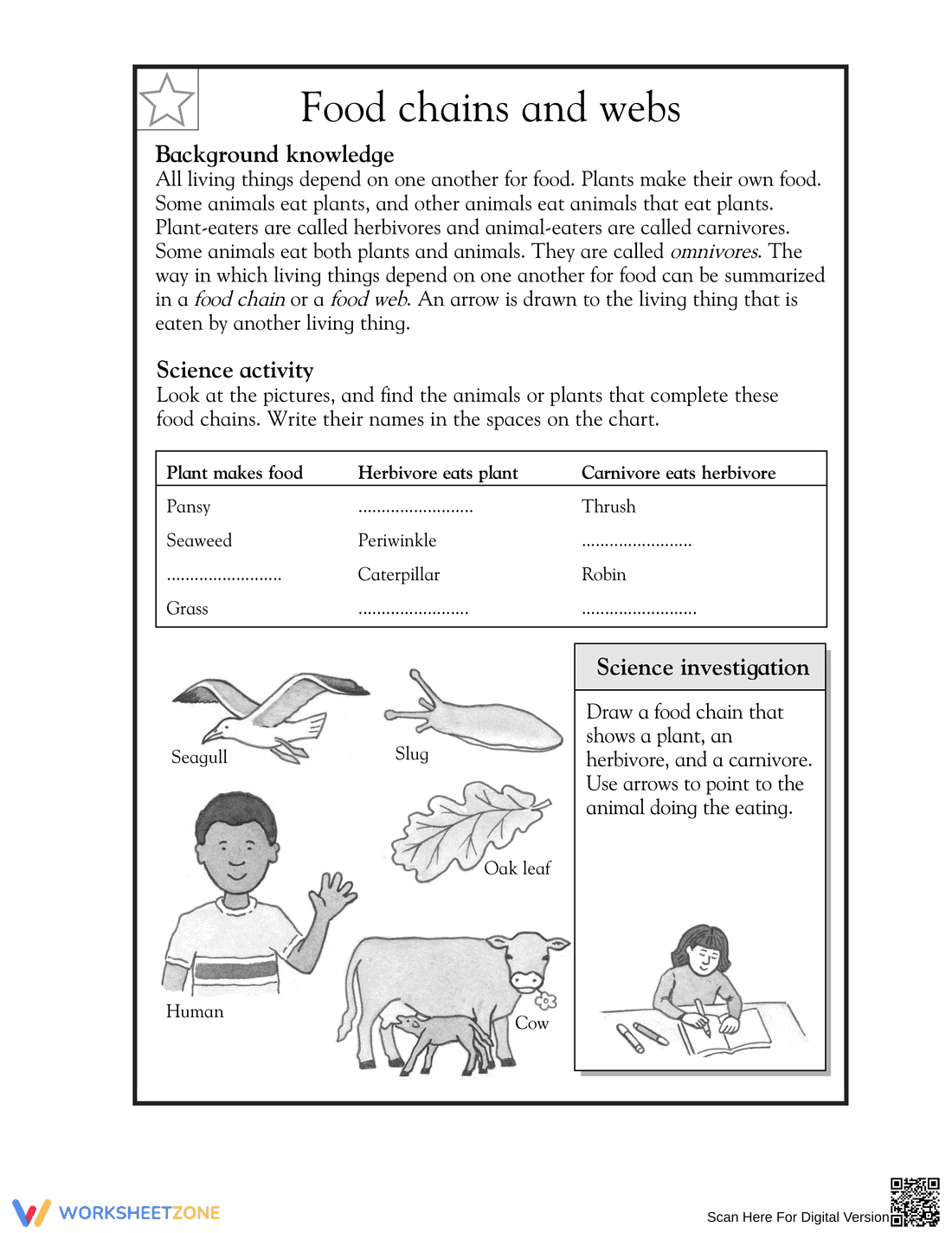
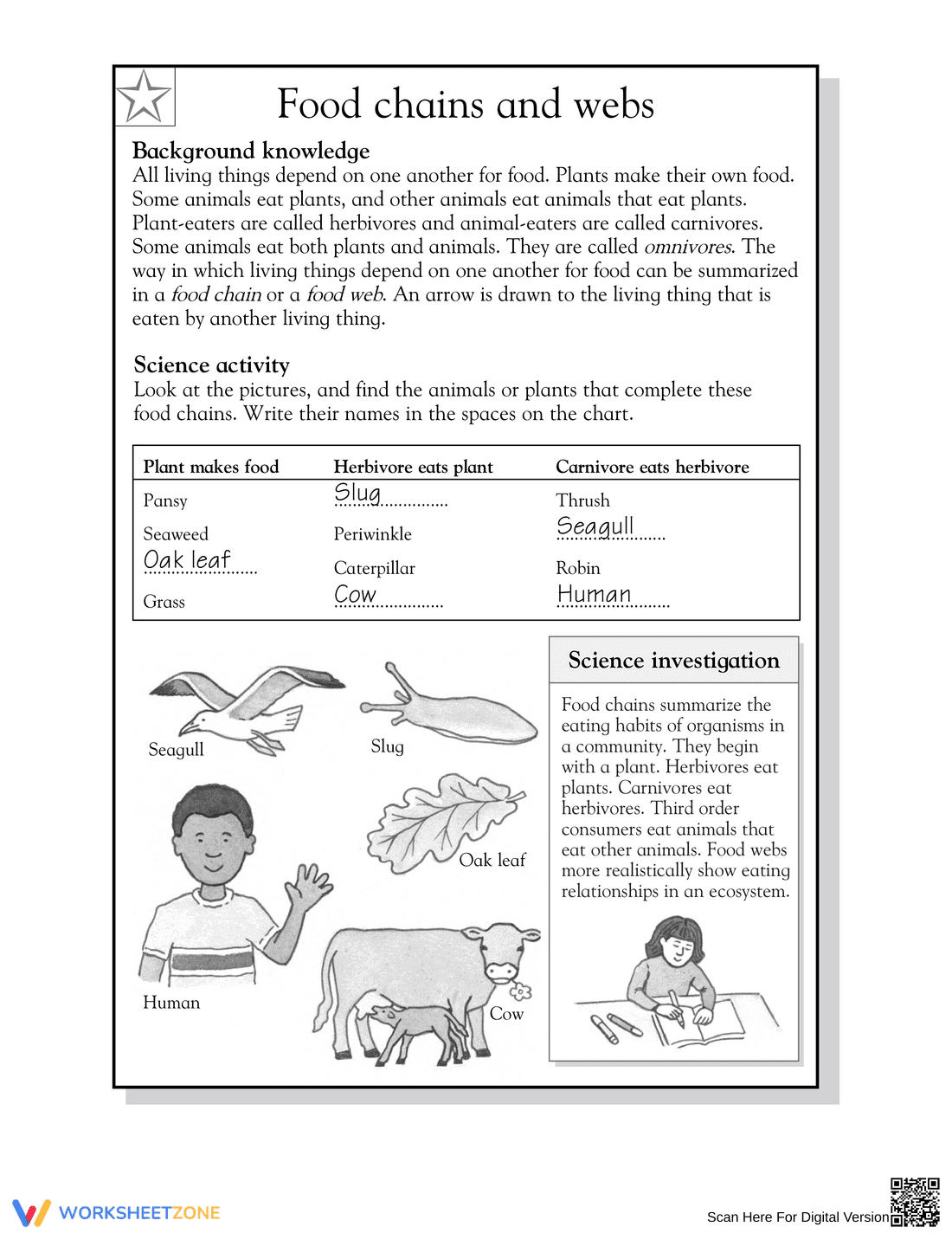
Students will master the fundamentals of energy flow in ecosystems by identifying producers, herbivores, and carnivores. This worksheet guides learners through completing complex food chains and independent investigation of predator-prey relationships. By mapping biological connections, Grade 4 students develop a concrete understanding of how all living things depend on one another for survival.
At a Glance
- Grade: 4 · Subject: Living Things
- Standard:
4-LS1-1— Construct arguments explaining how organisms have structures that support their survival and growth- Skill Focus: Food chains and energy flow
- Format: 1 page · 2 tasks · Answer key included · PDF
- Best For: Independent science practice and quick assessments
- Time: 15–20 minutes
What's Inside
This one-page resource features a background section defining herbivores, carnivores, and omnivores. The science activity includes a structured data table where students fill in missing links for terrestrial and aquatic chains. The worksheet concludes with a science investigation section that prompts students to synthesize learning by drawing an original food chain using provided visual prompts and labels. A full answer key is provided.
Zero-Prep Workflow
This worksheet is designed for maximum efficiency, requiring zero teacher preparation beyond basic printing. The workflow is simple: print the single-sided PDF (30 seconds), distribute to students during your science block (1 minute), and review using the provided answer key (30 seconds). Total teacher prep time is under 2 minutes. The self-explanatory layout makes it an ideal resource for emergency sub plans or as a quick transition activity.
Standards Alignment
This activity is primarily aligned to NGSS 4-LS1-1, focusing on how organisms have structures that support survival. By analyzing food chains, students examine how external structures related to diet facilitate energy acquisition. It also supports 3-LS4-3 regarding environmental interactions. Both standard codes can be copied directly into lesson plans, IEP goals, or district curriculum mapping tools.
How to Use It
Assign this worksheet as a formative assessment following a lesson on ecosystem roles to gauge understanding. It also serves as an excellent science center activity for student pairs. Teachers should observe if students correctly point arrows toward the consumer, a common misconception in biology. Expect a 15-to-20 minute completion time for most Grade 3 or Grade 4 learners.
Who It's For
This resource is tailored for Grade 3 and Grade 4 students studying life science. The clear definitions and visual aids make it accessible for English Language Learners. For advanced learners, pair this worksheet with a local ecosystem passage or an anchor chart showing a complex food web to extend thinking from linear chains to interconnected networks.
Understanding energy transfer through food chains is a foundational concept in biological literacy, as highlighted by the RAND AIRS 2024 report on elementary science achievement. Research indicates that visual modeling of ecological relationships, such as the table-based and drawing-based tasks in this worksheet, significantly improves retention of abstract scientific concepts. By standardizing the terminology for producers, herbivores, and carnivores, educators provide students with the linguistic tools necessary to discuss biodiversity and environmental impact. This worksheet aligns with best practices for scaffolded science instruction, moving from guided definitions to independent application. The inclusion of NGSS standard 4-LS1-1 ensures that the content remains rigorous and relevant to state-mandated science frameworks. Utilizing such standards-aligned resources helps close the gap in science proficiency by providing structured, evidence-based practice. Educators can confidently integrate this tool into their curriculum to assess student mastery of basic ecosystem dynamics.


