


























Views
Downloads
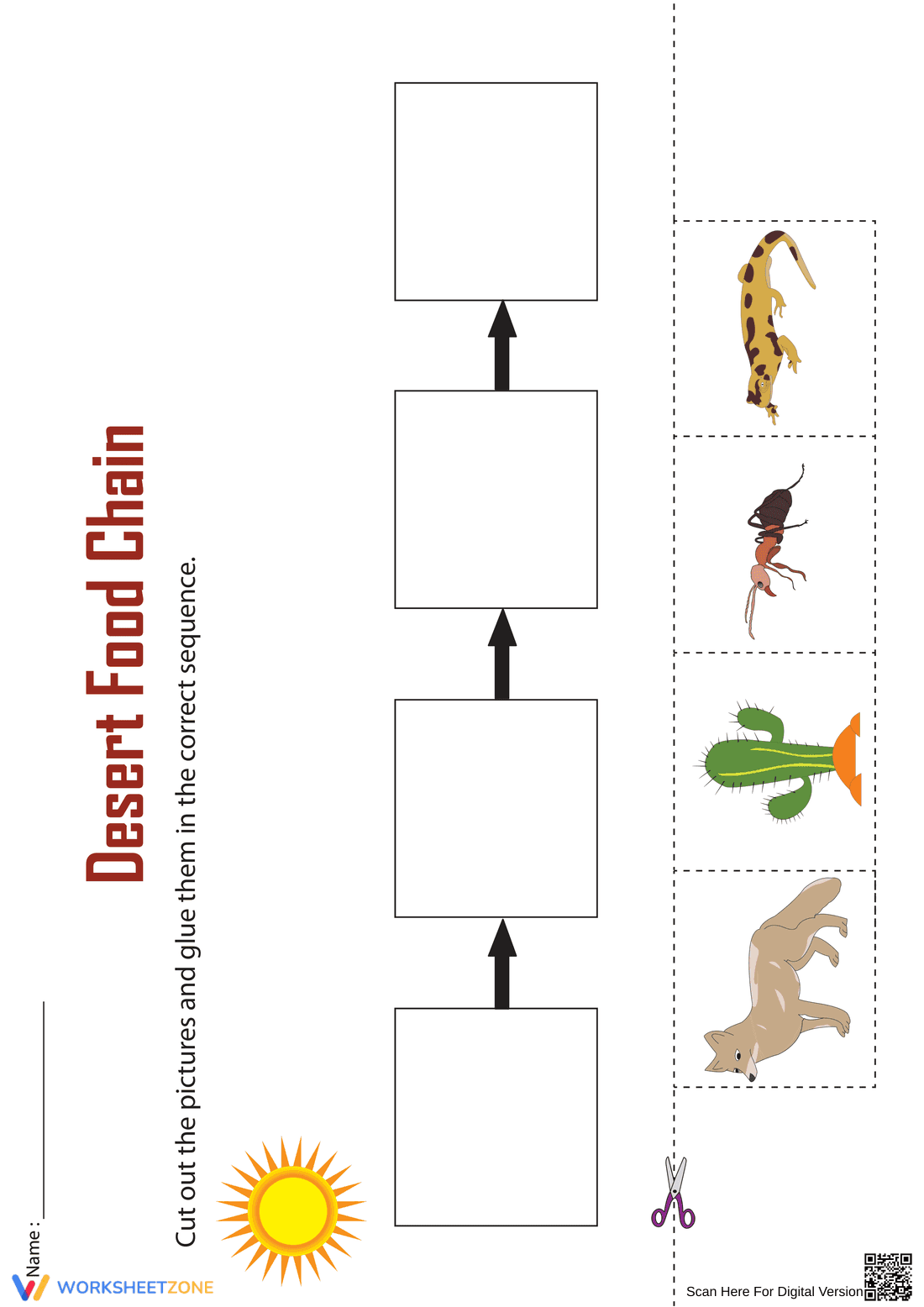

Essential Desert Food Chain Worksheet | Grade 3-4 Printable
Paste this activity's link or code into your existing LMS (Google Classroom, Canvas, Teams, Schoology, Moodle, etc.).
Students can open and work on the activity right away, with no student login required.
You'll still be able to track student progress and results from your teacher account.
This interactive Desert Food Chain worksheet helps students visualize the complex energy relationships within one of the world's most extreme biomes. By sequencing producers and consumers, learners develop a concrete understanding of how energy originates from the sun and moves through a specific ecosystem to sustain diverse living things.
At a Glance
- Grade: 3 – 4 · Subject: Living Things
- Standard:
3-LS4-3— Construct an argument that in a habitat some organisms survive well- Skill Focus: Ecosystem energy flow and trophic sequencing
- Format: 1 page · 4 problems · Answer key included · PDF
- Best For: Interactive science journals and independent practice
- Time: 15–20 minutes
What's Inside
This focused one-page PDF features a clear, vertical flow diagram starting with the primary energy source: the sun. It includes four distinct high-quality illustrations of desert organisms—a cactus, an ant, a lizard, and a coyote—specifically designed for cutting and pasting. The worksheet includes a name line and clear instructions to ensure student independence during the activity.
Zero-Prep Workflow
Implementing this lesson is designed for maximum efficiency in busy classrooms. Teachers can follow a simple three-step process: Print the single-page PDF (30 seconds), distribute the sheets and scissors to students (1 minute), and facilitate a quick group review of the completed sequences (2 minutes). Total teacher preparation time is under two minutes, making this an ideal emergency sub plan.
Standards Alignment
This resource is directly aligned with 3-LS4-3, which requires students to "construct an argument with evidence that in a particular habitat some organisms can survive well, some survive less well, and some cannot survive at all." By modeling the desert food chain, students demonstrate how specific organisms are interdependent for survival. This standard code can be copied directly into lesson plans, IEP goals, or district curriculum mapping tools.
How to Use It
Use this worksheet during the "Explore" or "Explain" phase of a 5E lesson on biomes or ecosystems. It serves as an excellent check for understanding after a direct instruction session on producers, consumers, and predators. For a formative assessment observation, watch how students determine the placement of the cactus as the producer; students who struggle may need a reminder about photosynthesis and primary energy sources.
Who It's For
This activity is perfectly suited for general education students in Grades 3 and 4, as well as English Language Learners who benefit from visual-heavy, low-linguistic-load tasks. It pairs naturally with a non-fiction passage about desert adaptations or a classroom anchor chart detailing the different trophic levels within a food web.
The transition from abstract ecological concepts to concrete visual models is a critical milestone in elementary science education. According to the ScienceDirect TpT Analysis (2024), tactile activities like cut-and-paste worksheets significantly improve retention of hierarchical information compared to passive reading alone. This resource leverages that principle by requiring students to physically manipulate the sequence of the 3-LS4-3 desert food chain, moving from the primary producer (cactus) through various consumer levels (ant, lizard, and coyote). By grounding the abstract concept of energy flow in the specific, observable organisms of the desert biome, the worksheet ensures that the plain-English skill of sequencing trophic levels becomes a permanent part of the student's cognitive framework. This approach aligns with modern pedagogical standards that emphasize active modeling over rote memorization, providing a robust foundation for more complex middle-school studies in environmental biology and global ecosystem dynamics.


