


























Views
Downloads
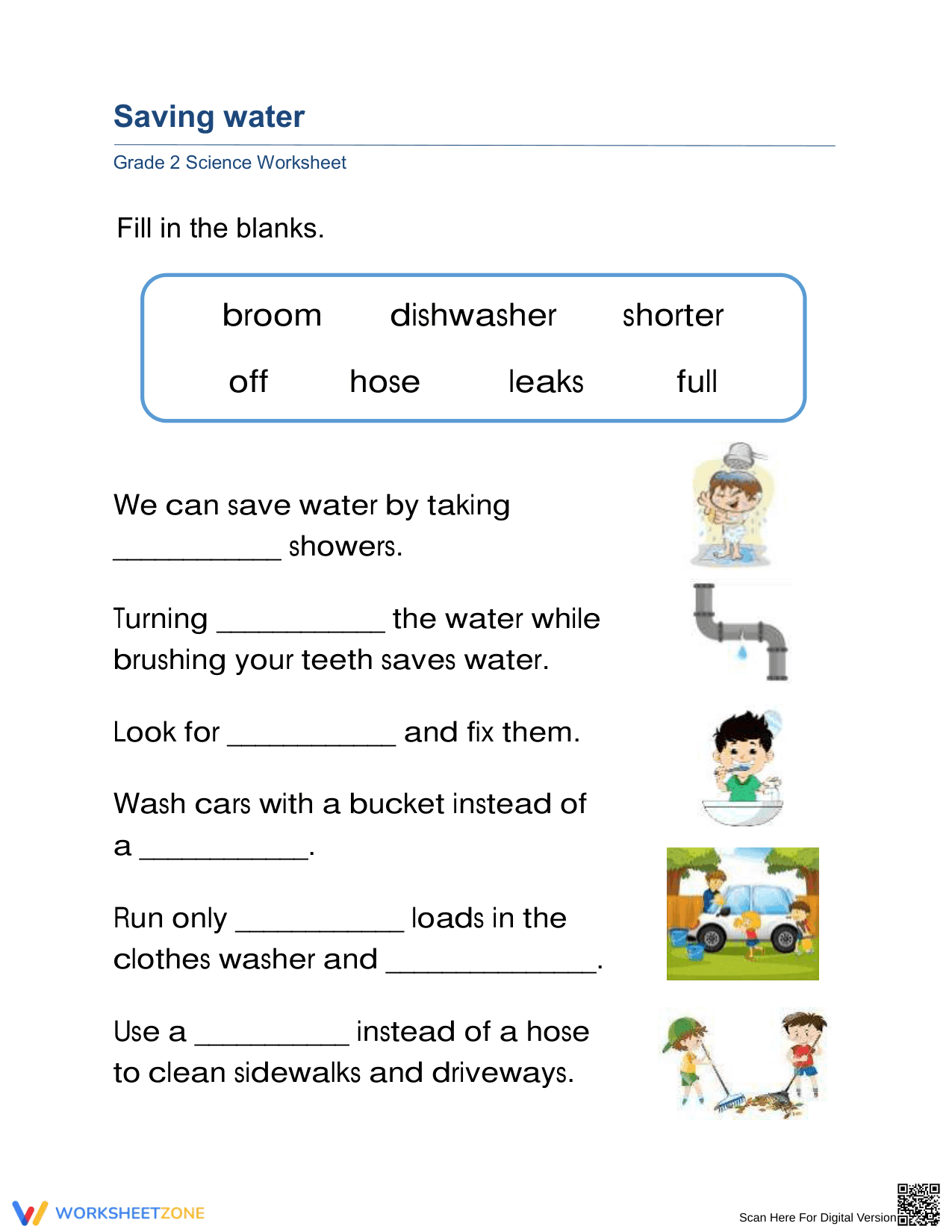


Essential Saving Water Worksheet | Grade 2 Science
Paste this activity's link or code into your existing LMS (Google Classroom, Canvas, Teams, Schoology, Moodle, etc.).
Students can open and work on the activity right away, with no student login required.
You'll still be able to track student progress and results from your teacher account.
This Grade 2 Science worksheet helps students identify practical ways to conserve water in their daily lives. Through structured fill-in-the-blank exercises and creative drawing tasks, learners develop a concrete understanding of environmental stewardship. Students will recognize how simple actions like turning off the faucet or taking shorter showers contribute to protecting our planet's vital resources.
At a Glance
- Grade: 2 · Subject: Science
- Standard:
K-ESS3-3— Communicate solutions that reduce human impact on water resources- Skill Focus: Water conservation strategies
- Format: 2 pages · 8 problems · Answer key included · PDF
- Best For: Earth Day or environmental science lessons
- Time: 15–20 minutes
This two-page PDF includes a focused fill-in-the-blank section supported by a clear word bank and helpful illustrations. Students solve six problems related to home water usage, such as fixing leaks and using buckets instead of hoses. The second page features two large drawing and writing frames, allowing students to demonstrate personal connections to conservation. A complete answer key ensures easy grading.
This resource is designed for immediate classroom implementation with zero teacher setup. Print the two pages in less than 30 seconds, distribute them to your students for a 15-minute independent activity, and review the answers together using the included key for a 5-minute wrap-up. The total preparation time is under two minutes, making it an ideal choice for sub plans or morning work.
This worksheet aligns with `K-ESS3-3`, which requires students to communicate solutions that will reduce the impact of humans on the land, water, air, and other living things in the local environment. By identifying man-made solutions to water waste, students build foundational knowledge for later environmental science modules. Both standard codes can be copied directly into lesson plans, IEP goals, or district curriculum mapping tools.
Assign this worksheet after a direct instruction lesson on natural resources to serve as an independent practice activity. It also works effectively as a formative-assessment tool; observe whether students can correctly apply the word bank terms to the corresponding illustrations to gauge their comprehension of conservation vocabulary. Expected completion time ranges from 15 to 25 minutes depending on the level of detail in the drawing section.
This resource is tailored for second-grade students but is appropriate for first or third-graders needing differentiation in environmental science. It pairs naturally with a read-aloud about the water cycle or an anchor chart listing household resources. The visual cues support English Language Learners and students requiring reading intervention by providing context for the vocabulary terms.
Standard `K-ESS3-3` emphasizes the importance of early childhood exposure to conservation solutions, a pedagogical approach supported by the `RAND AIRS 2024` report. Research suggests that students who engage with concrete, actionable steps—such as the 8 specific tasks provided in this Grade 2 Science worksheet—are more likely to retain environmental stewardship habits into later grades. By bridging the gap between abstract concepts like 'resource management' and daily actions like 'shorter showers,' this worksheet facilitates cognitive mapping of human impacts on Earth systems. The inclusion of drawing tasks aligns with `Fisher & Frey (2014)`'s recommendations for multi-modal learning, ensuring that students can express mastery through both linguistic and visual channels. This evidence-based design makes it a reliable tool for classroom teachers looking to meet standard requirements while fostering genuine environmental awareness through structured practice and creative expression.


