




























1 / 2
0
Views
0
Downloads

0.0
0
Save
0 Likes
Share
Weathering, Erosion, Deposition Worksheet
0 Views
0 Downloads

Paste this activity's link or code into your existing LMS (Google Classroom, Canvas, Teams, Schoology, Moodle, etc.).
Students can open and work on the activity right away, with no student login required.
You'll still be able to track student progress and results from your teacher account.
Information
Description
What It Is:
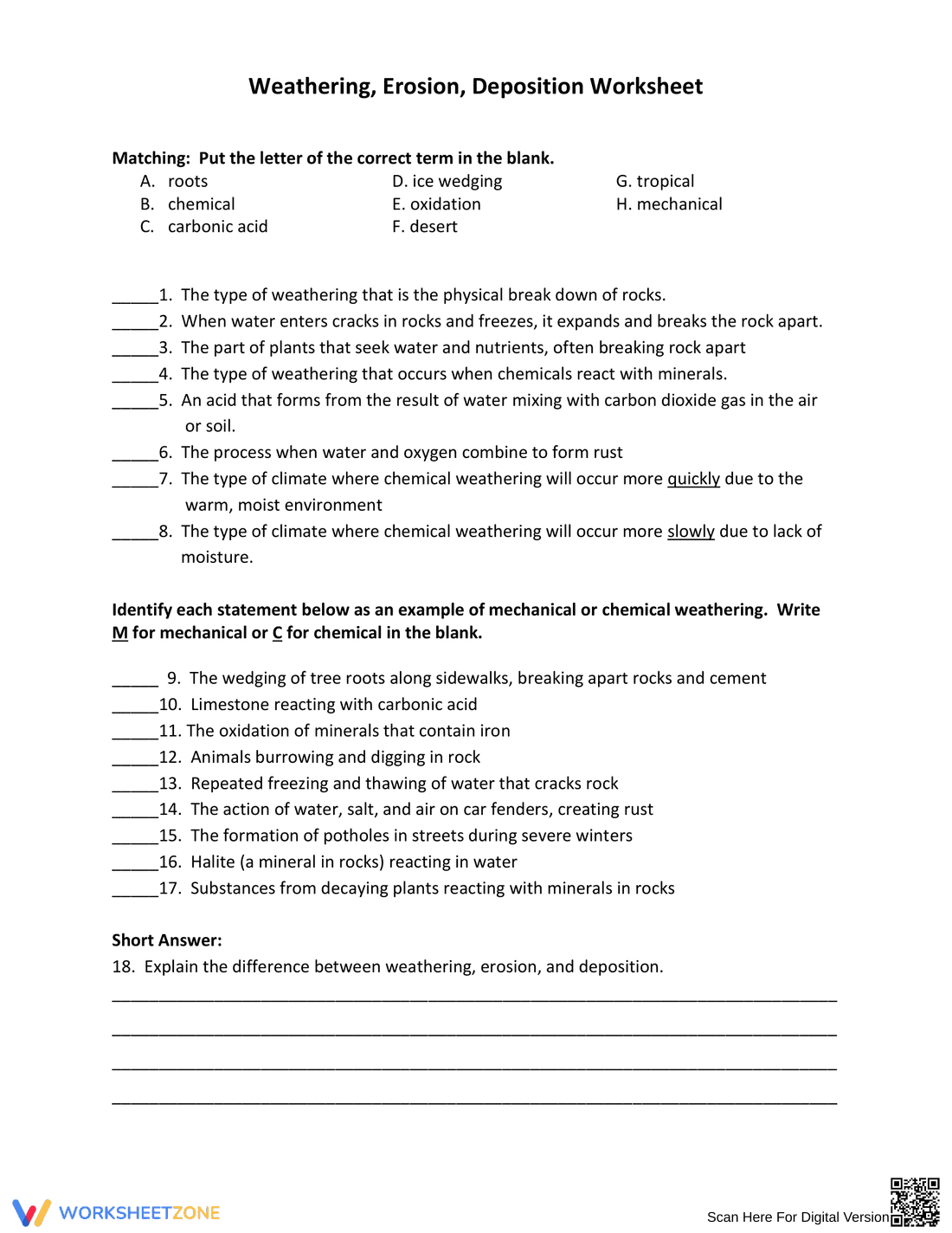
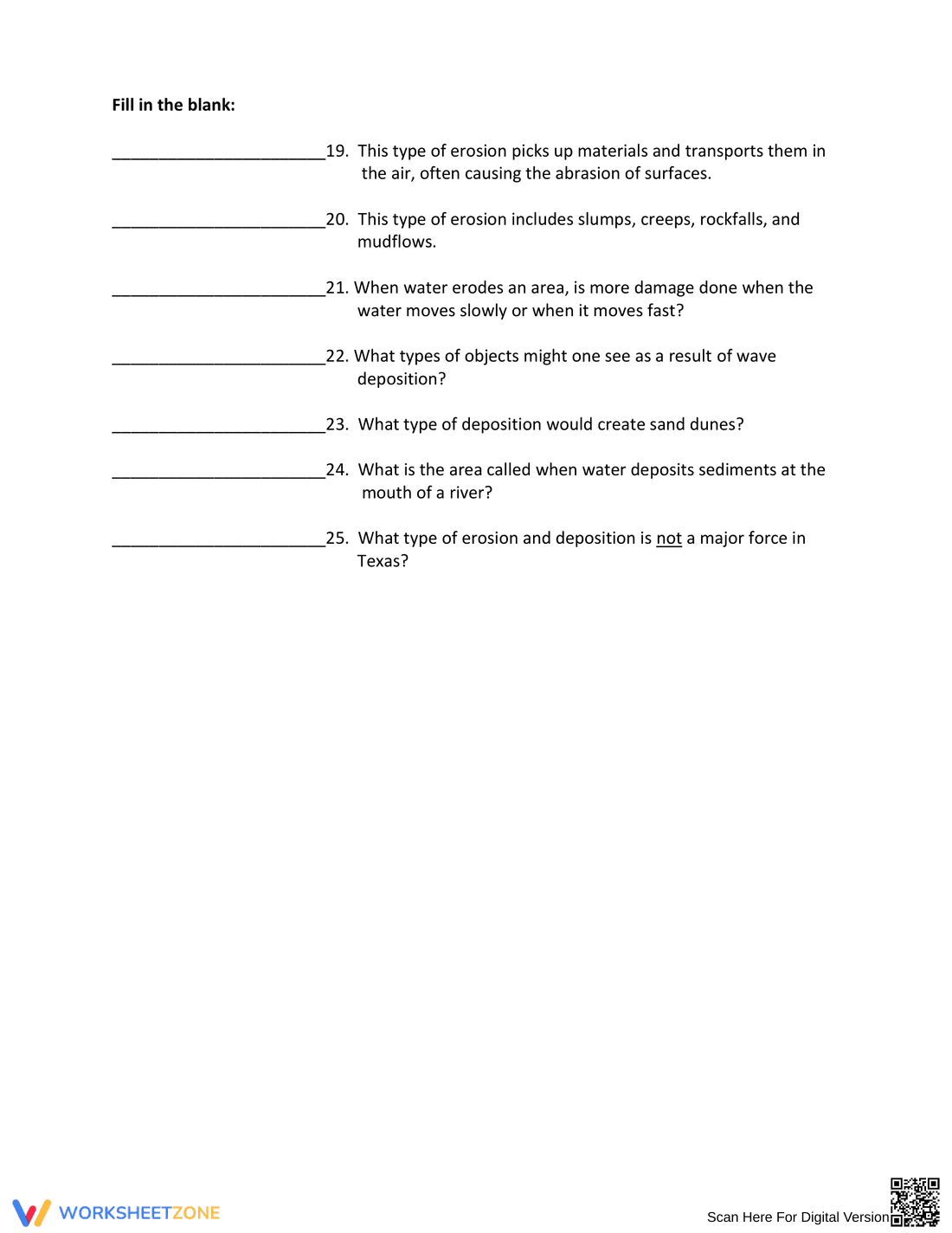
This is a worksheet focused on the topics of weathering, erosion, and deposition. It includes three sections: a matching section where students match terms like 'roots,' 'chemical,' and 'ice wedging' to definitions related to weathering, a section where students identify examples of mechanical or chemical weathering, and a short answer question asking students to explain the difference between weathering, erosion, and deposition.
Grade Level Suitability:
This worksheet is suitable for upper elementary (4th-5th grade) and middle school (6th-8th grade) students. The concepts are introductory earth science topics and the activities require reading comprehension and basic science knowledge. The short answer question could be challenging for younger students.
Why Use It:
This worksheet helps students understand the processes of weathering, erosion, and deposition. It reinforces vocabulary, encourages critical thinking by identifying types of weathering, and assesses understanding through a short answer question. It provides a structured way to learn and review these earth science concepts.
How to Use It:
Students should first complete the matching section by associating the terms with their definitions. Next, they should read each statement in the second section and identify it as either mechanical or chemical weathering, marking it with 'M' or 'C' respectively. Finally, they should answer the short answer question by explaining the difference between weathering, erosion, and deposition in their own words.
Target Users:
This worksheet is designed for students learning about earth science, specifically weathering, erosion, and deposition. It is appropriate for teachers to use in the classroom or as homework, and for homeschool parents teaching earth science concepts.
This is a worksheet focused on the topics of weathering, erosion, and deposition. It includes three sections: a matching section where students match terms like 'roots,' 'chemical,' and 'ice wedging' to definitions related to weathering, a section where students identify examples of mechanical or chemical weathering, and a short answer question asking students to explain the difference between weathering, erosion, and deposition.
Grade Level Suitability:
This worksheet is suitable for upper elementary (4th-5th grade) and middle school (6th-8th grade) students. The concepts are introductory earth science topics and the activities require reading comprehension and basic science knowledge. The short answer question could be challenging for younger students.
Why Use It:
This worksheet helps students understand the processes of weathering, erosion, and deposition. It reinforces vocabulary, encourages critical thinking by identifying types of weathering, and assesses understanding through a short answer question. It provides a structured way to learn and review these earth science concepts.
How to Use It:
Students should first complete the matching section by associating the terms with their definitions. Next, they should read each statement in the second section and identify it as either mechanical or chemical weathering, marking it with 'M' or 'C' respectively. Finally, they should answer the short answer question by explaining the difference between weathering, erosion, and deposition in their own words.
Target Users:
This worksheet is designed for students learning about earth science, specifically weathering, erosion, and deposition. It is appropriate for teachers to use in the classroom or as homework, and for homeschool parents teaching earth science concepts.


