


























1 / 2
0
Views
0
Downloads

0.0
0
Save
0 Likes
Share
Weathering, Erosion, and Deposition Study Guide
0 Views
0 Downloads
Paste this activity's link or code into your existing LMS (Google Classroom, Canvas, Teams, Schoology, Moodle, etc.).
Students can open and work on the activity right away, with no student login required.
You'll still be able to track student progress and results from your teacher account.
Information
Description
What It Is:
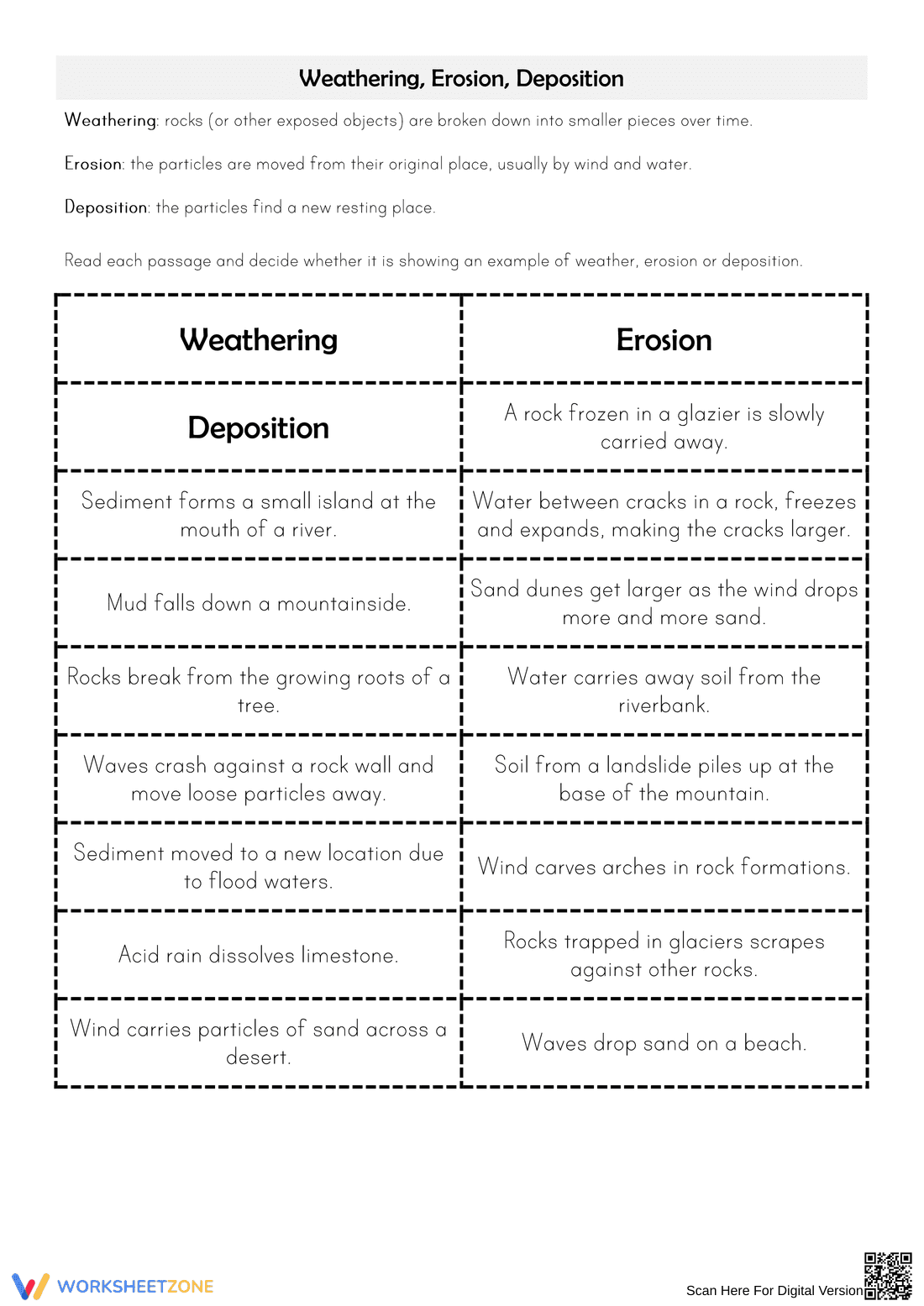
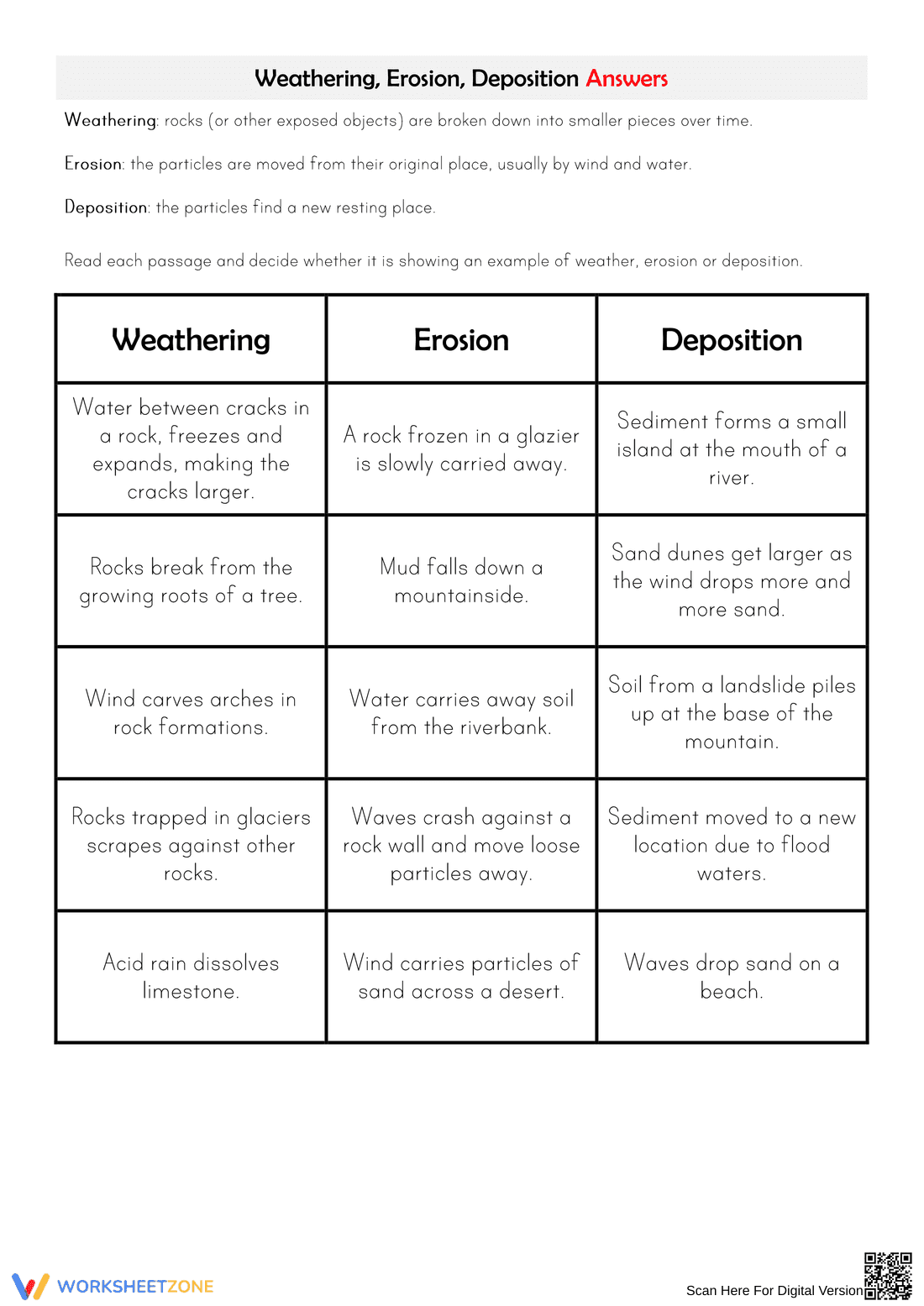
This is an educational worksheet focused on the concepts of weathering, erosion, and deposition. The worksheet provides brief definitions of each process and then presents a table with descriptions of various scenarios. Students are expected to read each scenario and determine whether it is an example of weathering, erosion, or deposition. Scenarios include examples like 'A rock frozen in a glacier is slowly carried away,' 'Sediment forms a small island at the mouth of a river,' and 'Acid rain dissolves limestone.'
Grade Level Suitability:
This worksheet is suitable for grades 3-5. The concepts are introduced in a simple manner, and the scenarios are generally easy to understand for students in this age range. The vocabulary is appropriate for this grade level.
Why Use It:
This worksheet helps students understand the differences between weathering, erosion, and deposition through real-world examples. It reinforces their understanding of these geological processes and encourages critical thinking as they analyze each scenario. It also promotes reading comprehension skills.
How to Use It:
First, review the definitions of weathering, erosion, and deposition at the top of the worksheet. Then, read each scenario in the table carefully. Decide whether the scenario is an example of weathering, erosion, or deposition. Students can write the correct term above each scenario or color code them according to their category.
Target Users:
This worksheet is designed for elementary school students, particularly those in grades 3-5, who are learning about earth science and geological processes. It can be used in a classroom setting or as a supplemental activity for homeschooling.
This is an educational worksheet focused on the concepts of weathering, erosion, and deposition. The worksheet provides brief definitions of each process and then presents a table with descriptions of various scenarios. Students are expected to read each scenario and determine whether it is an example of weathering, erosion, or deposition. Scenarios include examples like 'A rock frozen in a glacier is slowly carried away,' 'Sediment forms a small island at the mouth of a river,' and 'Acid rain dissolves limestone.'
Grade Level Suitability:
This worksheet is suitable for grades 3-5. The concepts are introduced in a simple manner, and the scenarios are generally easy to understand for students in this age range. The vocabulary is appropriate for this grade level.
Why Use It:
This worksheet helps students understand the differences between weathering, erosion, and deposition through real-world examples. It reinforces their understanding of these geological processes and encourages critical thinking as they analyze each scenario. It also promotes reading comprehension skills.
How to Use It:
First, review the definitions of weathering, erosion, and deposition at the top of the worksheet. Then, read each scenario in the table carefully. Decide whether the scenario is an example of weathering, erosion, or deposition. Students can write the correct term above each scenario or color code them according to their category.
Target Users:
This worksheet is designed for elementary school students, particularly those in grades 3-5, who are learning about earth science and geological processes. It can be used in a classroom setting or as a supplemental activity for homeschooling.


