


























1 / 4
0
Views
0
Downloads


0.0
0
Save
0 Likes
Share
Renewable vs. Nonrenewable Resources - Earth Science Worksheet
0 Views
0 Downloads
Paste this activity's link or code into your existing LMS (Google Classroom, Canvas, Teams, Schoology, Moodle, etc.).
Students can open and work on the activity right away, with no student login required.
You'll still be able to track student progress and results from your teacher account.
Information
Description
What It Is:
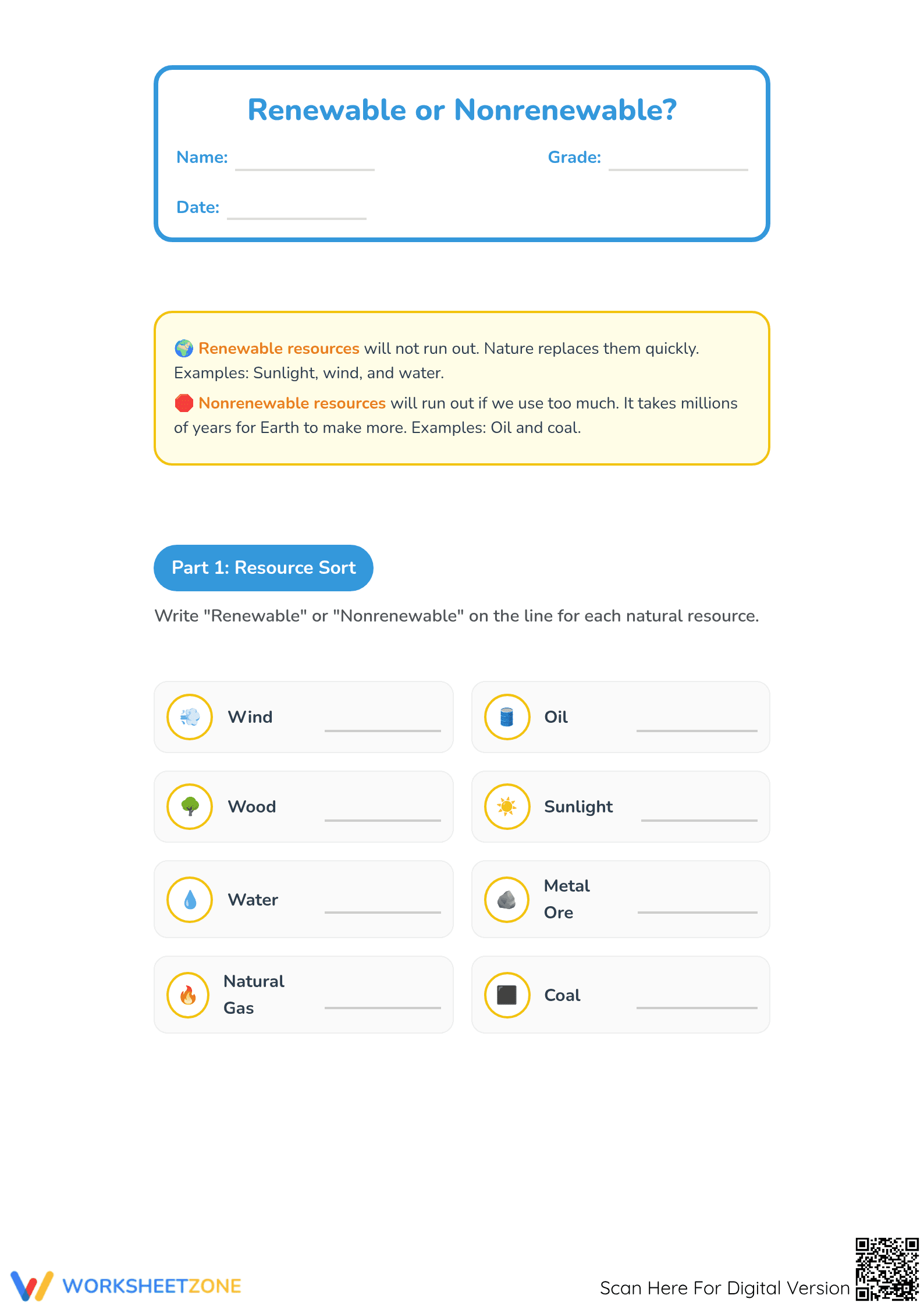
This is an educational worksheet designed to teach students about renewable and nonrenewable resources. It features a brief explanation of each type of resource. Students are asked to classify resources like wind, wood, oil, sunlight, water, and metal ore as either renewable or nonrenewable. The worksheet also prompts students to write how they use one renewable and one nonrenewable resource in their daily lives.
Grade Level Suitability:
This worksheet is suitable for grades 3-5. The concepts are presented in a simple manner, and the vocabulary is appropriate for this age range. The task of classifying resources and providing examples of their use is achievable for students in these grades.
Why Use It:
This worksheet helps students understand the difference between renewable and nonrenewable resources and encourages them to think about their own consumption habits. It promotes critical thinking and environmental awareness.
How to Use It:
Begin by reviewing the definition of renewable and nonrenewable resources with students. Then, have them individually classify each resource listed on the worksheet. Finally, guide them in reflecting on and writing about their own use of renewable and nonrenewable resources.
Target Users:
This worksheet is ideal for elementary school teachers teaching science or environmental studies. It can also be used by parents homeschooling their children or as a supplemental activity to reinforce classroom learning.
This is an educational worksheet designed to teach students about renewable and nonrenewable resources. It features a brief explanation of each type of resource. Students are asked to classify resources like wind, wood, oil, sunlight, water, and metal ore as either renewable or nonrenewable. The worksheet also prompts students to write how they use one renewable and one nonrenewable resource in their daily lives.
Grade Level Suitability:
This worksheet is suitable for grades 3-5. The concepts are presented in a simple manner, and the vocabulary is appropriate for this age range. The task of classifying resources and providing examples of their use is achievable for students in these grades.
Why Use It:
This worksheet helps students understand the difference between renewable and nonrenewable resources and encourages them to think about their own consumption habits. It promotes critical thinking and environmental awareness.
How to Use It:
Begin by reviewing the definition of renewable and nonrenewable resources with students. Then, have them individually classify each resource listed on the worksheet. Finally, guide them in reflecting on and writing about their own use of renewable and nonrenewable resources.
Target Users:
This worksheet is ideal for elementary school teachers teaching science or environmental studies. It can also be used by parents homeschooling their children or as a supplemental activity to reinforce classroom learning.


