


























Views
Downloads

Grade 3 Renewable Resources — Printable No-Prep Worksheet
Paste this activity's link or code into your existing LMS (Google Classroom, Canvas, Teams, Schoology, Moodle, etc.).
Students can open and work on the activity right away, with no student login required.
You'll still be able to track student progress and results from your teacher account.
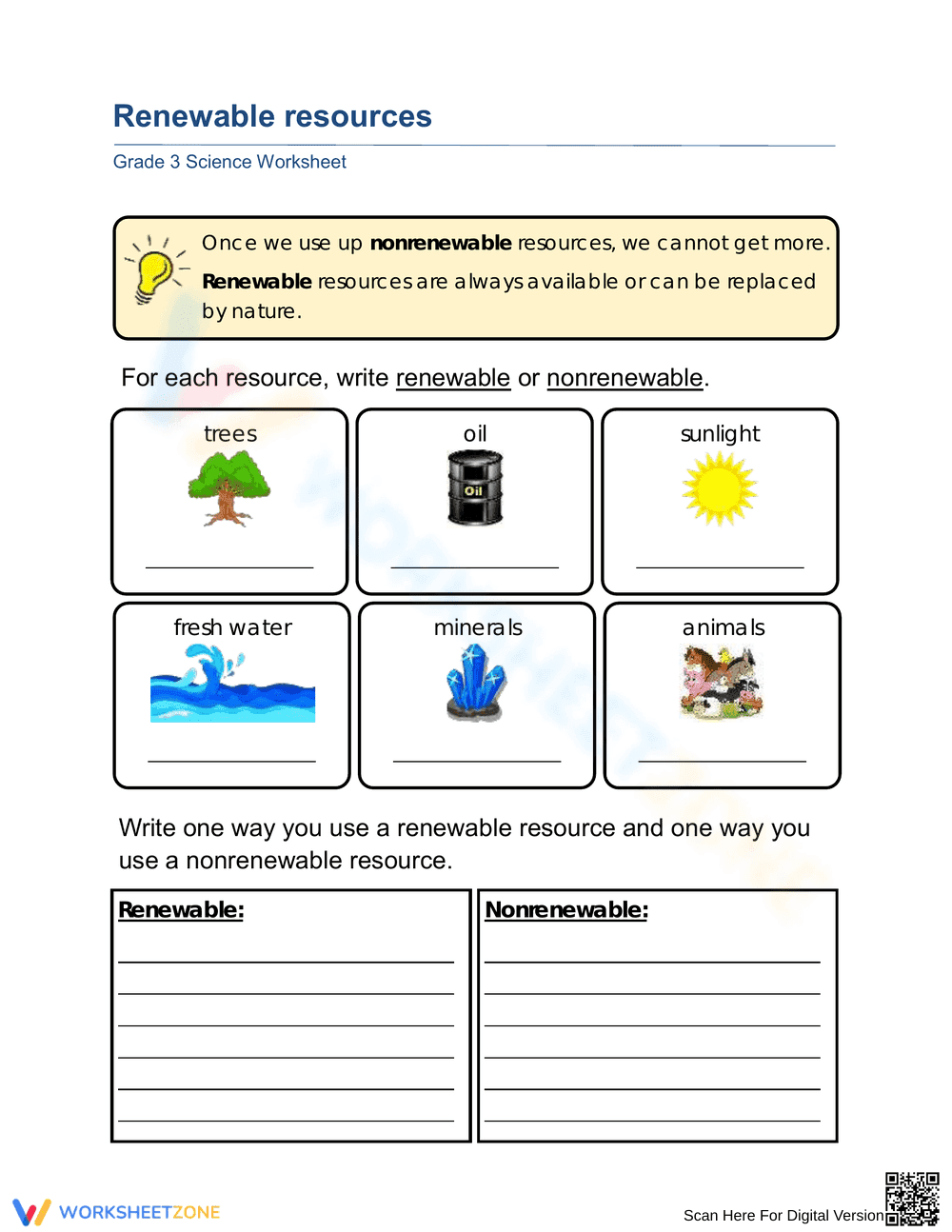
This Grade 3 science worksheet provides targeted practice in classifying natural resources. Students will identify common examples of renewable and nonrenewable resources and then apply their understanding by describing how they use each type in their daily lives. It's a fundamental introduction to resource management and environmental science concepts.
At a Glance
- Grade: 3 · Subject: Science
- Standard:
4-ESS3-1— Describe how energy and fuels from natural resources affect the environment.- Skill Focus: Classifying renewable and nonrenewable resources
- Format: 2 pages · 8 problems · Answer key included · PDF
- Best For: Independent practice, science centers, or substitute plans
- Time: 15–20 minutes
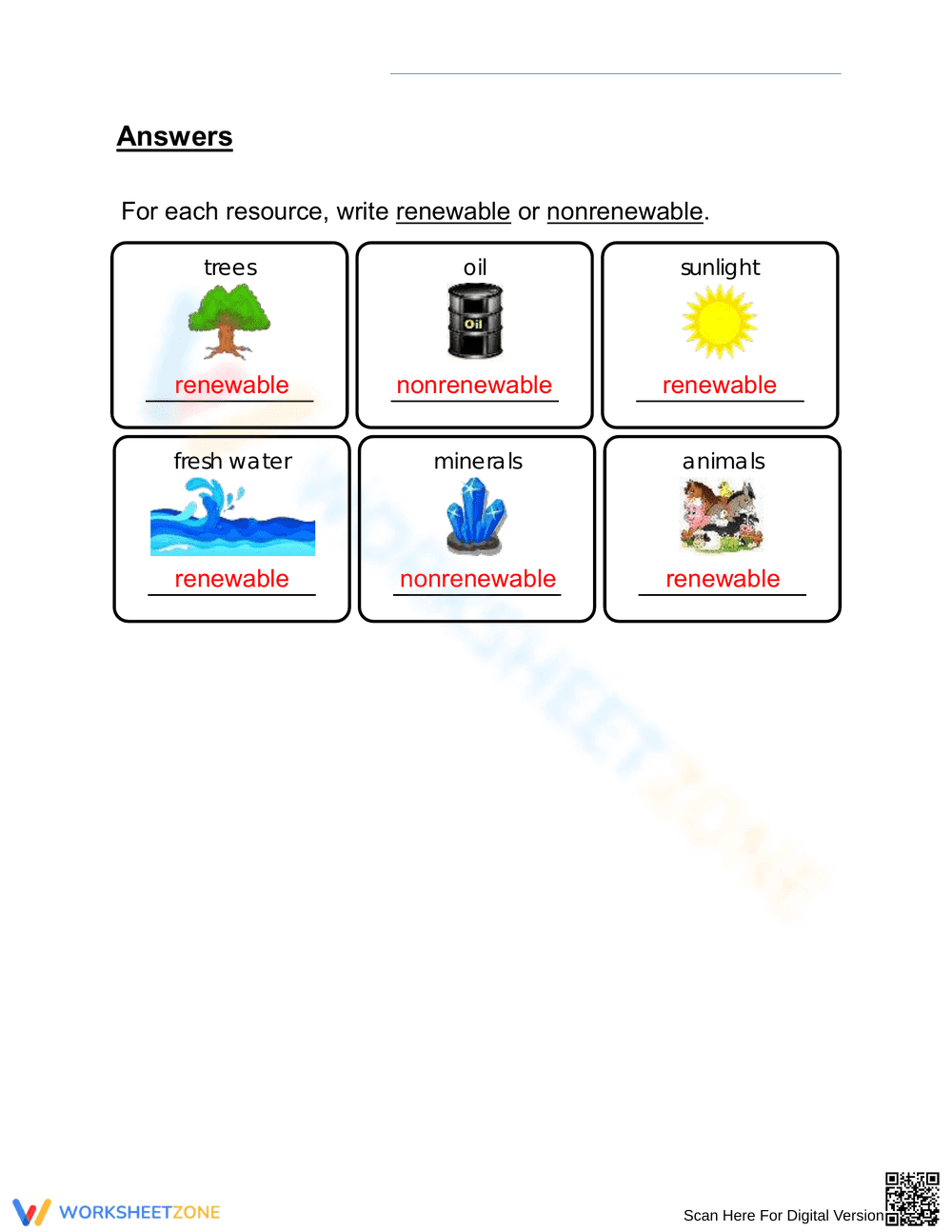
This resource is a two-page PDF with a student worksheet and answer key. It features definitions, a six-item classification task, and a two-part short-answer question connecting concepts to students' lives.
A Zero-Prep Workflow
Designed for busy classrooms, this worksheet is a true print-and-go resource. The workflow is simple:
- Print (1 min): A single student page and answer key are ready to go.
- Distribute (1 min): Clear instructions allow students to start working immediately.
- Review (5 mins): Use the provided answer key for quick grading or to lead a class review.
With under two minutes of total prep time, it's an ideal choice for substitute plans, science centers, or quick reinforcement.
Standards Alignment
This worksheet supports the Next Generation Science Standards (NGSS), introducing concepts for standard 4-ESS3-1. It serves as a foundational activity for the Grade 4 expectation that students describe how natural resources and their uses affect the environment, establishing the critical vocabulary needed for that analysis. The standard code can be copied directly into lesson plans or curriculum maps.
How to Use It
Use this worksheet for independent practice after a lesson on natural resources. Students can complete it at their desks or in a science center. For formative assessment, observe students' ability to connect resource types to personal examples in the short-answer section. Completion time is 15-20 minutes, making it a perfect warm-up or exit ticket.
Who It's For
This activity is designed for third-grade students being introduced to environmental science. The clear layout and visual aids support all learners. For a more comprehensive lesson, pair this worksheet with an anchor chart of resource examples or use it as a follow-up to a read-aloud about conservation.
Foundational knowledge of natural resources is a key component of elementary science education. This worksheet provides practice aligned with NGSS standard 4-ESS3-1, which requires students to understand that fuels from natural resources impact the environment. By learning to classify resources as renewable or nonrenewable, students build the vocabulary necessary for more complex environmental analysis. The format of this worksheet, combining classification with application, reflects the principle of active engagement. According to a comprehensive `EdReports 2024` analysis of science curricula, materials that connect scientific concepts to students' lived experiences lead to deeper and more durable understanding. The task requiring students to write how they use resources directly supports this evidence-based practice, moving beyond simple definition recall to personal connection and a first step toward scientific literacy in environmental decision-making.


