




























Views
Downloads
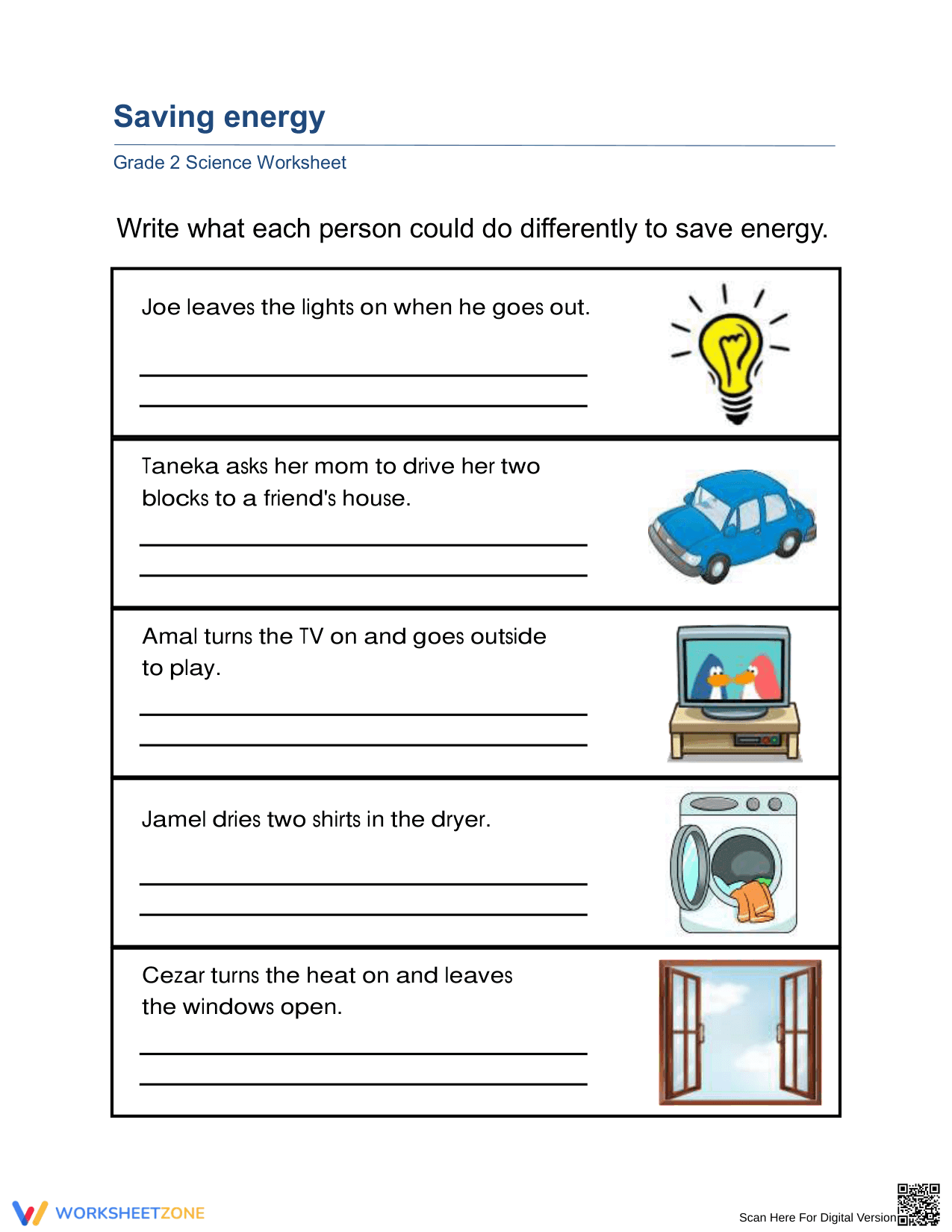

Grade 2 Saving Energy — Printable No-Prep Worksheet

Paste this activity's link or code into your existing LMS (Google Classroom, Canvas, Teams, Schoology, Moodle, etc.).
Students can open and work on the activity right away, with no student login required.
You'll still be able to track student progress and results from your teacher account.
This Grade 2 Saving Energy worksheet empowers students to identify and correct wasteful behaviors in everyday scenarios. By examining relatable situations—from leaving lights on to taking short car trips—learners develop a practical understanding of resource conservation. This activity fosters critical thinking about human impact on the environment through actionable problem-solving.
At a Glance
- Grade: 2 · Subject: Science
- Standard:
2-ESS3-1— Identify and propose solutions for human-driven environmental impacts on local resources- Skill Focus: Energy Conservation & Stewardship
- Format: 1 page · 5 problems · Answer key included · PDF
- Best For: Earth Day or Human Impact units
- Time: 15–20 minutes
What's Inside
Inside this printable PDF, you will find a focused one-page layout featuring five distinct illustrated scenarios. Each task presents a character engaging in an energy-wasting habit, followed by dedicated writing lines for students to draft their conservation solutions. The worksheet includes an answer key providing example responses to streamline the grading process for busy teachers.
Zero-Prep Workflow
- Step 1 (1 minute): Print the required number of copies for your class or small group.
- Step 2 (30 seconds): Distribute the pages as a morning warm-up or independent practice task.
- Step 3 (5 minutes): Review the collective responses during a closing discussion to share different saving strategies.
Total preparation time is under two minutes, making this an ideal choice for sub plans or last-minute lesson extensions.
Standards Alignment
This resource aligns directly with 2-ESS3-1, focusing on how human activities affect the environment and how stewardship can mitigate these effects. By requiring students to suggest improvements to existing behaviors, it targets the solution-oriented component of the standard. This standard code can be copied directly into lesson plans, IEP goals, or district curriculum mapping tools.
How to Use It
Use this worksheet as a formative assessment after a direct instruction lesson on natural resources. It also serves as an excellent science-focused writing prompt during literacy blocks. Observe students as they write to identify misconceptions about which appliances use electricity versus heat, allowing for immediate instructional pivots and clarifications. Expected completion time ranges from 15 to 20 minutes.
Who It's For
This activity is perfectly suited for second-grade students but can be used for differentiation in first or third grade. It provides enough visual support for English Language Learners and struggling readers to access the content. Pair this resource with a short informational text about the power grid or a video on renewable energy to provide broader context.
The Saving Energy worksheet for Grade 2 is a foundational tool for introducing environmental stewardship through the lens of NGSS 2-ESS3-1. By analyzing real-world scenarios like turning off lights or walking instead of driving, students move beyond rote memorization of conservation rules into the cognitive domain of evaluating human impact. This worksheet focuses on the plain-English skill of identifying how individuals can reduce energy waste in their daily lives. According to the NAEP Science Framework, engaging young learners in practical problem-solving regarding natural resources is critical for developing lifelong scientific literacy. The structure of this resource encourages critical thinking as students must propose specific, actionable alternatives to wasteful behaviors. It serves as an essential bridge between classroom theory and real-world application, ensuring that second graders understand their personal agency in protecting the environment. This alignment ensures that the material is both developmentally appropriate and scientifically rigorous for early elementary students.


