These 3rd grade fossils printable worksheets resources give students a precise vocabulary for fossil types, a clear mental model of the fossilization sequence, and practice making the evidence-based inferences that NGSS ESS1.C actually demands. Third grade is the point where students can begin reasoning about deep time abstractly but still need concrete grounding through labeled diagrams and structured sequencing — that developmental tension shapes how every worksheet in this collection is put together.
The Specific Skills Targeted
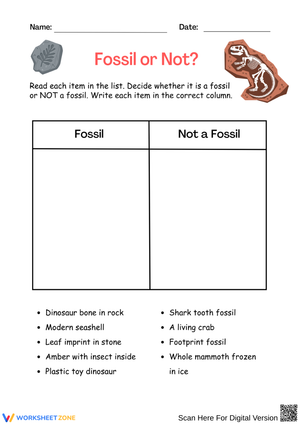
Each worksheet in this 3rd grade fossils printable worksheets collection focuses on one of four fossil types: mold fossils (an imprint left in hardened sediment), cast fossils (formed when minerals fill that mold), trace fossils (footprints, burrows, feeding marks), and body fossils, where actual hard parts such as bone, shell, or teeth survive the mineralization process. Students sort examples, label illustrated diagrams, and match fossil types to the conditions that produce them.
The sequencing worksheets ask students to arrange the fossilization process in order: organism dies, rapid burial by sediment, soft tissue decays, minerals slowly replace hard parts, sediment compresses into rock, erosion eventually exposes the fossil. That six-step sequence is where the real conceptual work happens. Understanding that fossilization takes millions of years — and that most organisms never fossilize at all — replaces the familiar "dinosaur graveyard" mental image with a more accurate picture of deep time and selective preservation.
The set includes five distinct worksheet formats:
- Fossil type identification: Students label diagrams of mold, cast, trace, and body fossils based on illustrations paired with written descriptions.
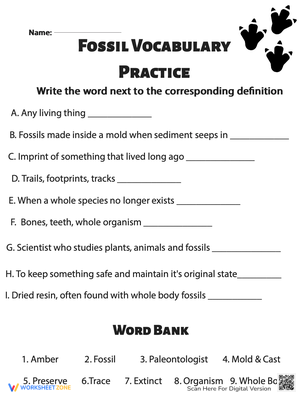
- Vocabulary fill-in-the-blank: Terms like paleontologist, sediment, mineral, extinct, and prehistoric appear in context-rich sentences that require more than simple recall.
- Fossilization sequencing: Students arrange the six-step process from organism death through fossil exposure — the format that surfaces the most diagnostic errors.
- Reading comprehension passages: Short, grade-level texts about fossil formation and what fossils reveal, followed by inference and recall questions.
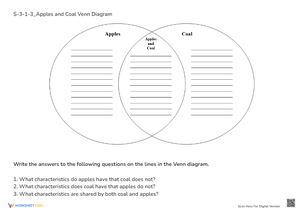
- Compare and contrast: Students use Venn diagram frames to set living organisms against their fossil counterparts, noting which features survive and which are lost.
Frequent Student Errors Worth Watching For
The mold-cast confusion is close to universal at this grade. Students who correctly define a mold fossil will still draw an arrow to the cast illustration and write "mold" — the terminology doesn't map onto anything familiar. Explicit contrast before the labeling worksheet goes out (mold is the hollow impression; cast fills it) keeps this error from hardening into a fixed misconception.
A subtler problem shows up in the sequencing activity. Students consistently place "minerals replace hard parts" immediately after "organism dies," collapsing the burial and decay steps entirely. They're not guessing randomly — they're applying a shortcut: dead thing becomes fossil. That specific transposition is diagnostic. When you see it in student work, those students need another pass at why rapid burial must come first before mineralization can begin.
There's also the artifact confusion worth heading off directly. Third graders will occasionally classify an arrowhead or pottery shard as a fossil because it's old and found underground. A fossil must be the remains or trace of a living organism — not an object made by people. This distinction comes up explicitly in the reading passages and is worth raising before students work independently, not after the misconception is already written down.
Lesson-Planning Moves That Get the Most From This Set
The vocabulary worksheets make strong Monday warm-ups after introducing a new fossil type the Friday before. That short retrieval gap — even just over a weekend — does more for retention than re-reading the same definition the following day. Students pull the word back rather than passively receiving it again.
Before students touch the sequencing worksheet, run a ten-minute kinesthetic activity. One student plays the organism; several others stand in around that student as sediment, stepping in one at a time while the class names each phase aloud. The physical reference point makes the written ordering noticeably more accurate afterward and reduces the "skip straight to mineralization" error described above. This works well in the window between morning meeting and the formal science block — no materials needed, done at the carpet.
The reading comprehension passages fit naturally into a literacy rotation. Each is short enough for a guided reading group to finish with time left for the follow-up questions, and the unfamiliar science vocabulary creates a real opportunity to practice context-clue strategies. Students who fake comprehension on familiar topics can't lean on background knowledge here — the content is genuinely new, which makes these passages formative reading assessments as much as science practice.
Standard Alignment
These worksheets support NGSS Disciplinary Core Idea ESS1.C: The History of Planet Earth, which at the upper elementary level asks students to analyze fossil evidence to describe the organisms and environments of the distant past. When a student examines a diagram of a fossilized fern and concludes that the site was once a warm, wet environment, that is exactly the move ESS1.C targets — using physical evidence to reason about past conditions, not just identifying vocabulary terms. The 3rd grade fossils printable worksheets activities are sequenced so that vocabulary and identification work come first, building the conceptual language students need before the inference tasks arrive.
Making This Set Work for Students at Different Levels
For students tripped up by academic vocabulary, pre-teaching four terms before the unit begins — sediment, mineral, organism, and extinct — removes the language barrier so students can focus on the science. A visible word wall during independent work helps these students move through fill-in-the-blank and sequencing tasks without losing their thread. The diagram and labeling worksheets are accessible even to students reading well below grade level because they rely primarily on visual matching rather than text decoding.
Students who move through the identification work quickly can go further into the inference layer: given a specific fossil find — a tropical fern, a coral reef organism, a deep-water fish — what does that reveal about the ancient climate and geography of that location? That extension connects directly to ESS1.C's analytical target and challenges students who have mastered fossil names to apply their knowledge to new evidence. The compare-and-contrast activities work particularly well here because distinguishing preserved features from lost ones is genuinely harder than labeling a diagram.
Frequently Asked Questions
Which fossil types do these worksheets cover?
The set covers mold fossils, cast fossils, trace fossils, and body fossils. Each type appears in the diagram labeling and sort-and-match activities, and the reading passages give students the context they need to distinguish between them in writing.
Can I use these for assessment, not just practice?
Yes. Labeling and vocabulary worksheets work well as exit tickets during the unit. A combination of matching and short-answer items from the set gives a clear picture of each student's understanding at the close of a paleontology unit. Some teachers use a labeling worksheet as a pre-assessment at the unit's start and repeat the same format at the end to show growth side by side.
How do these address the NGSS fossil evidence standard?
Each worksheet in the 3rd grade fossils printable worksheets set is built around the analytical reasoning in ESS1.C — using fossil data to describe ancient organisms and the environments they inhabited. Rather than stopping at identification, the reading passages and compare-and-contrast activities push students toward evidence-based inference, which is the actual cognitive target of the standard.
Do these work for students reading below grade level?
The reading passages are written at a third-grade level, but the diagram and sequencing worksheets are accessible to students working below grade level in reading because they rely on visual reasoning rather than text decoding. Reading a passage aloud to the group first, or pairing a below-level reader with a partner, addresses the access barrier without removing the science content those students need to engage with.












 Interactive Worksheet Maker
 Quiz Maker
 Word Search Maker
 Crossword Puzzle Maker
 Word Scramble Generator
 Sentence Scramble Generator
 Handwriting Worksheet Generator
 Name Tracing Generator
 Fill In The Blank Generator