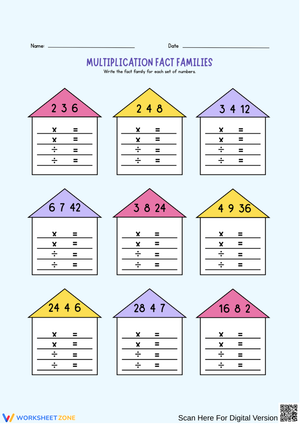
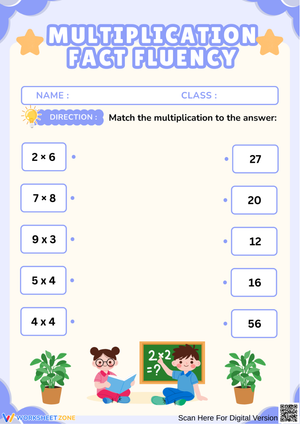
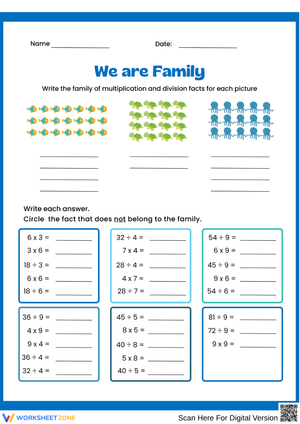
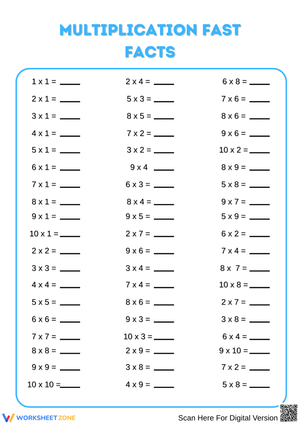
These multiplication printable worksheets for 3rd grade move through the full arc of third-grade multiplication — equal groups, arrays, fact families, the core properties, and applied word problems that ask students to decide which operation fits before they write a single number. Each worksheet targets one concept, which makes it straightforward to match the right printable to the right point in a unit rather than sorting through a mixed-topic packet.
Skills These Worksheets Build
Third grade is when multiplicative thinking first takes hold, and the worksheets reflect that developmental window. Students at this age can grasp the idea of equal groups before they can fluently recall facts, so the set moves from visual models toward abstract fluency rather than jumping straight to drills. The skills covered include:
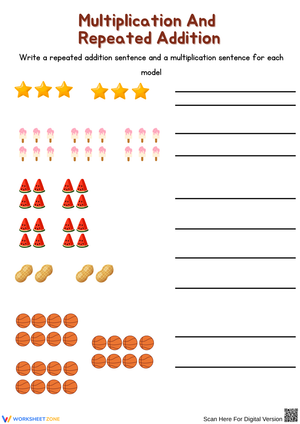
- Equal groups and repeated addition — matching multiplication sentences to group models and connecting the new operation back to addition students already know
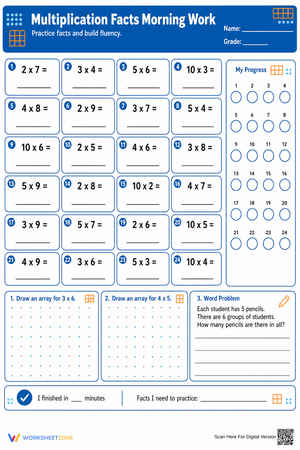
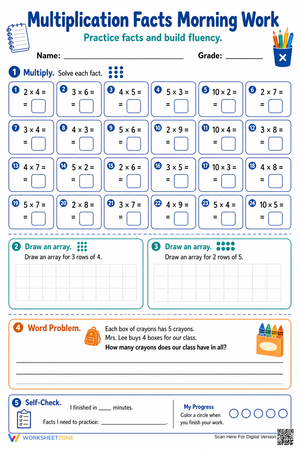
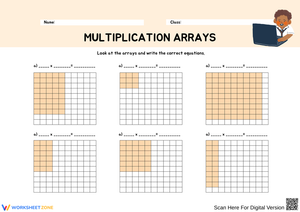
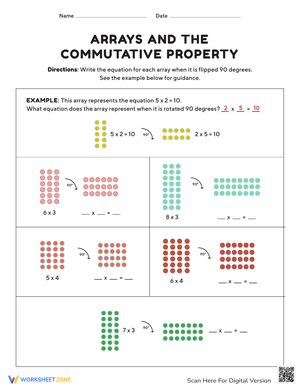
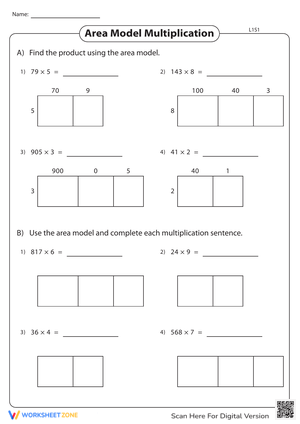
- Arrays — drawing rows and columns from a multiplication expression, reading array dimensions from a model, and writing the corresponding equation
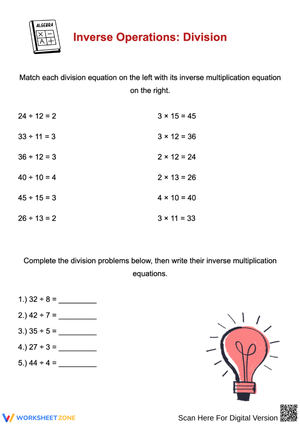
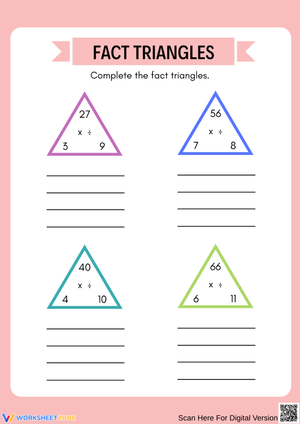
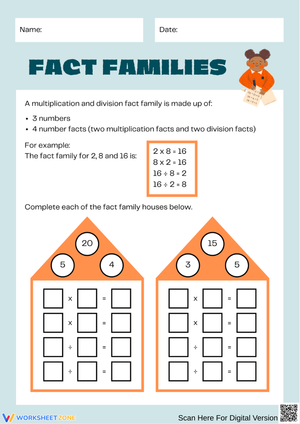
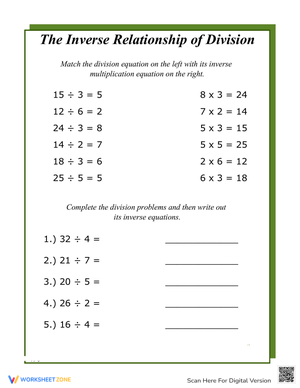
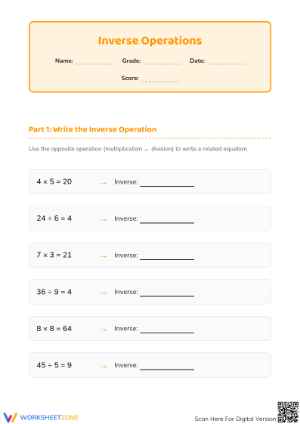
- Fact families — writing all four related equations from a set of three numbers (for example, 6, 4, and 24) to cement the inverse relationship between multiplication and division
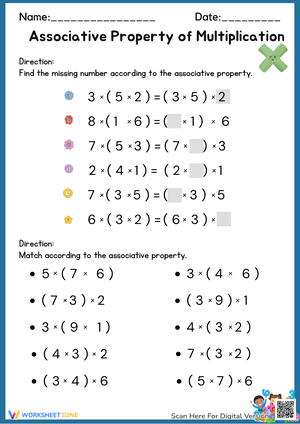
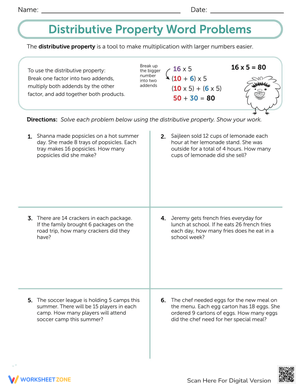
- Properties of multiplication — the Commutative, Associative, and Distributive properties applied to actual calculations, not just named and defined
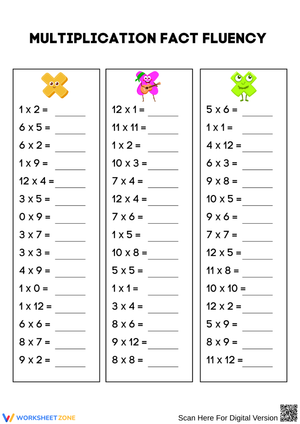
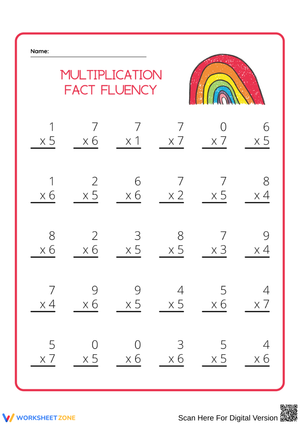
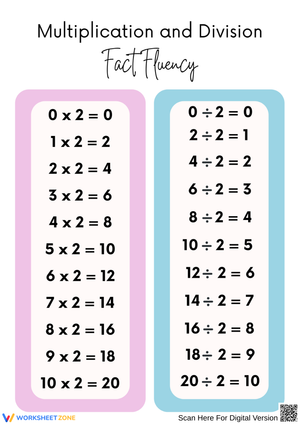
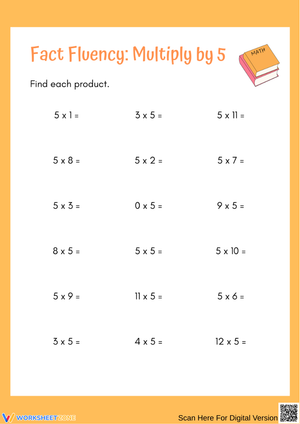
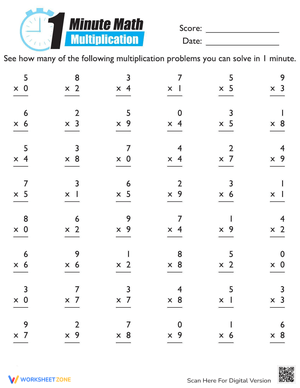
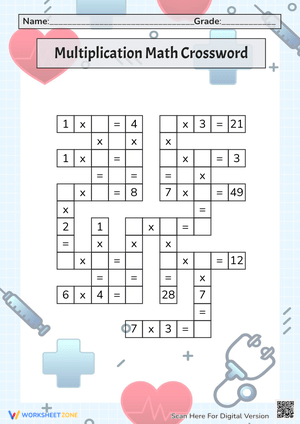
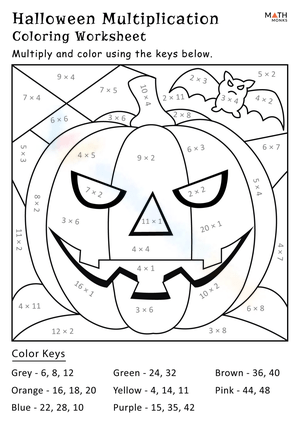
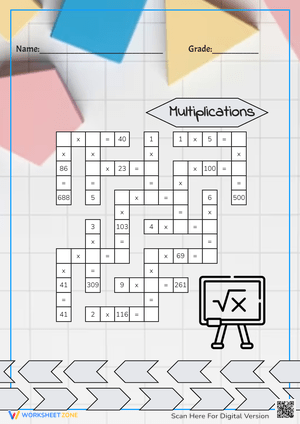
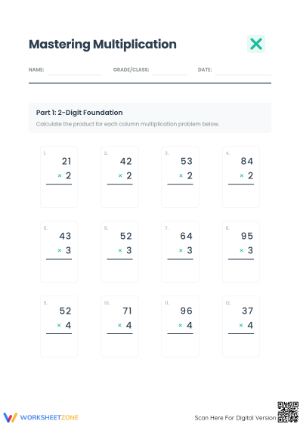
- Fluency drills — targeted practice organized by individual fact families, so teachers can assign the 4s this week and the 7s the next without jumping across all tables at once
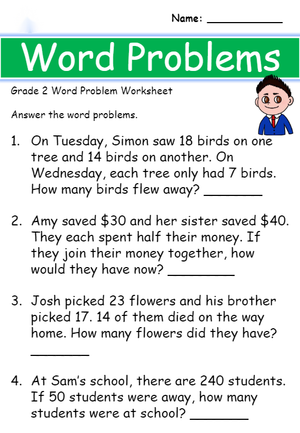
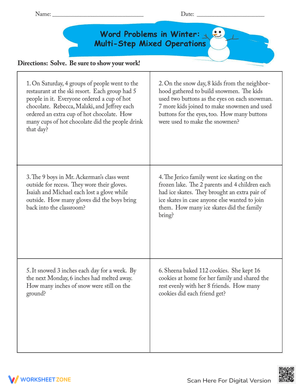
- Word problems — one- and two-step scenarios where students interpret equal-groups language and write the matching equation before solving
Patterns in Student Work Worth Knowing
Third graders make a handful of errors so consistently that you can almost predict them before collecting papers. The most common: students who draw an accurate array — say, 5 rows of 6 — then write the multiplication sentence as 6 × 5 rather than 5 × 6. They aren't mathematically wrong, and explaining the Commutative Property temporarily resolves it, but the confusion resurfaces in word problems. A student told "there are 5 bags with 6 apples each" should write 5 × 6 because the problem structure specifies groups first, even though the product is the same either way. The array worksheets address this directly by asking students to label which factor represents the number of groups and which represents items per group.
The 6s and 7s are the other consistent trouble zone. Students who have the 2s, 5s, and 10s solid will skip-count their way through the 6s and land on 42 or 48 depending on where they lose count — 6 × 7 is the fact that trips up the most students. That's worth a targeted fact-family worksheet on those three numbers alone rather than another full pass through the 6s table. A separate pattern shows up in word problems: students who spot two numbers in a sentence and add them immediately — "6 boxes, 8 crayons, the answer is 14" — even after direct instruction on identifying equal-group structure. Worksheets that include a step requiring students to underline the group language before writing an equation slow that reflex down.
How to Fit These Worksheets Into Your Teaching Week
The most consistent use pattern is pairing an array or equal-groups worksheet with the direct-instruction lesson where that concept is introduced, then returning to a fluency drill two or three days later as a warm-up. Spaced retrieval — coming back to a fact family after a short gap rather than drilling it to exhaustion in one sitting — produces better long-term retention than massed practice. The format supports that without extra planning: assign one fact-family worksheet on Tuesday, skip Wednesday, revisit with a timed drill on Friday.
Exit tickets are the other high-value use. Pulling two or three problems from one of the multiplication printable worksheets for 3rd grade at the end of a lesson gives an immediate read on who has the concept and who is still guessing. That five-minute check prevents a week of re-teaching caused by assuming mastery that wasn't there. For math centers, the array and word-problem worksheets run well at independent stations while the teacher pulls a small group — both formats carry enough visual or contextual structure that students can work without constant questions.
Standard Alignment
The worksheets address three standards within the Common Core Operations and Algebraic Thinking domain for Grade 3. 3.OA.A.1 requires students to interpret products of whole numbers — the equal-groups and array worksheets sit directly inside this standard, asking students to explain what each factor represents in context, not just compute an answer. 3.OA.B.5 covers the properties of multiplication; the Distributive Property worksheets ask students to decompose a factor (breaking 7 × 8 into (5 × 8) + (2 × 8)) before solving, which is more instructionally useful than simply naming the property. 3.OA.C.7 calls for fluency within 100 using both multiplication and division — the fact-family drills target this standard directly and generate formative data teachers can use for reporting or for identifying which students need additional support before the unit ends.
Differentiating the Worksheets Across Ability Levels
For students who are still building the concept, the array worksheets offer a natural entry point because the visual structure carries some of the cognitive load — students can count rows and columns directly rather than holding the multiplication relationship in working memory alone. Have those students color or mark individual cells in an array before writing the equation. That keeps the problem concrete long enough to build the connection between the visual model and the abstract expression.
Students who have the basic facts secured can move into the Distributive Property worksheets and multi-step word problems. A useful extension: after completing a word problem, ask the student to rewrite it with different numbers but the same structure. That task checks whether the student understands the problem type or simply found the right numbers by feel. The multiplication printable worksheets for 3rd grade word-problem format leaves enough white space for this kind of annotation without requiring a separate sheet.
Frequently Asked Questions
Do these worksheets cover division as well as multiplication?
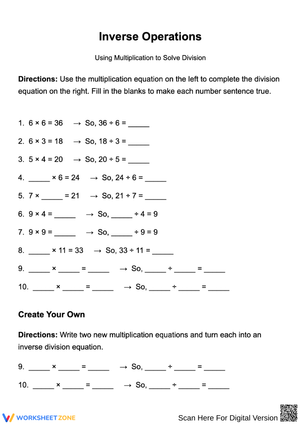
The fact-family worksheets address both. Because 3.OA.C.7 expects fluency with both operations within 100, the fact-family format pairs each multiplication equation with its two corresponding division equations. Students who work out 6 × 4 = 24 are prompted to write 24 ÷ 6 = 4 and 24 ÷ 4 = 6 on the same worksheet, building the inverse relationship without requiring a separate division unit.
Can these work as assessment tools rather than just practice?
Yes. The fact-family and word-problem worksheets function well as formative checks when you pull a few representative problems rather than assigning each worksheet in full. Using them as exit tickets gives you sortable data: a student who writes repeated addition instead of a multiplication sentence on day ten of the unit needs a different next step than a student who sets up the equation correctly but computes the wrong product.
How should the worksheets be sequenced within a multiplication unit?
Start with equal groups and arrays to build the visual and conceptual base. Move to fact families once students can write a multiplication sentence from a model. Introduce the properties after students have some fact fluency — the Distributive Property in particular makes more sense once students already know that 5 × 6 = 30, because they can verify that (5 × 3) + (5 × 3) gives the same result. The multiplication printable worksheets for 3rd grade in this set are labeled clearly enough that you can follow this sequence without a separate pacing guide.













 Interactive Worksheet Maker
 Quiz Maker
 Word Search Maker
 Crossword Puzzle Maker
 Word Scramble Generator
 Sentence Scramble Generator
 Handwriting Worksheet Generator
 Name Tracing Generator
 Fill In The Blank Generator