


























Views
Downloads

Printable Inverse Operations Worksheet | Grade 3 Math
Paste this activity's link or code into your existing LMS (Google Classroom, Canvas, Teams, Schoology, Moodle, etc.).
Students can open and work on the activity right away, with no student login required.
You'll still be able to track student progress and results from your teacher account.
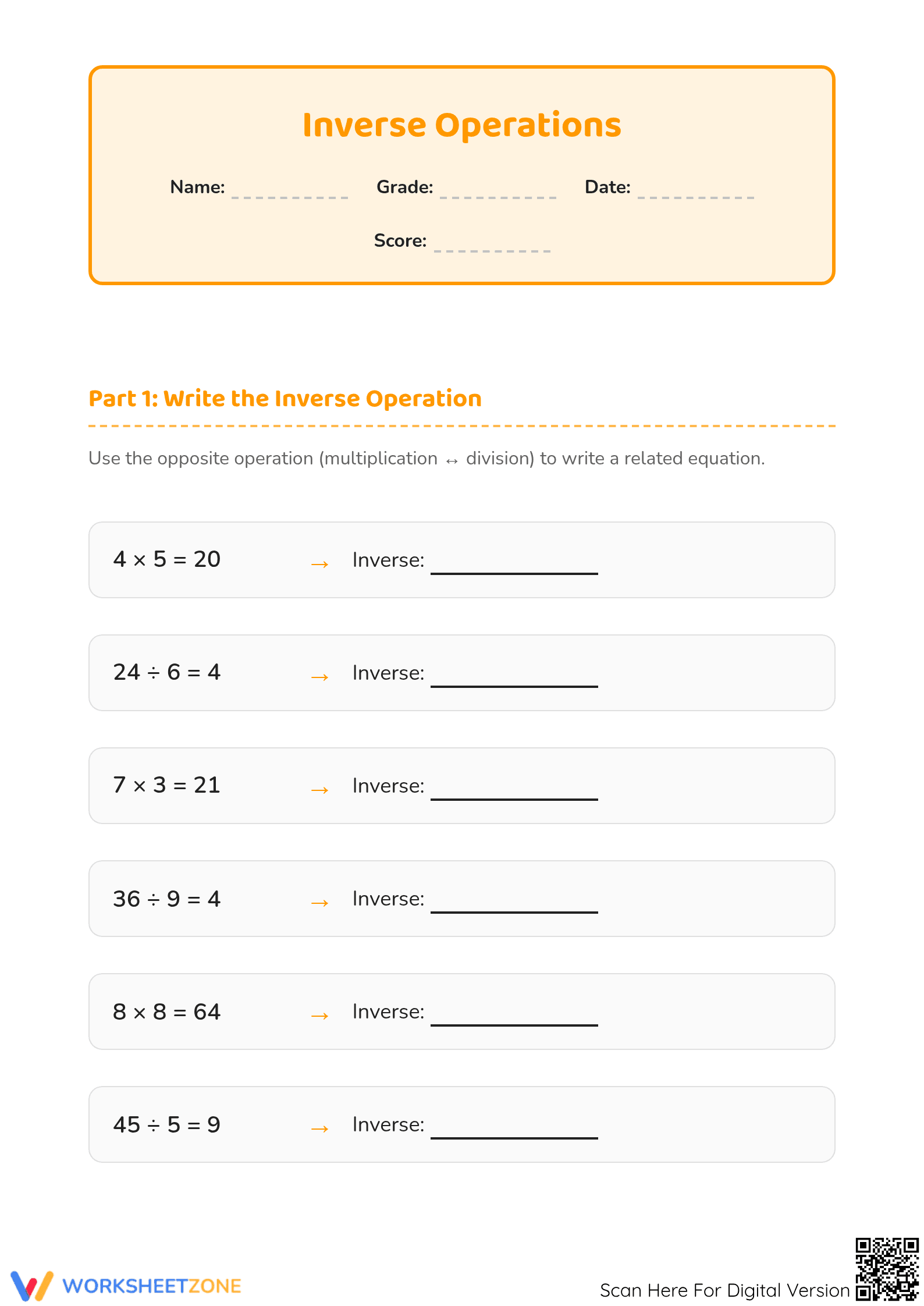
This Inverse Operations worksheet strengthens mathematical fluency by highlighting the reciprocal relationship between multiplication and division. Students practice converting equations and building fact families to deepen their conceptual understanding. By mastering these connections, learners develop the mental flexibility required for multi-step arithmetic and algebraic thinking.
At a Glance
- Grade: 3 · Subject: Math
- Standard:
CCSS.MATH.CONTENT.3.OA.C.7— Fluently multiply and divide within 100 using the relationship between operations- Skill Focus: Multiplication-Division Inverses & Fact Families
- Format: 2 pages · 24 problems · Answer key included · PDF
- Best For: Small group reinforcement or independent practice
- Time: 15–20 minutes
What's Inside
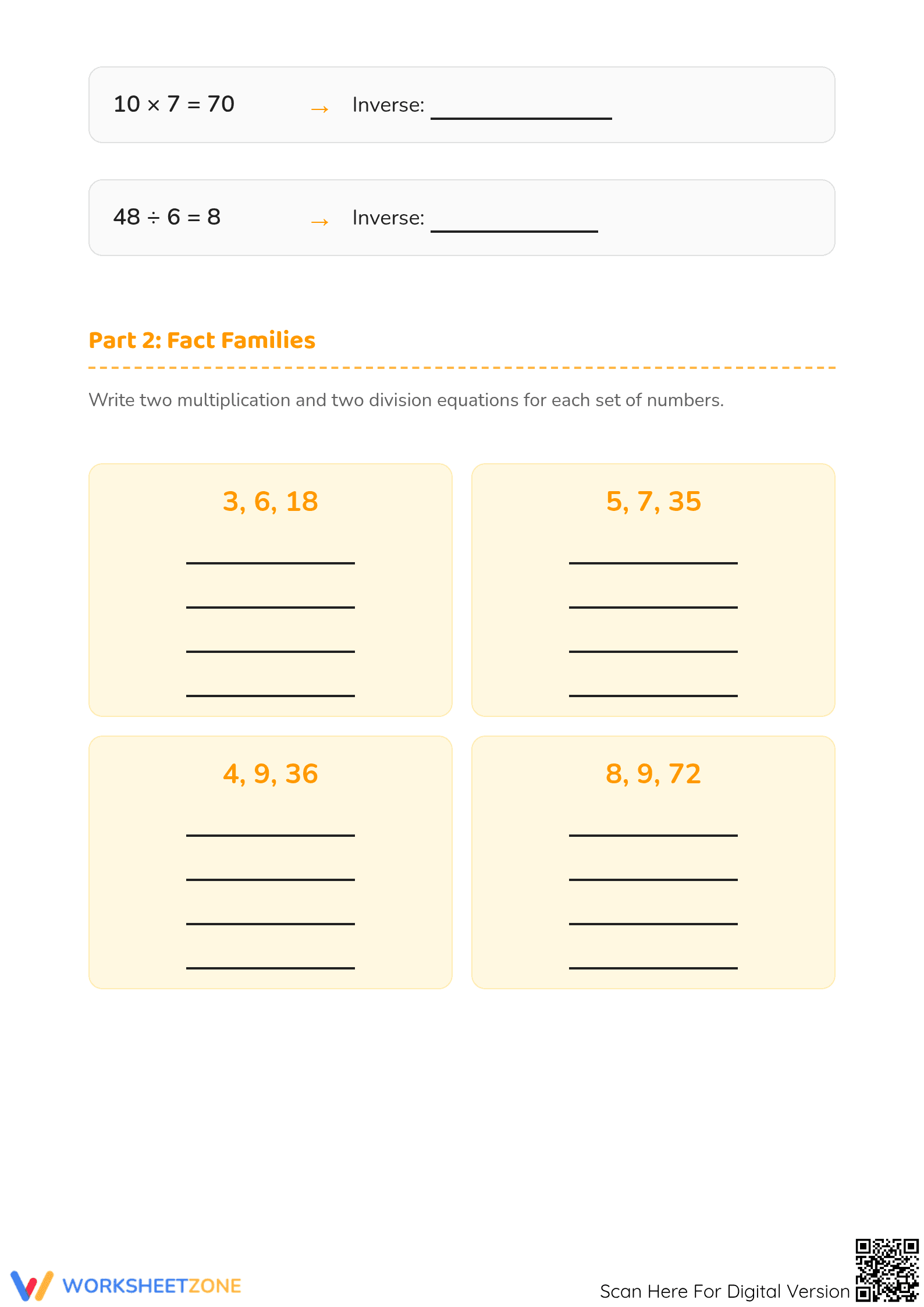
The two-page resource contains two distinct instructional parts designed to build procedural accuracy. Part one provides eight equations where students must write the corresponding inverse operation. Part two features four comprehensive fact family sets, requiring students to generate four related equations for each numerical trio. The layout is clean and spacious, including dedicated fields for student names and scores, alongside a complete answer key for rapid grading.
Skill Progression
- Guided Practice: The worksheet begins with inverse operation transformations (8 tasks), allowing students to focus on the mechanical shift between symbols while maintaining numerical relationships.
- Supported Practice: Learners progress to fact family construction (4 sets), using given numbers to build a mathematical system, scaffolding their understanding of factor-product interaction.
- Independent Application: Final tasks require students to synthesize knowledge by generating equations without prompts, demonstrating mastery of the standard.
This follows a gradual-release model, moving from structured identification to independent generation of related numerical sentences.
Standards Alignment
The primary alignment is CCSS.MATH.CONTENT.3.OA.C.7: "Fluently multiply and divide within 100, using strategies such as the relationship between multiplication and division." This resource also supports 3.OA.B.6, which emphasizes understanding division as an unknown-factor problem. Both standard codes can be copied directly into lesson plans, IEP goals, or district curriculum mapping tools to ensure instructional coherence across the math curriculum.
How to Use It
This worksheet is ideal as a mid-lesson check during a unit on operations. Teachers can use the first page as a "guided exit ticket" to verify if students can identify the inverse operation. During instruction, observe if students correctly identify the product as the dividend in division. Expected completion time is 15 to 20 minutes.
Who It's For
The material is tailored for third-grade students working on multiplication fluency and fourth-grade students needing remediation. It provides excellent support for English Language Learners through symbolic math rather than dense word problems. For best results, pair this with an anchor chart showing a "fact family triangle" to help students visualize number connections.
Effective math instruction relies on students recognizing that operations are not isolated events but parts of an interconnected system. According to Fisher & Frey (2014) in their research on the gradual release of responsibility, providing structured practice that highlights the relationship between inverse operations is critical for building long-term retention. This worksheet addresses the CCSS.MATH.CONTENT.3.OA.C.7 standard by requiring students to fluently navigate these relationships through 24 targeted tasks. By focusing on both simple transformation and fact family generation, students move beyond rote memorization toward a conceptual understanding of number interactions. This approach is supported by the NAEP framework, which identifies mathematical connections as a key indicator of proficiency. The inclusion of an answer key ensures that students receive immediate feedback, further reinforcing correct mathematical models and preventing misconceptions.


