


























Views
Downloads
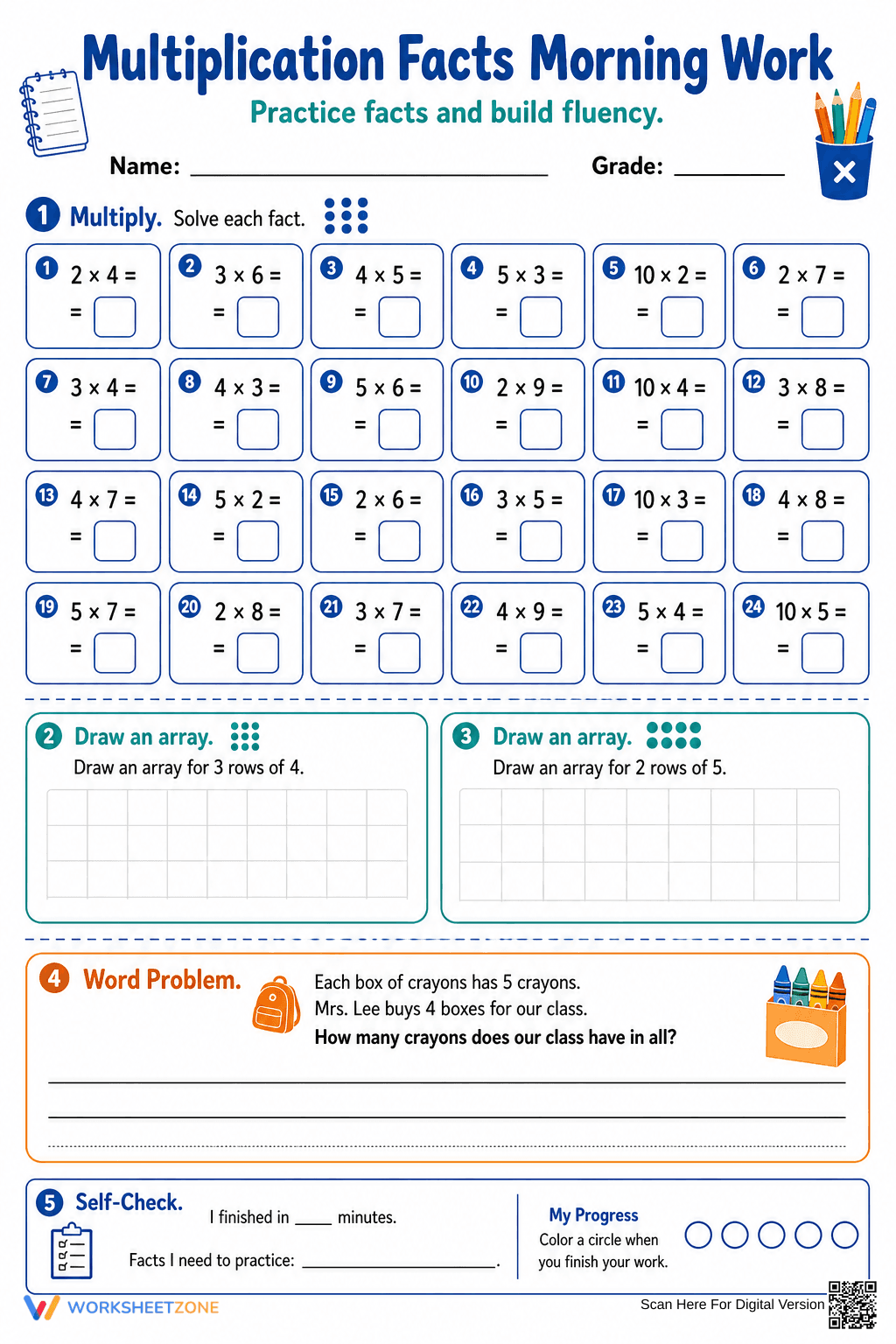

Multiplication Facts Morning Work | Grade 3 Essential
Paste this activity's link or code into your existing LMS (Google Classroom, Canvas, Teams, Schoology, Moodle, etc.).
Students can open and work on the activity right away, with no student login required.
You'll still be able to track student progress and results from your teacher account.
This Grade 3 multiplication worksheet helps students master basic facts through 27 targeted exercises. By combining mental math with visual array modeling, learners build the conceptual foundation necessary for multi-digit operations. The structured layout ensures students remain engaged while developing the automaticity required for higher-level mathematics and problem-solving.
At a Glance
- Grade: 3 · Subject: Math
- Standard:
CCSS.MATH.CONTENT.3.OA.C.7— Fluently multiply and divide within 100 using strategies such as relationship between multiplication and division- Skill Focus: Multiplication Fluency & Arrays
- Format: 1 page · 27 problems · Answer key included · PDF
- Best For: Morning work or daily warm-ups
- Time: 10–15 minutes
This single-page PDF features 24 vertical multiplication facts focusing on the 2, 3, 4, 5, and 10 families. Below the fluency drill, students encounter two dedicated grid spaces for drawing arrays, reinforcing the connection between repeated addition and multiplication. A final word problem involving classroom supplies provides real-world context, while a self-check footer allows students to track their completion time and identify specific facts for future review.
The zero-prep workflow is designed for maximum efficiency in busy classrooms. Teachers can print the single-sheet PDF in less than 30 seconds. Distribution takes approximately 1 minute during the morning transition. Students typically complete the 27 tasks within a 10-minute window, allowing for a quick 2-minute whole-class review of the word problem and array drawings before moving into the core math block.
The primary focus is `CCSS.MATH.CONTENT.3.OA.C.7`, which requires students to fluently multiply and divide within 100. By the end of Grade 3, students should know from memory all products of two one-digit numbers. This resource also supports `CCSS.MATH.CONTENT.3.OA.A.1` by utilizing arrays to represent products of whole numbers. Both standard codes can be copied directly into lesson plans, IEP goals, or district curriculum mapping tools.
Use this worksheet as a consistent bell ringer to establish a calm morning routine while reinforcing essential numeracy. It also serves as an excellent formative assessment tool; observe students as they draw the arrays to identify those who still rely on counting individual dots versus those who understand row-column structure. Expect completion within 10 to 15 minutes depending on student fluency levels.
This resource is tailored for third-grade students beginning their multiplication journey, but it also serves as a valuable intervention tool for fourth or fifth graders needing fluency maintenance. It pairs naturally with physical manipulatives like counters or base-ten blocks for students who require concrete modeling before transitioning to the abstract facts presented on the page.
According to Fisher & Frey (2014), the gradual release of responsibility model is most effective when students have frequent opportunities for independent practice of foundational skills like multiplication. This worksheet aligns with that research by providing a high-volume, low-stakes environment for students to build the automaticity required by CCSS.MATH.CONTENT.3.OA.C.7. Research from the NAEP suggests that students who master basic multiplication facts early demonstrate significantly higher success rates in middle-school algebra. By integrating 27 varied tasks—including fluency drills, visual arrays, and contextual word problems—this resource ensures that students move beyond rote memorization toward a deep, conceptual understanding of mathematical operations. This balanced approach is essential for meeting the rigorous demands of modern state standards and preparing students for complex multi-step problem solving in later grades.


