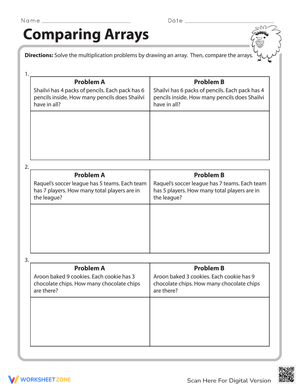
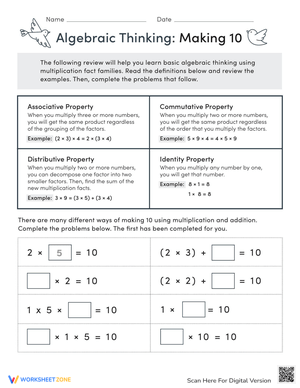
These properties of multiplication printable worksheets for 3rd grade isolate each of the five core properties — commutative, associative, distributive, identity, and zero — so teachers can sequence instruction deliberately rather than lumping everything into one unit block. The set moves from visual models, including arrays and split area diagrams, into symbolic equation writing, which mirrors how third graders actually build abstract reasoning. If you've watched a student stare at 8 × 7 with no strategy available, you know what happens when property instruction gets rushed past.
Skills These Worksheets Build
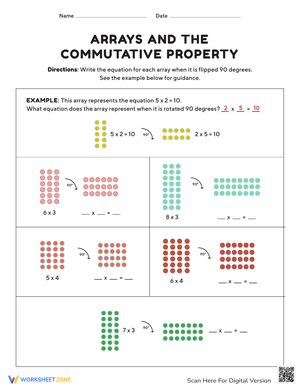
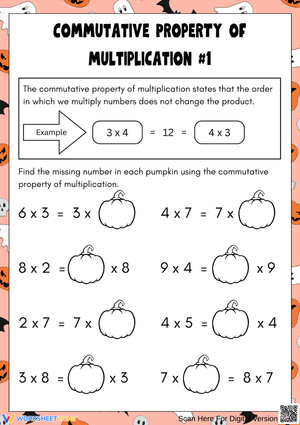
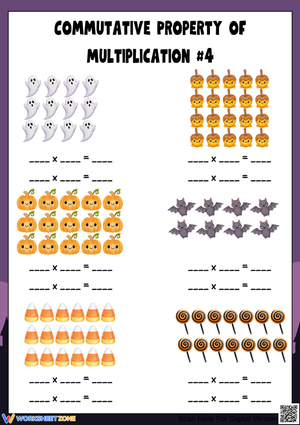
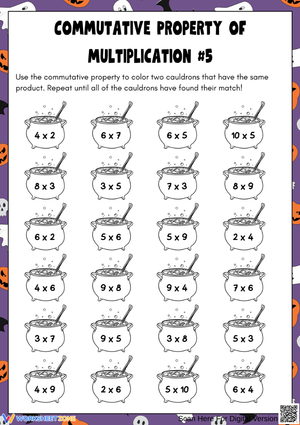
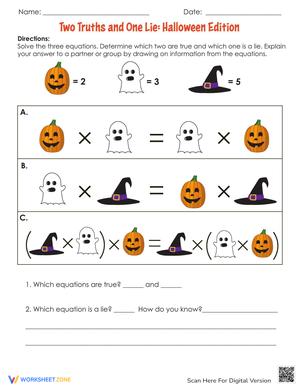
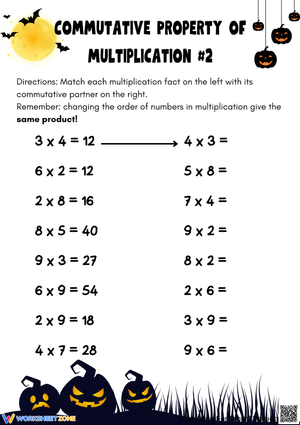
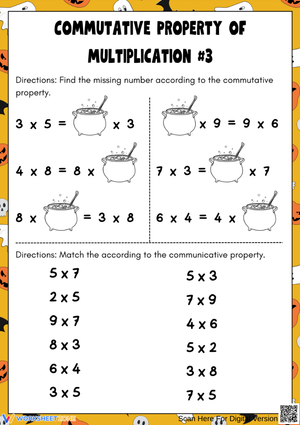
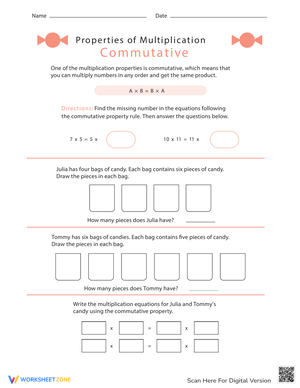
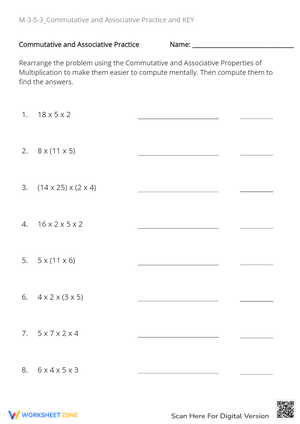
The commutative property worksheets ask students to write two separate equations from a single array and to match equivalent expressions from a scrambled list. The underlying goal is practical: a student who has 9 × 2 memorized should reach for that fact when they see 2 × 9, rather than treating it as an unrelated problem. That habit doesn't form without explicit practice.
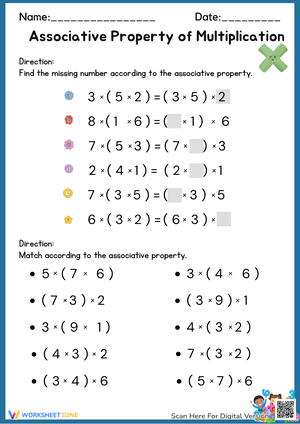
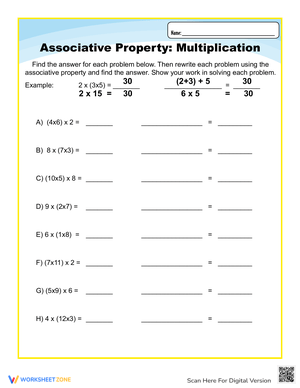
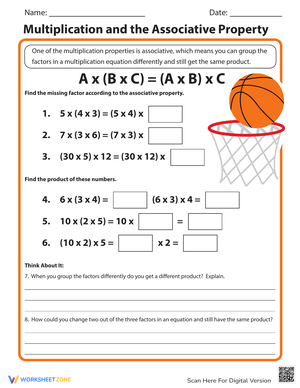
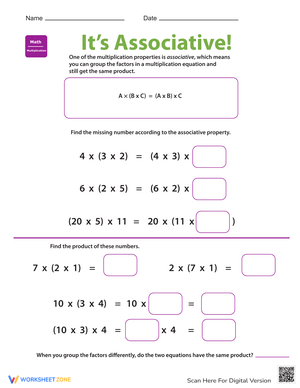
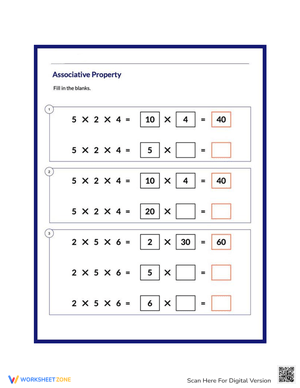
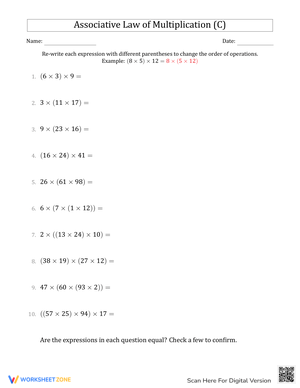
Associative property worksheets present three-factor equations with different parenthetical groupings. Students identify which grouping is easier to compute, then verify that both produce the same product. The problem (7 × 2) × 5 versus 7 × (2 × 5) looks straightforward on paper, but most third graders default to left-to-right calculation by habit and miss the friendlier route entirely.
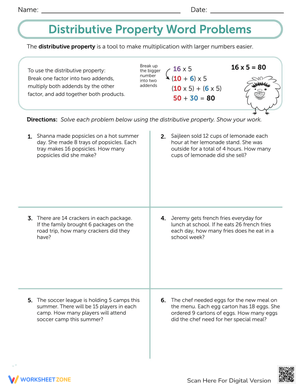
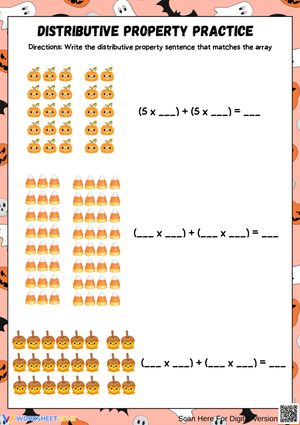
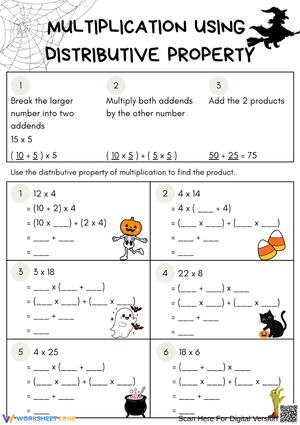
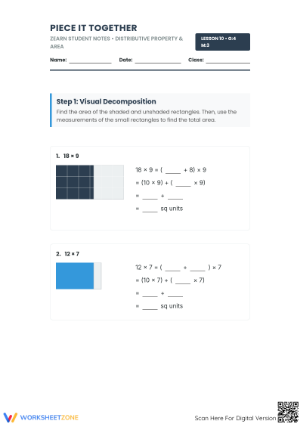
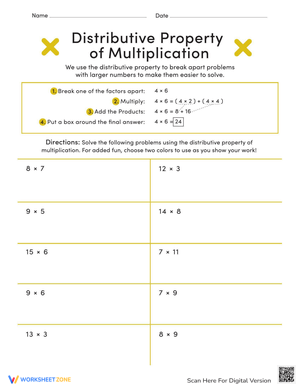
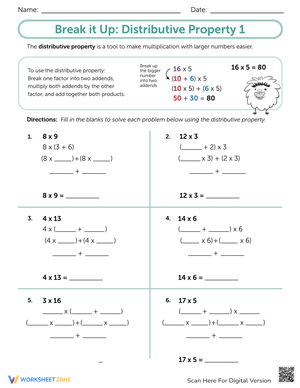
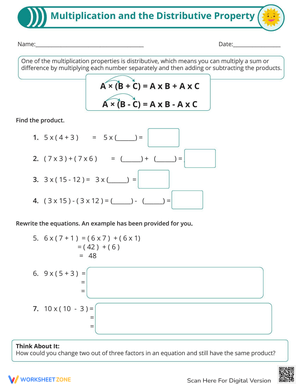
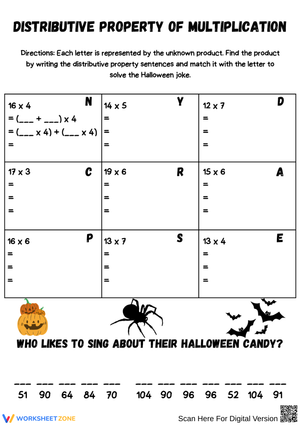
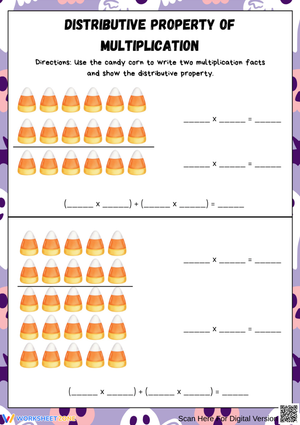
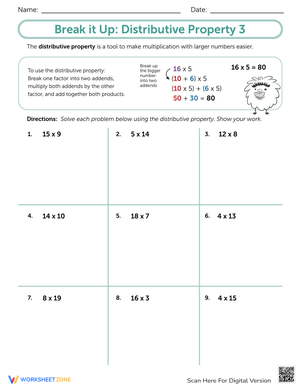
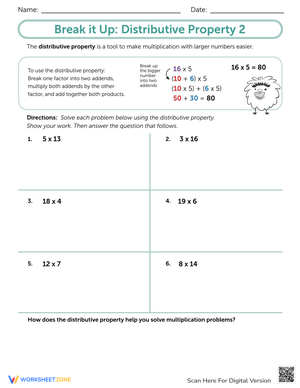
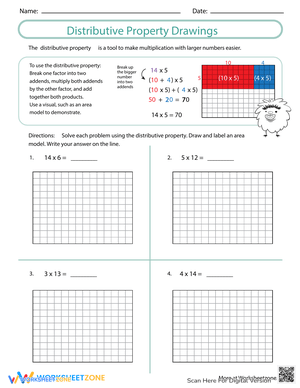
Distributive property worksheets open with pre-split area models — a rectangle already divided into two labeled sections — and move toward student-chosen decompositions as the sequence progresses. By the later worksheets, students are deciding how to break apart a factor themselves rather than following a given partition. That shift is where the skill becomes genuinely transferable.
Identity and zero property worksheets are brief on purpose. A short sorting task — grouping equations by whether the product equals the original factor, equals zero, or neither — surfaces the mix-up between the two properties early, before it causes trouble in more complex work later in the unit.
Mistakes Students Make That These Worksheets Help You Catch
The commutative property error isn't usually conceptual — most third graders accept that 4 × 3 = 3 × 4 without much resistance. What shows up in actual student work is something different: a student who answers 6 × 8 correctly will sometimes leave 8 × 6 blank on that same worksheet, apparently treating the reversal as a new, unrelated fact. Showing that student their own two entries side by side lands better than restating the rule.
With the associative property, the persistent issue is left-to-right calculation habit. Students work through 7 × 5 × 2 as (7 × 5) × 2, landing on 35 × 2, when (7 × 2) × 5 produces 14 × 5 — a far more manageable computation for a third grader. These worksheets include items that require students to name which grouping they used, making that habit visible in the written work rather than invisible in mental shortcuts.
The distributive property produces the most stubborn error: students correctly split a factor but then multiply only one part and add the other, rather than multiplying both. For a problem like 6 × (5 + 3), the faulty work ends up as (6 × 5) + 3 = 33. Area model formats make this error harder to commit because each rectangular region has to be labeled and computed separately before anything gets combined. Having students shade each section in a different colored pencil — one color for the 5 × 6 area, another for the 3 × 6 area — gives them a visual separation that keeps the two partial products from collapsing into each other.
Lesson-Planning Ideas to Get the Most From These Worksheets
The commutative and identity property worksheets fit inside the first ten minutes of math block — most third graders move through them quickly, and they work well as warm-up reviews after a long weekend or break when prior learning needs a brief refresh. The distributive property worksheets need more instructional context. Use them in the main lesson, directly after whole-group instruction, while the area model on the board is still visible. That timing keeps cognitive demand manageable: students aren't holding the visual structure in working memory while simultaneously trying to parse a new procedure.
In a center rotation, the commutative property sorting tasks run without teacher oversight once students have had a guided introduction. Associative property worksheets are worth pulling into small group — two students who choose different groupings and arrive at the same answer often need a few minutes to process why that happened, and facilitating that exchange does more than independent seatwork would. These properties of multiplication printable worksheets for 3rd grade also function as quick formative checkpoints: a two-minute scan of the distributive property work tells you precisely who is computing both partial products and who is adding one instead of multiplying it.
Standard Alignment
These worksheets address CCSS.MATH.CONTENT.3.OA.B.5, which asks students to apply properties of operations as strategies to multiply and divide. That standard sits in the Operations and Algebraic Thinking domain and serves as the instructional bridge between basic fact fluency and the flexible numerical reasoning students need in grades 4 and 5. The distributive property work here also supports CCSS.MATH.CONTENT.3.OA.B.6, which connects division to unknown-factor thinking — a student who can decompose 7 × 8 into (7 × 5) + (7 × 3) has already started treating multiplication as a structure to work with rather than a list of answers to recall.
Differentiating These Worksheets Across Your Class
For students still developing fact fluency, the commutative and associative worksheets work just as well with a multiplication chart available. The learning target in those worksheets is property recognition and application, not recall speed — removing the recall pressure keeps the focus where it belongs. Students who can work without a chart should do so, but offering it is a fair adjustment for those who need it.
Students who move through the set quickly can be asked to generate their own examples: write three equations demonstrating the associative property using factors you choose, then explain which grouping you used and why. That shifts the task from recognition to production, a meaningful increase in rigor that costs nothing to set up. For students working well beyond grade level, the properties of multiplication printable worksheets for 3rd grade in this set can be reframed as strategy tools — use the distributive property to find facts not yet memorized — turning the exercise into flexible number sense work rather than unit review.
Students who freeze when they see equations with parentheses for the first time — a genuine response, not an uncommon one — benefit from building the area model with physical square tiles before writing any equations. The format pairs the diagram and the equation on the same worksheet, which gives those students a consistent visual anchor to return to rather than toggling between a separate manipulative and the written task.
Frequently Asked Questions
How do I introduce the Distributive Property to a third grader who has never seen it?
Frame it as breaking one hard problem into two easy ones you already know. Draw a large rectangle, split it with a vertical line, and label each section. For 7 × 6, the split might be a 5 × 6 section and a 2 × 6 section — two facts most third graders already have. Students calculate each area and add: 30 + 12 = 42. Having them shade each section in a different color makes the decomposition visible rather than abstract, and the two-color area model carries directly into the written equation.
What's a reliable way to help third graders tell apart the Commutative and Associative properties?
Anchor each term to its plain-language meaning. Commutative: the numbers change position, the way a person commutes between two places. Associative: the parentheses shift which numbers group together, the way people associate in different pairs. A quick self-check — "did the numbers move, or just the parentheses?" — gives students an independent monitoring step they can apply on any problem. That question also works well posted in the classroom during the unit.
Is it worth spending instructional time on properties when students still need more fact practice?
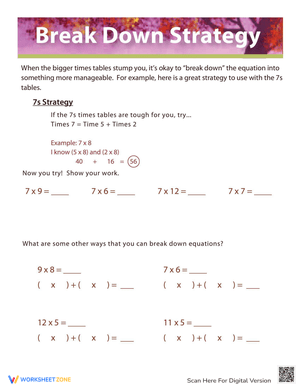
Properties give students a recovery strategy that memorization alone doesn't. A student who forgets 8 × 7 mid-assessment can decompose it into (8 × 5) + (8 × 2) and still arrive at 56. A student relying only on recalled facts has no fallback. The reasoning pattern that underlies these properties also reappears in multi-digit multiplication, fraction computation, and algebraic expressions — the time invested in third grade compounds across multiple later units.
Can these worksheets be sent home as homework, or do they work better in class?
The commutative, identity, and zero property worksheets travel home without much trouble — the directions are self-explanatory once students have seen the concept in class. The distributive property worksheets work better as classroom practice first, because the area model requires enough initial guidance that sending it home cold tends to produce confusion rather than useful practice. Once students have labeled a split rectangle during the lesson, a homework follow-up makes good sense. When building a unit sequence, properties of multiplication printable worksheets for 3rd grade fit most naturally as classroom introduction first and take-home reinforcement second, not the other way around.













 Interactive Worksheet Maker
 Quiz Maker
 Word Search Maker
 Crossword Puzzle Maker
 Word Scramble Generator
 Sentence Scramble Generator
 Handwriting Worksheet Generator
 Name Tracing Generator
 Fill In The Blank Generator