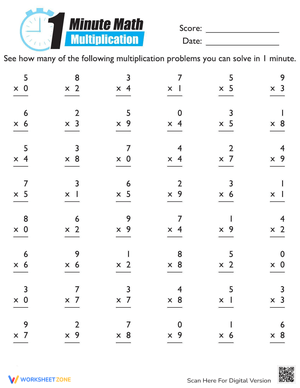
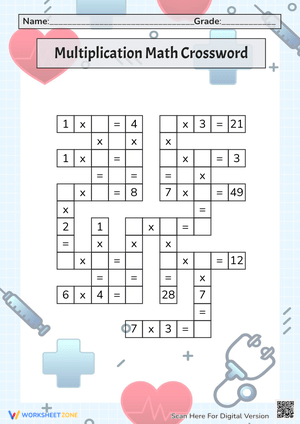
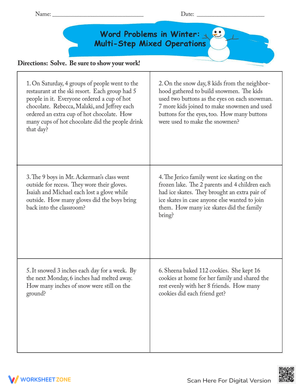
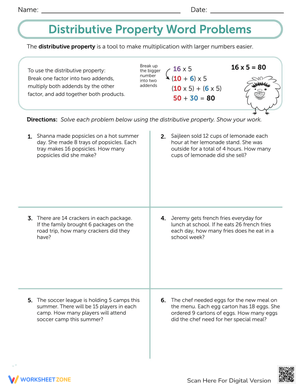
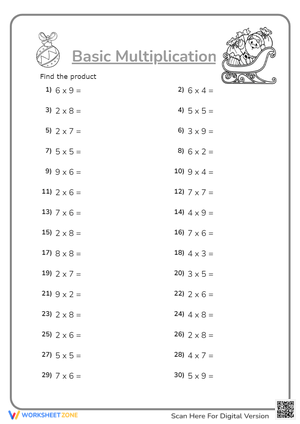
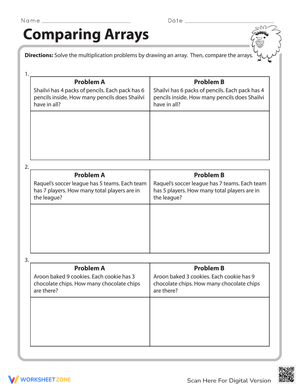
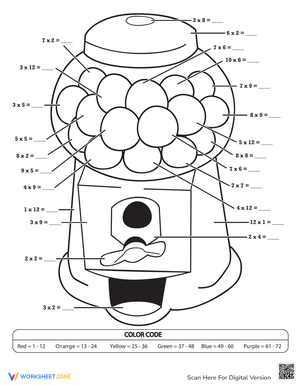
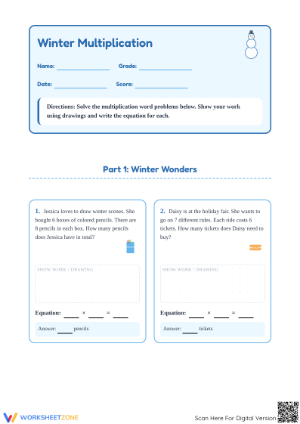
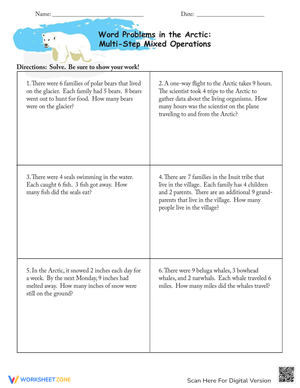
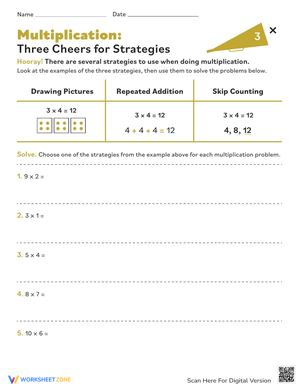
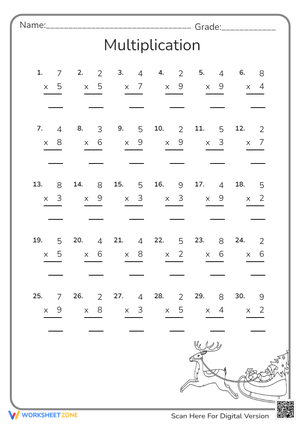
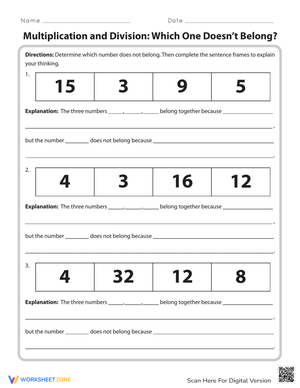
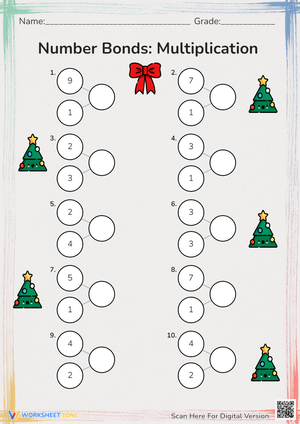
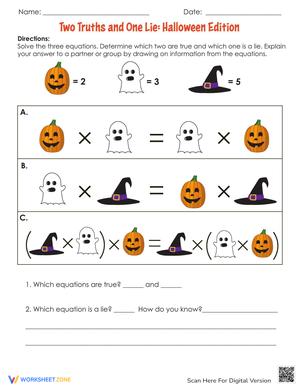
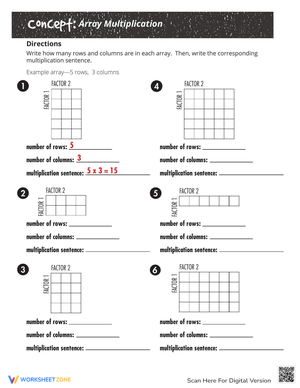
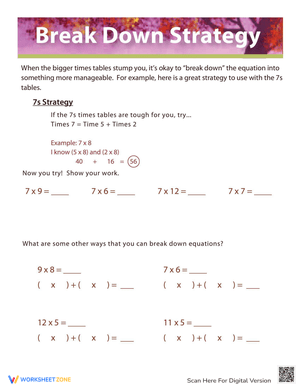
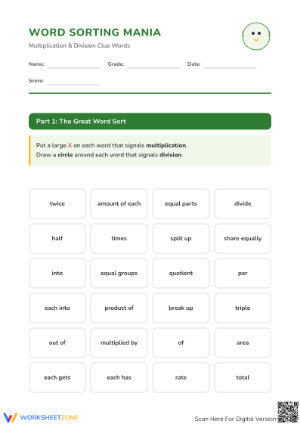
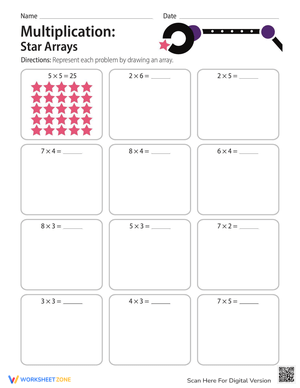
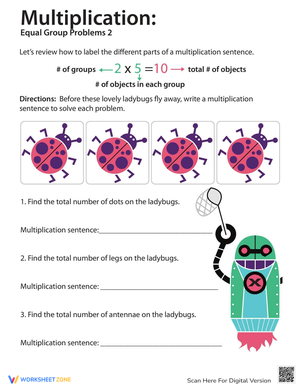
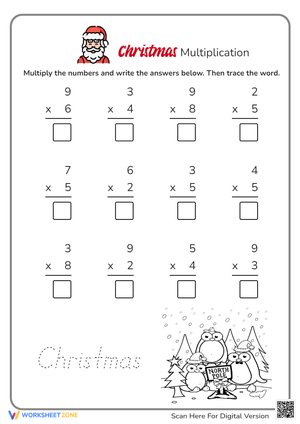
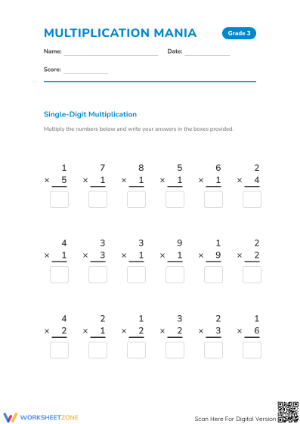
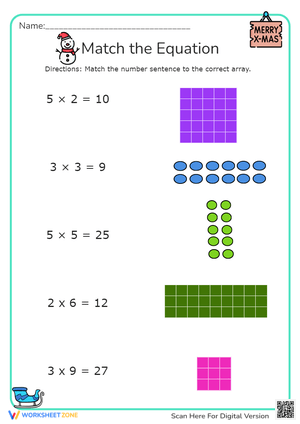
These 3rd grade one digit multiplication worksheets give teachers a targeted bank of practice materials covering every single-digit factor combination, from the foundational 2s and 5s through the harder-to-lock-down 7s and 8s. The set moves students from first encounter with multiplication — drawing equal groups, building arrays — through the mixed-fact fluency work that marks the end-of-year benchmark. Each worksheet stands alone, which makes it easy to pull exactly what a class or small group needs without printing an entire packet.
The Specific Skills Covered
Each worksheet targets a defined slice of the multiplication landscape. Teachers working through the set have materials for:
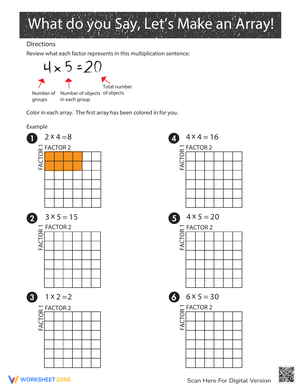
- Drawing and interpreting arrays — identifying rows, columns, and the equation they represent
- Equal-groups problems, including both "how many in all" and "how many groups" framings
- The identity property and the zero property, practiced in isolation before students encounter them in mixed sets
- The commutative property — pairing 4×7 with 7×4 so students see the relationship before memorizing both facts separately
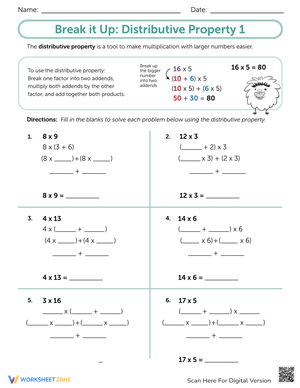
- The distributive property applied to harder single-digit facts: breaking 8×7 into (5×7)+(3×7)
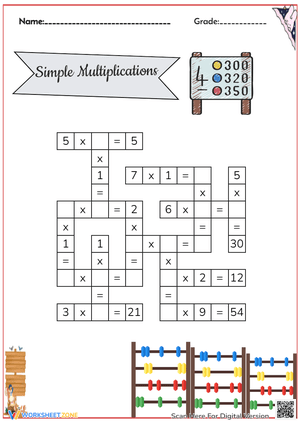
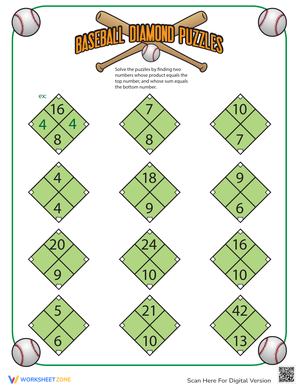
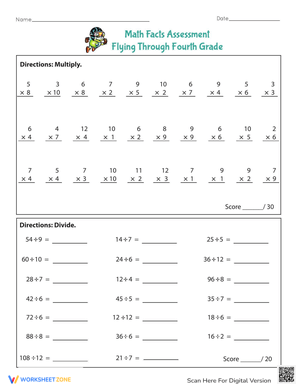
- Mixed-fact fluency sets that cross number families once individual families are secure
- Single-step word problems requiring students to identify the "groups of" structure before writing an equation
The array and equal-groups work appear early in the set deliberately. Third graders who can draw a 6×4 array and explain what the rows and columns represent are doing something qualitatively different from students who are just skip-counting — they are building the mental model that will support division, area, and eventually fraction multiplication in later grades.
Multiplication Mistakes That Surface in Third Grade
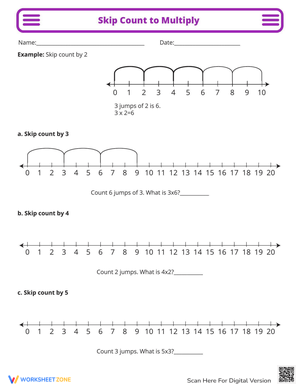
The error pattern that catches most third graders off guard is the anchor-fact miscalculation. A student who has correctly learned that 5×7=35 will often try to use that fact to find 6×7 — but when asked "one more group of what?", they add 6 instead of 7, arriving at 41. The correct move is adding one more group of 7 (the size of the group), not 6 (the new factor). These worksheets surface that confusion because they pair anchor facts with nearby facts in the same problem set, giving teachers a clear diagnostic window.
Two other errors show up consistently at this stage. Students who have recently mastered the commutative property — grasping that 4×6 and 6×4 are equal — sometimes overapply it, writing identical answers for problems like 4×6 and 4×8 simply because both share a factor of 4. They have recognized a pattern but misread which part of the equation is actually changing. Separately, the zero property causes trouble not when students see 0×9 in isolation, but when it appears mid-list in a mixed fluency set. Students who know the rule abstractly will still pause and try to calculate, revealing that the rule has not yet become automatic. Both patterns are more informative than a timed test score, and both surface clearly in completed worksheet work.
Fitting These Worksheets Into the Week
The most consistent fluency gains come from short, daily contact rather than occasional longer sessions. One worksheet used as morning work — five to eight minutes while students settle after arrival — outperforms a twenty-minute Friday drill over any given month. The predictability matters as much as the repetition: when students know the routine, they spend less time orienting and more time actually retrieving facts.
Beyond morning warm-ups, these resources fit naturally into a math workshop rotation. One station runs independent fluency practice using a 3rd grade one digit multiplication worksheets while the teacher pulls a small group to address the specific factor families causing the most errors that week. Because each worksheet targets a defined skill, the right resource for a given group is immediately identifiable — no sorting through a mixed packet mid-lesson.
For introducing multiplication the first time, the concrete-to-abstract progression holds. Students should work with physical counters arranged in equal groups before they ever see an equation on paper. Once they can explain what "3 groups of 6" means using objects, the transition to written problems happens quickly. The array worksheets work especially well at that bridge point — drawing a 3×6 requires students to hold the group structure in mind even as they move to paper, which solidifies the representation before abstract notation takes over.
Standard Alignment
CCSS.MATH.CONTENT.3.OA.C.7 — Fluently multiply and divide within 100 — is the anchor standard for this set. In classroom terms, that standard asks students to have all single-digit products memorized by year's end, but the pathway runs through the operational understanding addressed in 3.OA.A.1 (interpreting products of whole numbers) and 3.OA.B.5 (applying properties of operations). The worksheets sequence through those three standards in order: meaning first, properties second, fluency third. Teachers who assign the fluency sets without first working through the array and properties worksheets often find that students can answer quickly but cannot explain why — a gap that tends to surface during fourth-grade work with multi-digit multiplication.
Adjusting the Set for a Range of Learners
Students who are still building conceptual understanding benefit most from the array and equal-groups worksheets — ones with extra white space for drawing. Slowing down at the representational stage builds more durable knowledge than pushing straight to fact recall. For these students, pairing a 3rd grade one digit multiplication worksheets with a printed multiplication chart as a reference reduces working memory load enough that they can focus on the structure of the problem rather than the arithmetic.
Students who have already secured most of their facts need problems that push on flexibility, not speed. The distributive property worksheets — breaking an unknown fact into two known ones — serve this group well, as do the word problems that ask students to write both an equation and a brief explanation of what the numbers represent. At the opposite end, a student who is still unclear on "groups of" needs to return to the array worksheets entirely and should have a multiplication chart visible not as a shortcut but as a reference that frees up attention for the conceptual work at hand.
Frequently Asked Questions
Which fact families should teachers introduce first, and why?
Start with the 2s, 5s, and 10s. Students come to third grade already fluent with skip-counting in those sequences, so the multiplication facts click into place quickly and build early confidence. The 3s, 4s, and 6s follow in most teaching sequences, with the 7s, 8s, and 9s saved for last — those are the families where anchor-fact strategies matter most, and students need the earlier facts locked in before those strategies become reliable.
What should teachers do when students freeze during timed practice?
Drop the timer. Anxiety actively interferes with retrieval, and a student who shuts down during a timed drill is not getting the practice repetitions that build fluency — they are just practicing shutting down. Use the same worksheets untimed, focusing entirely on accuracy. Once a student completes a worksheet accurately without time pressure, introduce a loose window ("let's see how far you get in five minutes") rather than a strict countdown. Because each worksheet isolates a single fact family, there is no penalty for a student who works carefully through the 5s section but does not reach the 7s.
How well do these worksheets work as homework?
They work well with one important constraint: the fact family on a homework worksheet should match what the student has already practiced in class that day or week. Sending home a mixed-fluency set before a student has worked through the individual families turns homework into a frustration exercise. Used in sequence, a 3rd grade one digit multiplication worksheets sent home the evening after a fact family has been introduced gives students one additional retrieval opportunity — which is exactly the spacing effect that retention research supports.
How do teachers use completed worksheets as a formative tool?
A quick scan of a finished worksheet tells you more than a quiz score. Look at which problems a student skipped versus which ones show an incorrect answer — skips often signal that a student had no retrieval pathway at all, while consistent wrong answers in one fact family (all the 7s wrong, but the rest solid) point directly to where the next small-group session should focus. That kind of targeted information is harder to extract from a unit test where errors are spread across multiple concepts.













 Interactive Worksheet Maker
 Quiz Maker
 Word Search Maker
 Crossword Puzzle Maker
 Word Scramble Generator
 Sentence Scramble Generator
 Handwriting Worksheet Generator
 Name Tracing Generator
 Fill In The Blank Generator