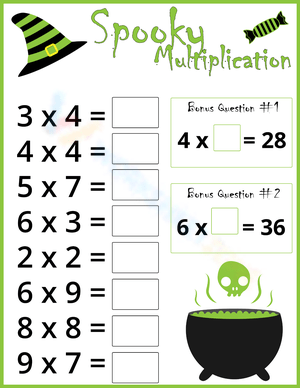
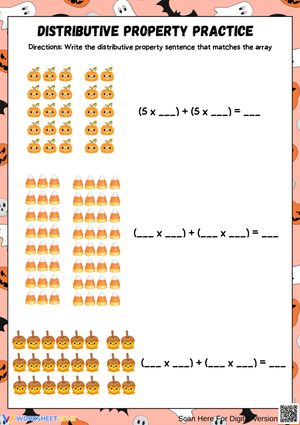
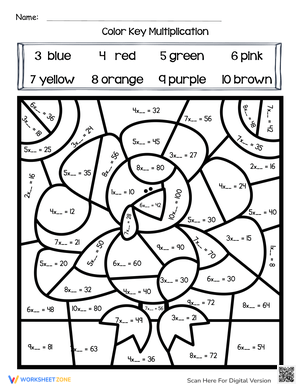
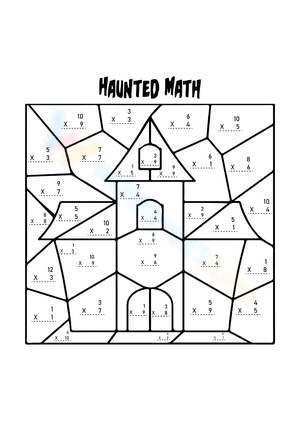
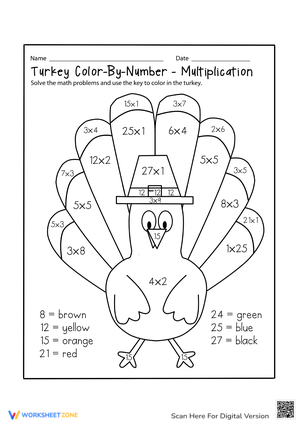
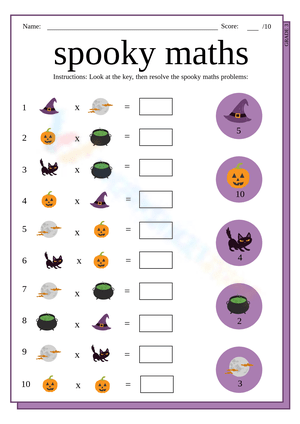
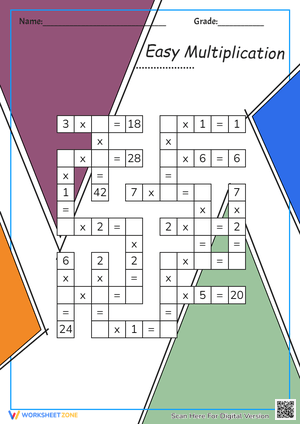
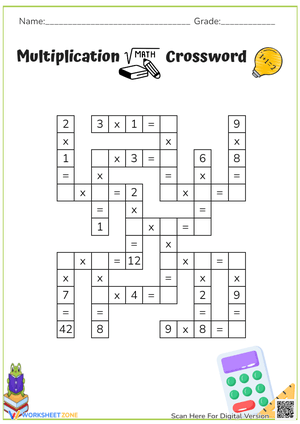
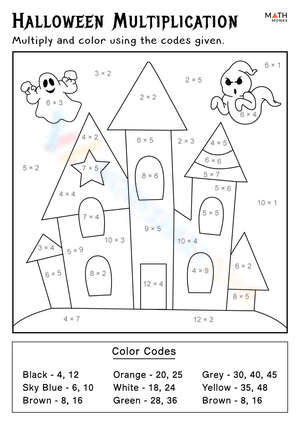
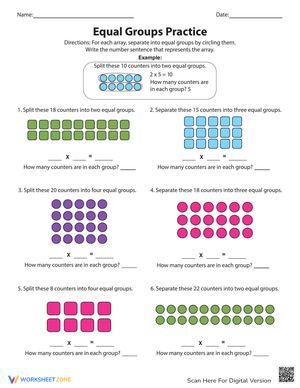
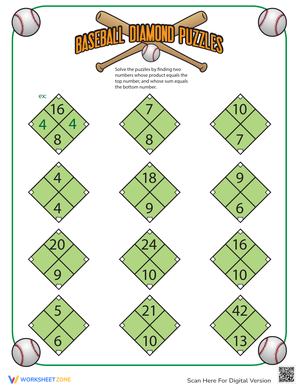
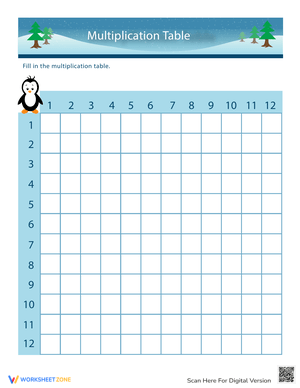
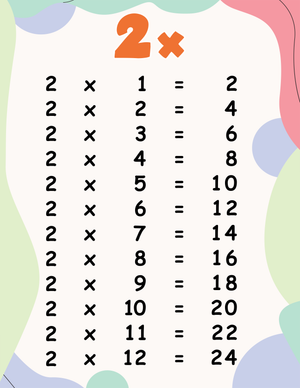
These 3rd grade multiplication facts worksheets resources give teachers a structured bank of printable practice tools for the year when multiplication moves from novelty to foundation skill. The set spans single-digit products within 100, carrying students from visual representations of equal groups all the way through recall-speed exercises — with each worksheet targeting a distinct entry point so teachers can assign based on where a student actually stands, not just where the calendar says they should be.
The Specific Skills Covered Across the Set
Each worksheet focuses tightly on one or two related skills rather than mixing every concept onto a single task. Across the set, students work through:
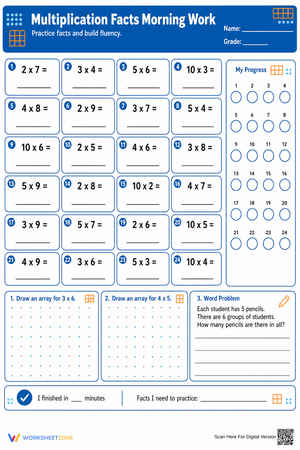
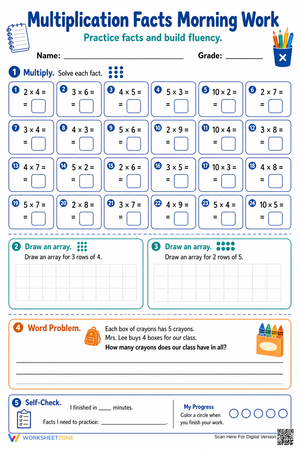
- Drawing and labeling arrays for products up to 12×12, connecting the visual arrangement to the equation
- Skip-count sequences on number lines that make the repeated-addition logic of multiplication visible before abstract facts are introduced
- Commutative property pairing problems, where students write both orientations of a fact (4×7 and 7×4) and confirm the product matches
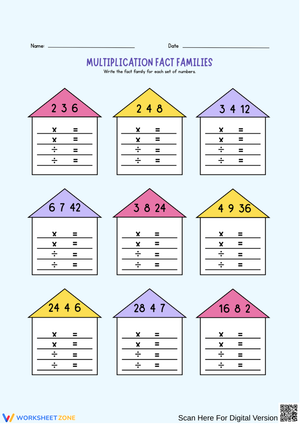
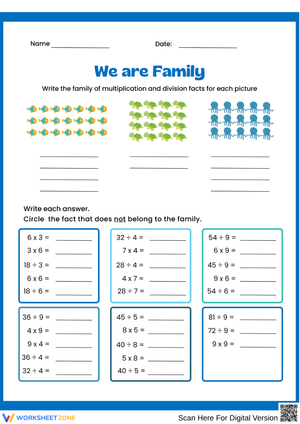
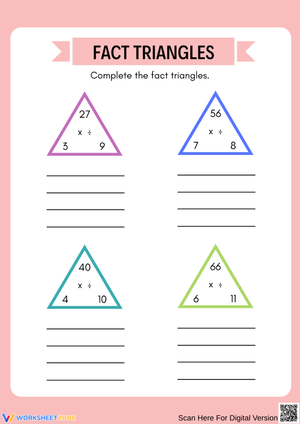
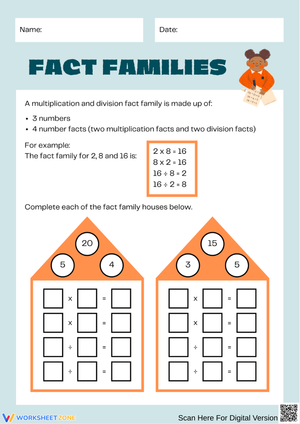
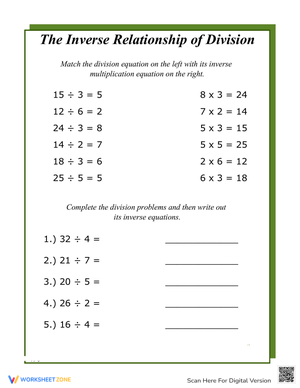
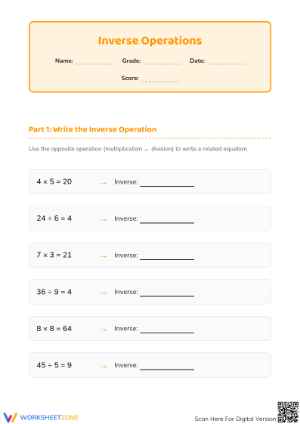
- Fact family triangles linking multiplication and division — connecting 6, 8, and 48 across all four related equations
- Missing-factor problems that shift the unknown from the product to one of the factors (□ × 9 = 63)
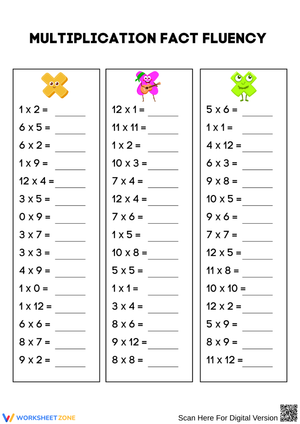
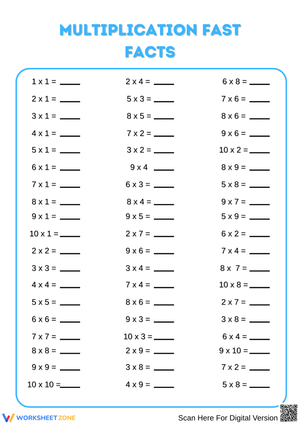
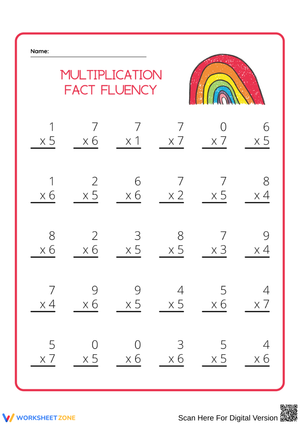
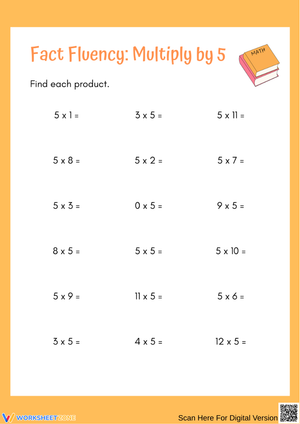
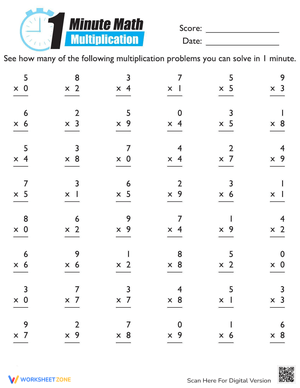
- Timed recall grids for students who have moved past conceptual work and are building automaticity with the 6s, 7s, 8s, and 9s
The derived-fact approach runs through several worksheets — students use a known anchor to reach an adjacent fact. If a student knows 5×8=40, they find 6×8 by adding one more group of 8 rather than starting from scratch. That pattern recognition is what separates durable fluency from temporary memorization that evaporates over the summer.
Standard Alignment
These worksheets align directly with CCSS.MATH.CONTENT.3.OA.C.7, which requires Grade 3 students to fluently multiply and divide within 100 and to know from memory all products of two one-digit numbers by the end of the year. In classroom terms, that standard has a hard deadline — a student who leaves third grade still counting on fingers for 7×8 will carry that gap into multi-digit multiplication in fourth grade and fraction work in fifth. These 3rd grade multiplication facts worksheets resources give teachers concrete tools to track progress toward that standard throughout the year rather than discovering the gap at report card time.
The fact-family and missing-factor worksheets also address CCSS.MATH.CONTENT.3.OA.B.6, which asks students to understand division as an unknown-factor problem. When a student sees □ × 6 = 54 and works backward from 54, they are doing exactly the operational reasoning that standard describes — they just happen to be doing it inside a multiplication worksheet.
Mistakes Students Make That These Worksheets Help You Catch
The most persistent error in the 8s and 9s involves students adding the wrong number during skip counting. A student who knows 8×5=40 will often find 8×7 by adding 7 to 40 and writing 47, rather than recognizing they need to add two more groups of 8. They confuse "how many more jumps" with "what number do I jump by." This error almost never surfaces on a pure recall drill — it only shows up when students record their thinking or work through a number line worksheet, which is exactly why those worksheets stay worth assigning even after students appear to have the facts.
A second common pattern: students correctly recall that 0 multiplied by any number equals 0 when that equation appears in isolation, then write 3×0=3 the moment it shows up in a mixed practice set. The explanation is usually consistent — "three times means I have three" — which tells you the concept of groups of nothing has not yet displaced the procedural shortcut. A brief whole-class discussion before distributing the zero-facts worksheet catches this before it becomes automatic.
Building These Worksheets Into Your Weekly Lesson Plan
The most natural home for a single worksheet is the 8–10 minutes after morning meeting, before the main math block opens. Students settle in, retrieval is low-stakes, and the work primes whatever conceptual lesson follows. For timed recall grids specifically, the last five minutes of a Friday math class works well — it gives the week's practice one final pass through long-term memory before the weekend gap.
Using each worksheet as a formative tool rather than just practice is where the set earns its place in the grade. When a student finishes the 7s worksheet and still misses 7×6, 7×7, and 7×8 consistently, that cluster is telling you something specific — not that the student needs more drill time, but that the anchor fact (likely 7×5=35) is not solid enough to build from. A short small-group session with a number line and those three problems is a faster fix than another full worksheet pass.
These 3rd grade multiplication facts worksheets files also work well as take-home practice in the later weeks of the unit, once students have moved past the conceptual phase and need repetitions with the harder fact families. Parents can see exactly what their child is working on, which removes the guesswork at home and sometimes surfaces the student who has been getting help from a sibling rather than retrieving facts independently.
Adjusting the Set for Students at Different Points in the Year
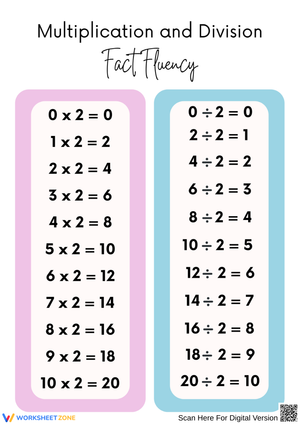
For students still connecting multiplication to equal groups, keep a multiplication chart visible while they work. The goal at that stage is not memorization — it is building the habit of checking work against a known reference, which develops number sense even when the facts themselves aren't stored yet. Pairing the array-drawing worksheets with physical counters extends this further without requiring a separate lesson.
Students who have the easier facts locked and are ready to push further get the most from the missing-factor worksheets with the chart removed. Working backward from the product exercises the same neural pathway as division, which is exactly where they are headed in the second half of the year. For students already demonstrating automaticity across all families, a short set of two-step word problems that embed the facts in context reveals whether that fluency actually transfers — which it does not always, even when timed grids look strong.
Frequently Asked Questions
Which fact families are hardest for most third graders, and which worksheets in the set address them most directly?
The 7s, 8s, and 9s consistently produce the most errors in third grade because those facts share fewer memorable anchor points than the 5s and 10s do. The worksheets targeting those families use a derived-fact format — students start from 5×7=35 or 5×8=40 and build upward — rather than presenting the facts cold. For the 9s, the finger trick is worth teaching alongside the worksheet; it is one of the few procedural shortcuts that actually reflects the underlying pattern (the tens digit increases by one, the units digit decreases by one: 9, 18, 27, 36).
How do I use these without turning timed drills into a source of anxiety?
Reserve the timed recall grids for students who have already demonstrated accuracy on the untimed versions. Running a timed drill on a fact family a student hasn't internalized yet measures stress tolerance, not fluency. The sequence that holds up in practice: array worksheets first, then untimed mixed practice, then timed only after a student completes the untimed version with fewer than two errors. A student watching their own completion time shrink across several sessions is a much more useful motivator than simply removing timing entirely.
Is isolated fact-family practice better than mixed practice, or should I use both?
Isolated-family practice works best when introducing a new set of facts — blocking the input gives students a clear structure to attach to. Mixed practice, where a worksheet pulls from the 3s, 6s, and 9s together, is more useful once each family is individually secure, because interleaving is what moves facts into durable long-term storage. The research on spaced retrieval is consistent here: blocked practice builds initial confidence, interleaved practice builds staying power. The set includes both formats so teachers can sequence them by instructional phase rather than relying on one format all year.
Can these worksheets be used with fourth graders who are still working on fact fluency?
A 3rd grade multiplication facts worksheets set covers exactly the fact range that fourth-grade division depends on, so the content is entirely appropriate for a student filling gaps a year later. Most worksheets in the set are visually neutral — no cartoon characters or primary-grade iconography — so older students do not feel the sting of working on material they associate with younger grades. Start those students on the missing-factor worksheets; that format reads as fourth-grade work even when the underlying skill is third-grade content.













 Interactive Worksheet Maker
 Quiz Maker
 Word Search Maker
 Crossword Puzzle Maker
 Word Scramble Generator
 Sentence Scramble Generator
 Handwriting Worksheet Generator
 Name Tracing Generator
 Fill In The Blank Generator