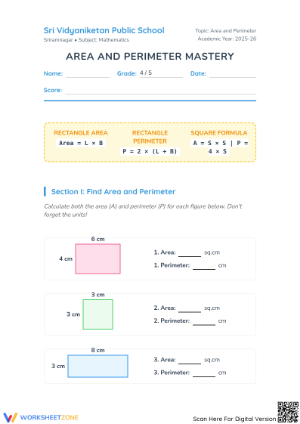
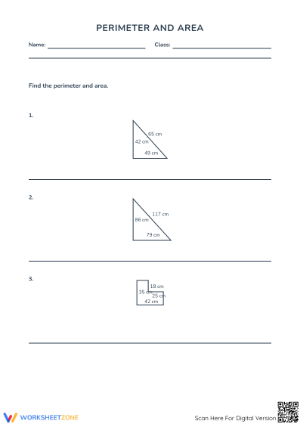
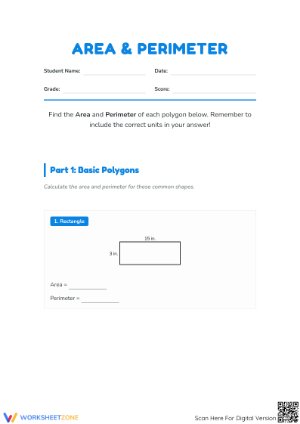
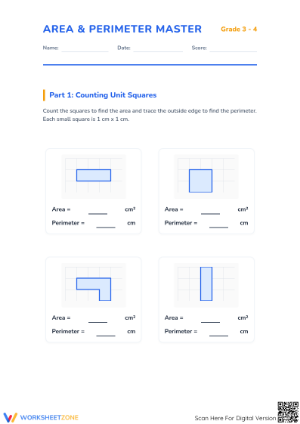
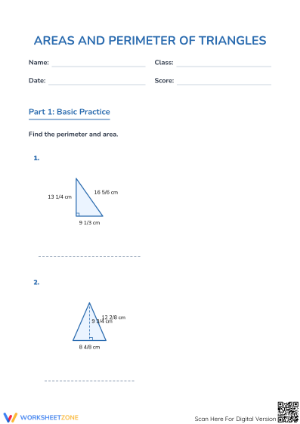
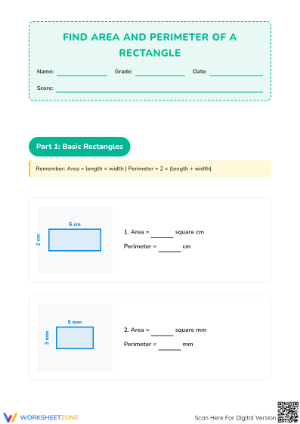
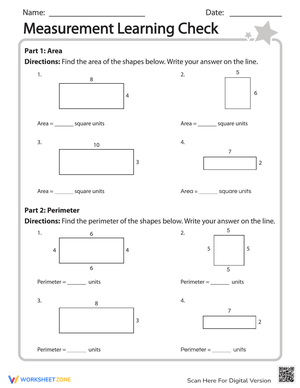
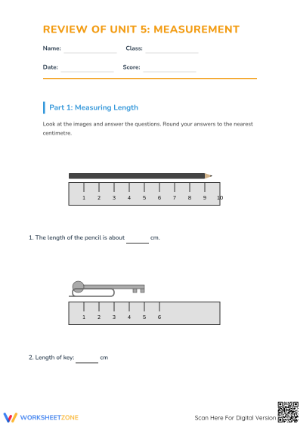
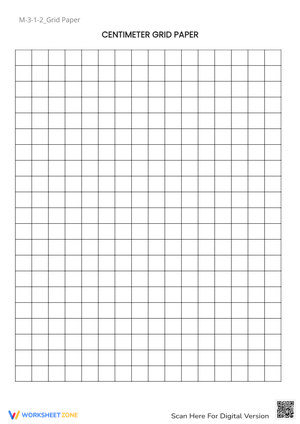
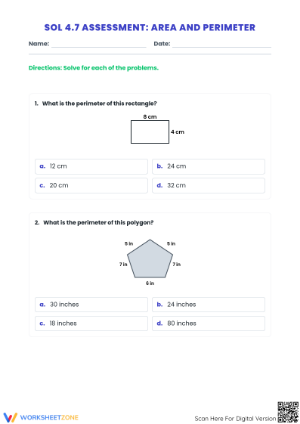
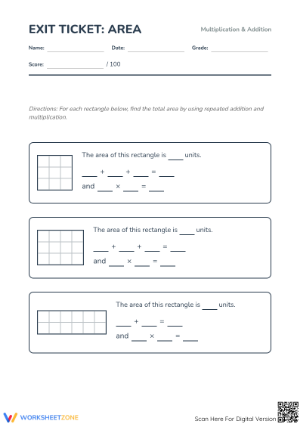
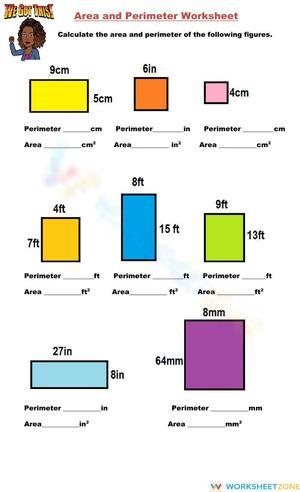
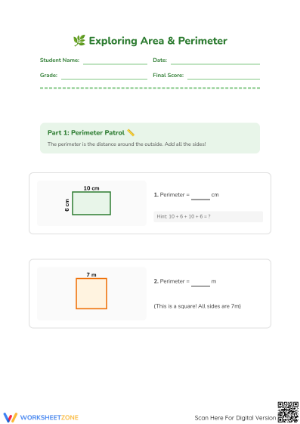
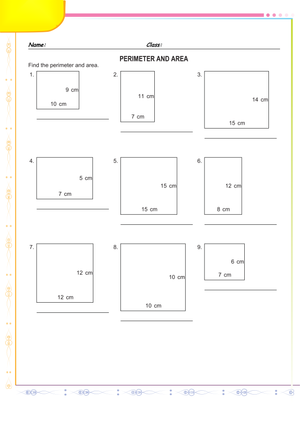
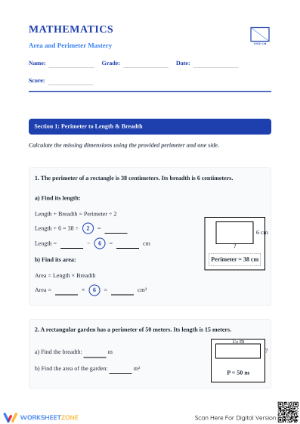
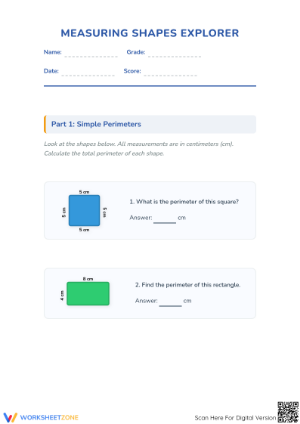
These area and perimeter printable worksheets for 3rd grade give teachers a focused set of resources covering the two measurement concepts that third graders most reliably mix up — the space a shape encloses and the distance along its edges. The set moves from grid-based counting and visual tiling all the way to missing-side perimeter problems, staying within the 3.MD standards throughout.
The Specific Skills Targeted
Each worksheet addresses one well-defined task rather than combining multiple demands at once. That separation matters at this grade level because the cognitive load of keeping area and perimeter conceptually distinct is already high before any arithmetic enters the picture. Across the set, students:
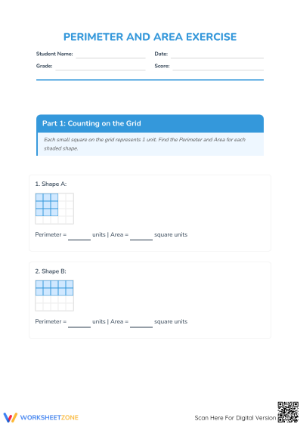
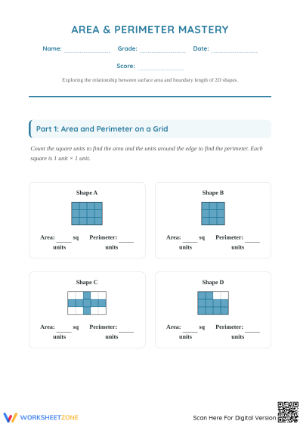
- Count unit squares on grids to determine the area of rectangles and irregular figures
- Multiply side lengths to find area once the tiling pattern is established
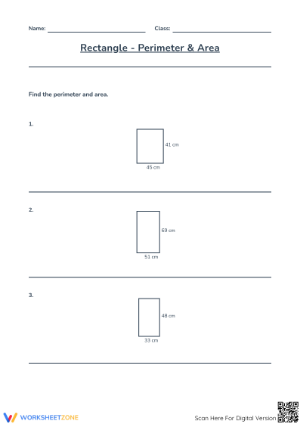
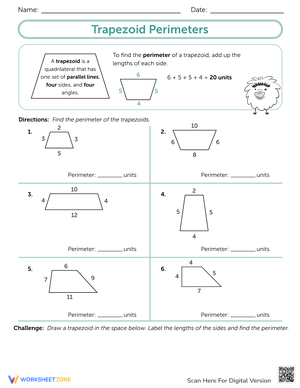
- Add all side lengths to calculate perimeter, including shapes with more than four sides
- Label answers using correct units — square units for area, linear units for perimeter
- Find a missing side length when the total perimeter and all other sides are given
- Compare rectangles that share the same area but have different perimeters
That last skill deserves its own worksheet rather than a footnote at the bottom of a mixed problem set. The comparison is genuinely counterintuitive to 8-year-olds — discovering that a 2-by-6 rectangle and a 3-by-4 rectangle are the same "size" in one sense but not another is a moment worth giving space to, not rushing past.
Mistakes Students Make That These Worksheets Help You Catch
The most persistent error is the swap: a student calculates area when asked for perimeter, or adds side lengths when asked for area. This isn't always carelessness. At the point in the unit when both concepts are live in working memory, students without a stable mental distinction will default to whichever procedure they used most recently. A useful diagnostic is to look at the units they write. A student who correctly finds the perimeter of a rectangle as 20 but labels it "20 square units" is telling you directly that they have the procedures without the concepts — they borrowed the area label without registering the mismatch.
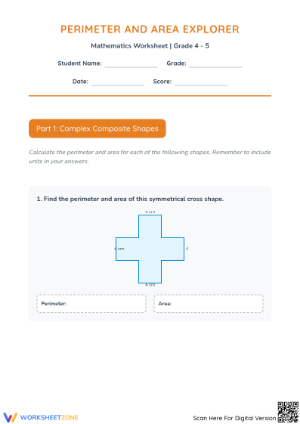
The second consistent error shows up on irregular polygons. Students count the obvious long sides and skip the short step-edges on staircase-shaped figures. Having them mark each segment with a pencil tick as they move around the boundary — one tick per counted side — externalizes a tracking process that working memory can't hold reliably at this age. A handful of worksheets in the set build that habit by printing small checkbox icons beside the sides of the shape, prompting the mark-and-count process before students move to addition.
A third misconception worth naming explicitly before students hit it: many 3rd graders assume two shapes with equal areas must share the same perimeter. Until they work through a direct comparison, that assumption feels airtight to them. The worksheets that place two equal-area rectangles side by side and ask students to find both perimeters force the confrontation. The surprise on students' faces when the numbers differ is visible, and it's the kind of productive confusion that anchors the concept far better than a teacher simply stating the fact.
How to Work These Worksheets Into Your Planning
The focused, single-skill format makes these resources practical for short windows in the math block. A perimeter-counting worksheet runs cleanly in the eight minutes before students transition to specials. A grid-area worksheet works well as a Monday morning warm-up after the weekend, which is reliably when the connection between tiling and multiplication loses traction — students remember the procedure but not the reasoning behind it.
For math centers, pairing one area worksheet and one perimeter worksheet in the same rotation gives students a side-by-side comparison that sharpens both concepts. After finishing both, a written reflection card — asking students to explain the difference between their two answers in one sentence — produces the metacognitive moment that makes the contrast stick. That written response also gives teachers something concrete to read during the debrief rather than relying entirely on the first hands up.
Area and perimeter printable worksheets for 3rd grade also function well as exit tickets, particularly worksheets where a single shape requires students to find and label both measurements. That dual demand surfaces confusion while there is still time to address it before the next lesson, rather than discovering it on the unit assessment.
Standard Alignment
These area and perimeter printable worksheets for 3rd grade address four closely related standards in the Measurement and Data domain:
- 3.MD.C.5 — Establishes area as an attribute of plane figures and introduces the unit square as the basis for area measurement.
- 3.MD.C.6 — Measures area by counting unit squares, covering square centimeters, square meters, square inches, and square feet.
- 3.MD.C.7 — Connects area to multiplication and addition; the area of a rectangle equals its length times its width, linking geometry directly to the multiplication facts students are building simultaneously in 3.OA.
- 3.MD.D.8 — Solves real-world and mathematical perimeter problems, including finding an unknown side length when the total perimeter is given.
These four standards fall within the same three-to-four-week stretch in most 3rd-grade pacing guides. That proximity is the instructional reason to use worksheets that keep both measures visible to students at the same time. Students who practice area exclusively and then switch entirely to perimeter tend to store them as separate topics rather than as two distinct properties of the same shapes — a gap that shows up clearly on any mixed-format assessment.
Differentiating the Set Across Ability Levels
Students still uncertain about which measure is which do best with worksheets that isolate one concept per sheet, use large grid squares, and limit shapes to simple rectangles. Color-coding adds a low-cost support structure without requiring a different worksheet entirely — one color to trace the perimeter path, a second color to shade the area. Two crayons and a clear instruction change how students visually process the task before they calculate anything.
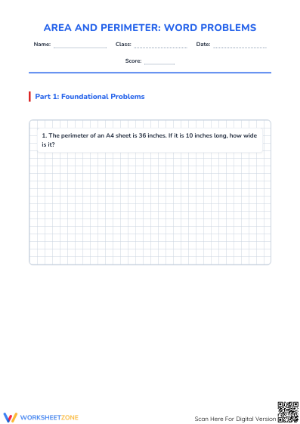
For students ready to move beyond calculation, the missing-side problems are the most productive stretch. Given that a rectangle's perimeter is 22 units and one side measures 7 units, finding the missing dimension requires subtraction and halving — it is genuinely harder than the standard "add all the sides" format, and it builds toward 4th-grade work without leaving the 3.MD domain. These worksheets can simply be withheld until a student demonstrates readiness rather than handed out with the rest of the set.
Students who process print slowly benefit from versions with fewer problems per sheet and a visual model alongside every question. Reducing the problem count does not lower the mathematical demand. A student who correctly finds both the area and perimeter of three different irregular polygons is demonstrating mastery whether the worksheet contains three problems or eight.
Frequently Asked Questions
Do these worksheets cover both concepts together, or is each one handled separately?
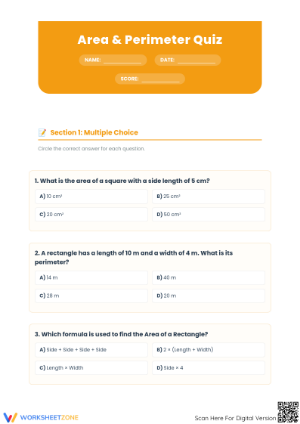
Both formats are in the set. Most worksheets focus on one concept at a time, which works well for early-unit instruction when the goal is building fluency with each measure independently. A smaller group of worksheets present both measures on the same problem — one shape, two labeled answers — and those are best suited for mid-unit checks and end-of-unit review.
When should I introduce the multiplication shortcut for area?
After students have counted unit squares accurately across several class sessions. The standard 3.MD.C.7 connects area to multiplication, but introducing that connection before students understand what the square units physically represent tends to produce students who can calculate without knowing what they are calculating. Two or three days of grid counting first, then the multiplication link, produces noticeably more durable understanding than skipping straight to length times width.
Are there word problems included, or only diagram-based problems?
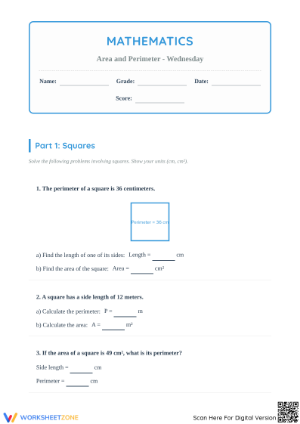
Both appear. Several worksheets present perimeter in applied contexts — garden borders, picture frame edges, room floor dimensions — because 3.MD.D.8 explicitly calls for solving real-world perimeter problems. The diagram-only worksheets are stronger for skill-building; the word-problem worksheets reveal whether students can transfer the skill to a context that does not hand them a labeled shape.
Can these worksheets challenge students who have already moved past the basic standard?
Yes. Area and perimeter printable worksheets for 3rd grade that involve missing side lengths and the construction of multiple rectangles with equal areas but different perimeters push well past the minimum 3.MD expectations. Those worksheets extend cleanly into pre-4th-grade territory without requiring an entirely different set of materials — identify them in the set and distribute them when specific students are ready.













 Interactive Worksheet Maker
 Quiz Maker
 Word Search Maker
 Crossword Puzzle Maker
 Word Scramble Generator
 Sentence Scramble Generator
 Handwriting Worksheet Generator
 Name Tracing Generator
 Fill In The Blank Generator