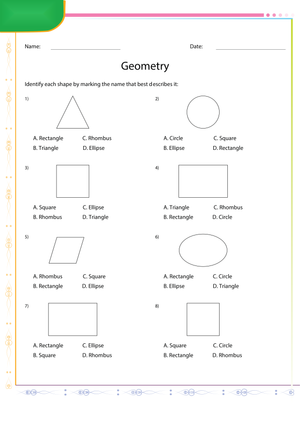
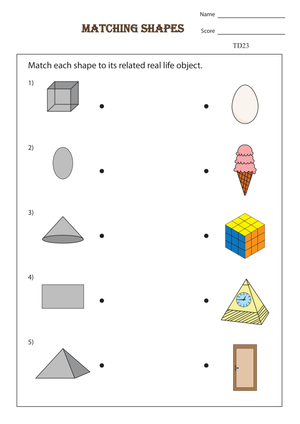
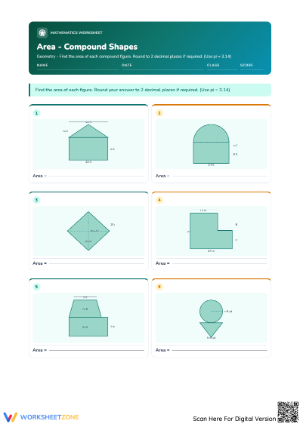
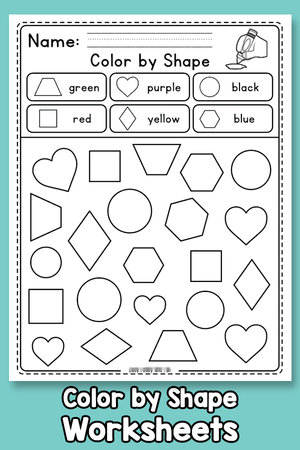
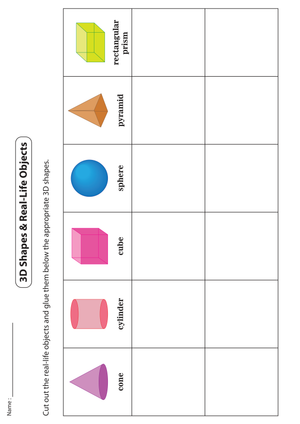
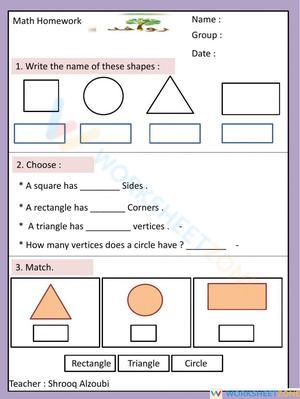
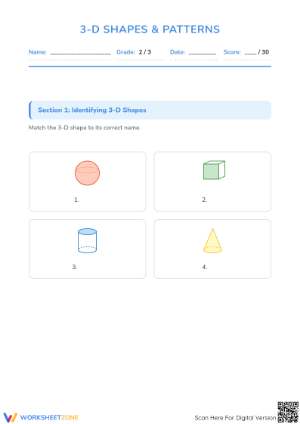
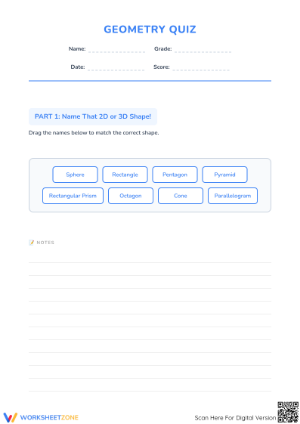
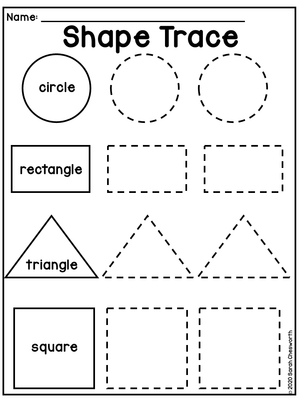
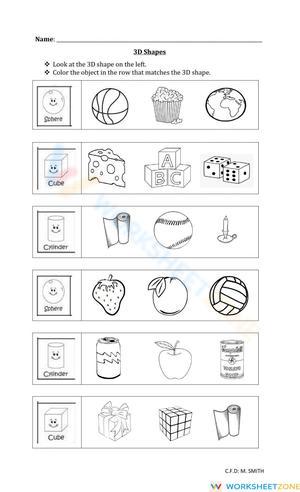
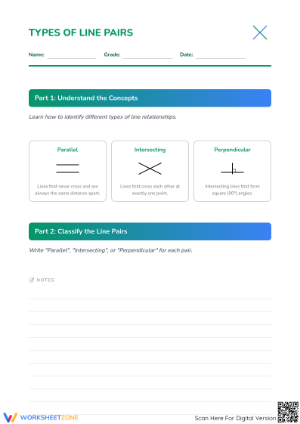
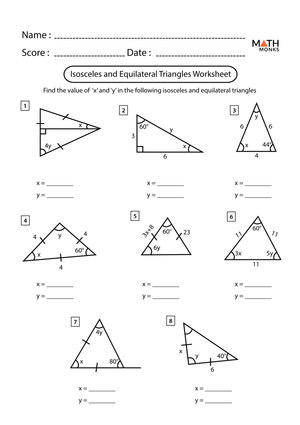
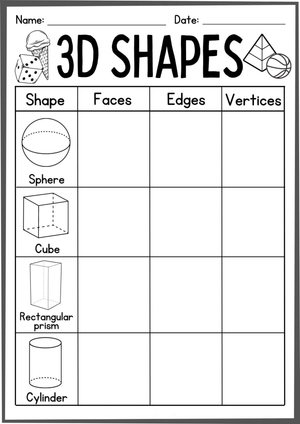
These 3rd grade shapes worksheets resources shift the instructional focus from "name the shape you see" to "justify why this shape belongs in this category" — the exact reasoning the Grade 3 geometry standards require. Teachers get a set of printable worksheets covering polygon identification, attribute analysis, quadrilateral classification, and shape partitioning, all built around property-based reasoning rather than visual recognition.
What's Inside the Set
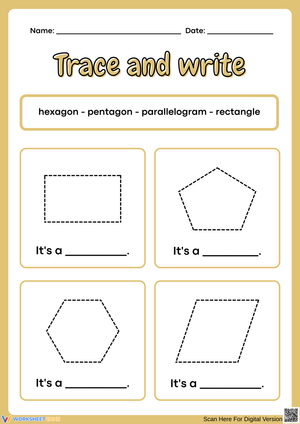
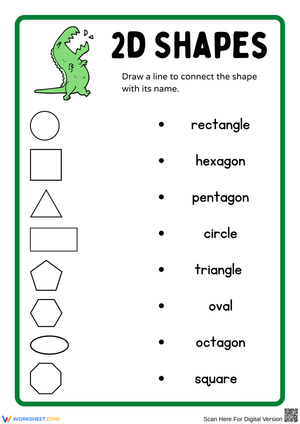
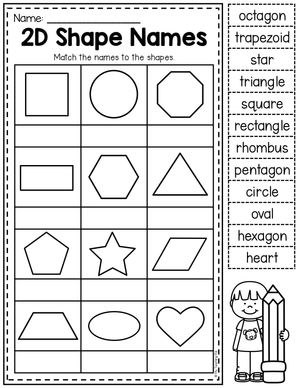
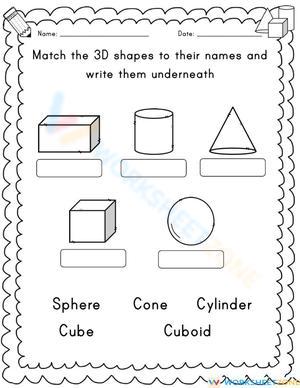
Each worksheet targets a specific part of the Grade 3 geometry progression. Polygon identification worksheets ask students to count sides and vertices to name shapes — triangles through octagons — with figures drawn in non-standard orientations so that counting, not visual pattern-matching, drives the answer. Attribute-analysis worksheets ask students to mark right angles with a small square, identify pairs of parallel sides, and compare side lengths directly on the printed shape.
The quadrilateral worksheets are the most involved. Sorting tasks group shapes by one property at a time: four right angles, four equal sides, exactly one pair of parallel sides. Rectangles, squares, rhombuses, parallelograms, and trapezoids all appear. A separate worksheet type asks students to evaluate true-or-false statements — "All squares are rectangles" or "A rhombus always has four right angles" — and justify the answer in writing. That task format surfaces hierarchical reasoning in a way that sorting alone does not.
The Fractions Connection Teachers Shouldn't Skip
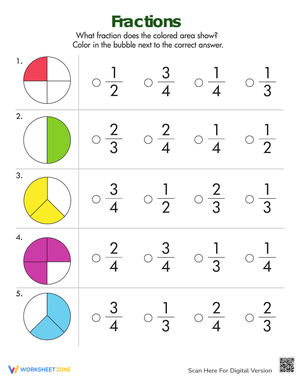
Partitioning worksheets are often treated as a minor add-on to geometry units, but the Grade 3 standards position them as central. Students draw lines to divide rectangles, squares, and circles into equal areas — halves, thirds, fourths, sixths, eighths — then shade a specified portion to represent a unit fraction. This is often the first time students encounter a fraction as a spatial quantity rather than an abstract symbol. A student who cannot picture one-third numerically will often grasp it immediately when partitioning a rectangle into three equal columns and shading one of them.
Error Patterns to Expect in Third-Grade Geometry
Orientation errors are the most persistent. Show a square rotated 45 degrees and a significant portion of third graders will call it a diamond, or classify it as a rhombus only — missing that its right angles also qualify it as a square. Presenting shapes in varied orientations across these worksheets surfaces that confusion before it calcifies into a firm misconception.
Hierarchy errors are subtler and harder to dislodge. Students who can correctly define a rectangle — four sides, four right angles — will still insist a square is not a rectangle because "squares have equal sides and rectangles don't." They are treating the categories as mutually exclusive when the relationship is explicitly nested. This error does not appear in fill-in-the-name tasks; it only surfaces when students have to evaluate a claim or explain why a shape belongs in more than one group. The true-or-false and written-justification tasks are the most effective tools for catching that specific confusion.
On partitioning: students regularly divide shapes into the correct number of parts but unequal areas. A rectangle split into "thirds" where the columns are visibly different widths is common at this grade. Simply telling students the parts must be equal rarely resolves it — students need to compare the resulting sections directly, which the worksheet tasks prompt them to do.
Building These Worksheets Into Your Geometry Unit
These worksheets fit into the geometry unit in three distinct roles:
- Pre-assessment before direct instruction on quadrilaterals
- Focused practice at math centers during the unit
- Spaced retrieval review two to three weeks after initial instruction
Using the 3rd grade shapes worksheets as a pre-assessment at the start of the quadrilateral unit is one of the more efficient moves in this stretch of the curriculum. A single attribute-analysis worksheet, given before direct instruction, reveals who already understands parallel sides and right angles, who knows polygon names but cannot articulate properties, and who needs to rebuild from basic vocabulary. That data takes five minutes to collect and changes how you group students for the first few days of the unit.
For the orientation error specifically, have students physically rotate each worksheet 45 degrees during center time and re-examine the shapes. That one action breaks the orientation anchor. Students who are certain a rotated square is "just a diamond" often reconsider when they view it from a familiar angle.
Returning to the classification worksheets three weeks after instruction — as a Monday warm-up, after morning meeting — often shows that students have retained the shape names but lost the hierarchy distinctions. Catching that before the unit assessment leaves time to reteach the specific point rather than revisiting the whole unit.
Standard Alignment
CCSS.Math.Content.3.G.A.1 asks students to understand that shapes in different categories may share attributes and that shared attributes can define a larger category — in instructional terms, this is the rhombus-square-rectangle hierarchy, where students must reason about subset relationships rather than treat named categories as separate bins. CCSS.Math.Content.3.G.A.2 addresses partitioning shapes into parts with equal areas and expressing each part as a unit fraction. Most teachers sequence the partitioning work after the 3.NF fractions domain, so that geometric partitioning reinforces a fraction concept students already recognize numerically rather than introducing both at the same time.
Tailoring These Worksheets for Students at Different Points
Students who are not yet fluent with polygon vocabulary will exhaust their working memory on name retrieval before reaching the attribute reasoning the tasks actually measure. A simple reference chart — polygon name alongside a drawn example and side count, placed visibly on the desk — keeps cognitive load on classification rather than vocabulary recall.
For students who move through classification tasks quickly, the most productive extension is generative: give them an attribute set — "four sides, two pairs of parallel sides, no right angles" — and ask them to draw a valid shape, then name it. Reversing the task direction reveals whether students understand that multiple valid shapes can satisfy the same attribute description, which is a more demanding application than sorting given examples.
For the 3rd grade shapes worksheets partitioning tasks specifically, students who struggle with equal area often benefit from working on grid paper alongside the printed worksheet, using the squares as a spatial reference before transferring partition lines to the shape. Students typically drop this once their spatial reasoning strengthens — it does not become a permanent accommodation.
Frequently Asked Questions
How do you teach the square-rectangle relationship without just telling students the rule?
Build the argument from attributes. Have students list every property of a rectangle — four sides, four right angles, opposite sides equal in length. Then list every property of a square — four sides, four right angles, all sides equal in length. Ask whether a square satisfies every condition on the rectangle list. It does, which means it qualifies as a rectangle by definition. That reasoning is more durable than an assertion, and it mirrors exactly what the true-or-false worksheet tasks ask students to work through independently.
Can these worksheets be used with students working below grade level on geometry?
Yes, with a sequencing adjustment. Students who are shaky on basic polygon names will struggle when they hit vocabulary gaps in the middle of a classification task. Use the polygon identification worksheets first as focused vocabulary work before moving students to the quadrilateral classification and hierarchy materials. Each worksheet is standalone, so you can order them to match where students actually are rather than following a fixed sequence.
Where do the partitioning worksheets fit relative to the fractions unit?
Most teachers place the partitioning work from the 3rd grade shapes worksheets set after students have worked through unit fractions in the 3.NF domain. At that point, dividing a rectangle into eighths and shading three sections connects to a fraction students already recognize numerically. Running geometric partitioning before fraction instruction asks students to manage two new concepts simultaneously — the partitioning procedure and the fraction notation — and tends to slow progress on both.













 Interactive Worksheet Maker
 Quiz Maker
 Word Search Maker
 Crossword Puzzle Maker
 Word Scramble Generator
 Sentence Scramble Generator
 Handwriting Worksheet Generator
 Name Tracing Generator
 Fill In The Blank Generator