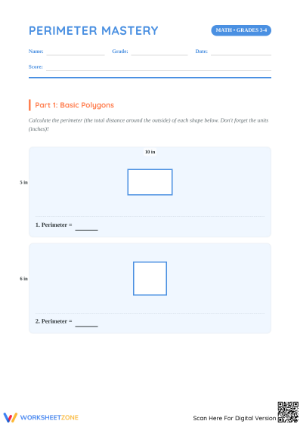
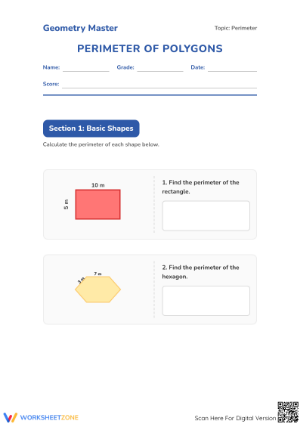
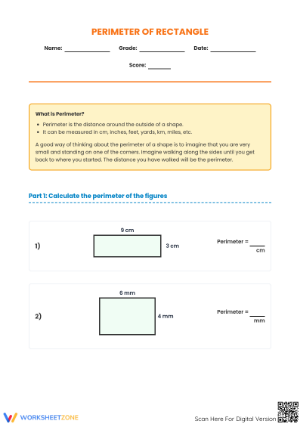
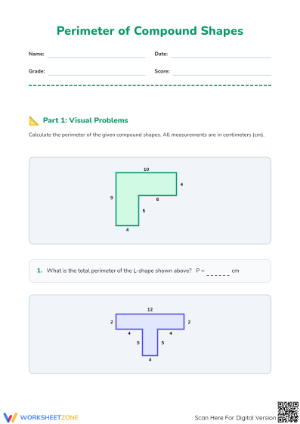
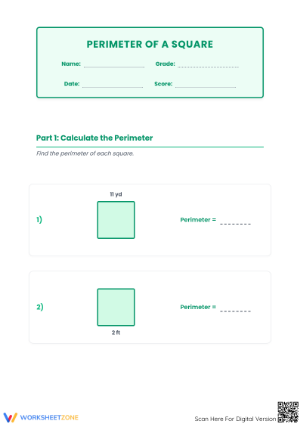
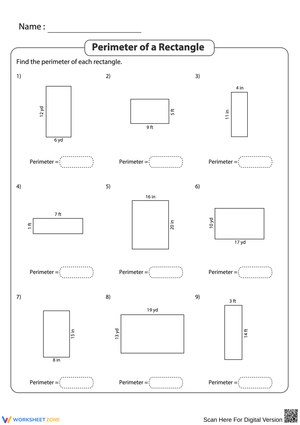
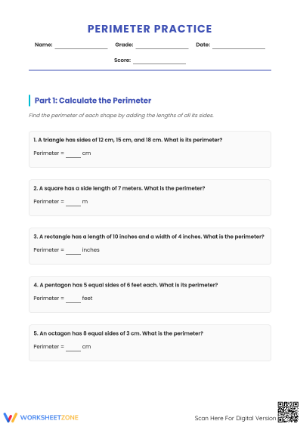
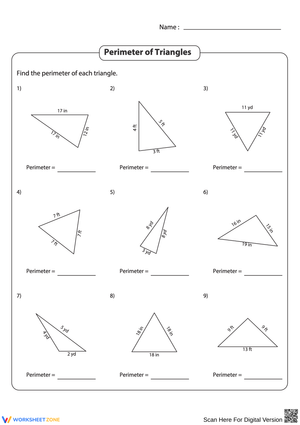
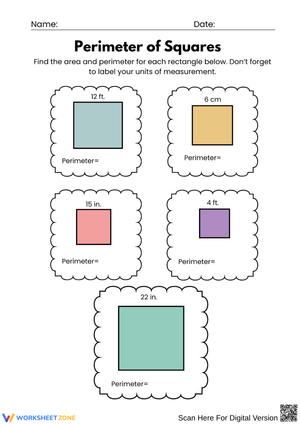
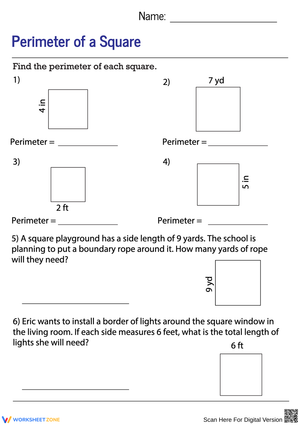
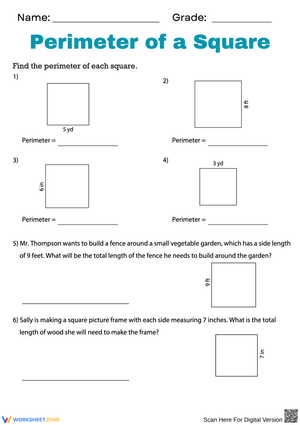
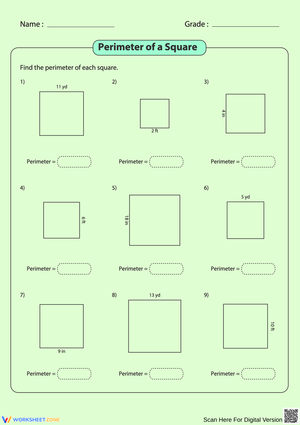
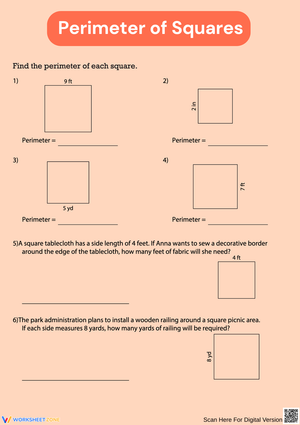
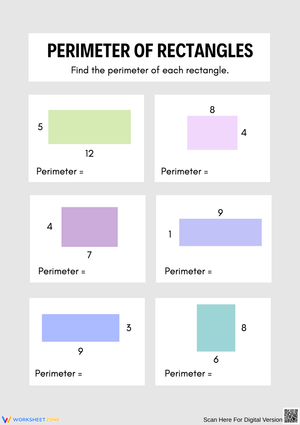
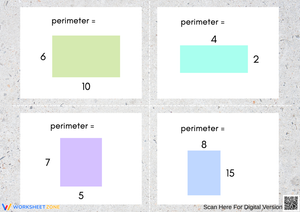
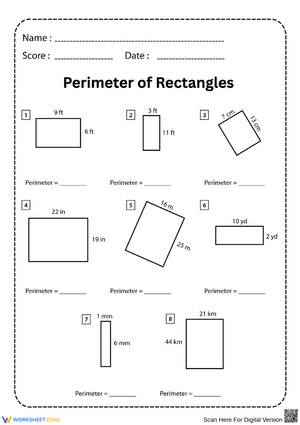
These 3rd grade perimeter worksheets resources hand teachers a progression that starts at simple rectangles with labeled sides and moves to irregular polygons where one measurement is missing — a range broad enough to carry a full unit from introduction through assessment. Each worksheet targets a specific skill rather than cramming every perimeter concept into one overstuffed assignment, which means teachers can assign exactly what the lesson calls for without cutting problems apart.
The Specific Skills Targeted
The set covers the full scope of what 3.MD.D.8 expects at third grade, distributed across worksheets by difficulty and problem type:
- Adding all side lengths of squares, rectangles, triangles, and irregular polygons with whole-number values
- Finding an unknown side length when the total perimeter and all other sides are given
- Working with standard measurement units — inches, centimeters, feet — and with grid-based unit squares
- Translating word problems into labeled diagrams before calculating
- Comparing shapes that share the same perimeter but differ in area, and vice versa
The irregular polygon problems deserve a note: these worksheets present shapes that can't be solved by formula — students have to add every labeled side individually and track their progress. That practice matters because it interrupts the third-grade habit of reaching for a rectangle shortcut and applying it everywhere.
Frequent Student Errors Worth Watching For
The most consistent error in this unit isn't the perimeter-vs.-area mix-up — it's side-skipping on irregular polygons. A student who correctly adds all four sides of a rectangle will undercount a six-sided figure, either because the shape's angles make two sides feel like one continuous edge, or because the labeling runs across the page in a way that's easy to misread. The tick-mark strategy — physically crossing off each number as it's added — fixes this faster than re-explaining the concept, and training students to use it on the very first worksheet pays off across the whole unit.
The perimeter-area confusion tends to arrive in word problems rather than diagram-only exercises. A student who reads "how much fencing does the garden need?" answers with a perimeter without hesitation. The same student, asked "how much sod covers the garden?", may write the exact same addition equation — because they stopped reading after spotting the numbers. That's a reading-comprehension problem wearing a math costume, and these worksheets surface it because the word problems require students to decide which measurement applies before picking up a pencil.
On missing-side problems, third graders frequently subtract the known sides from the perimeter and stop — presenting 8 cm when the correct missing side is 4 cm. They've found the combined length of the two unknown sides on a rectangle but don't recognize that those sides are equal and each needs to be halved. Writing "8 ÷ 2 = 4" as an explicit step on the worksheet is worth requiring in class; otherwise students don't see this as a division problem at all, and they'll repeat the error on every similar item.
How to Build These Worksheets Into Your Lesson Plans
Before assigning any worksheet, give students a loop of string — about 24 inches works — and ask them to form different shapes on a flat surface. They'll find quickly that a long skinny rectangle and a near-square rectangle can use the same string: same perimeter, different dimensions. That five-minute activity does more to cement the concept than a full period of diagram work, and it gives the worksheet problems something real to connect to. Teachers who skip straight to paper tend to revisit the concept again mid-unit when students start conflating perimeter with area on the word problems.
Within the week, the missing-side worksheets work well as a Wednesday check-in after two days of straight calculation. By that point, students have the adding routine down, and the missing-side problems introduce just enough new thinking to stay engaging without overwhelming the class. Word-problem worksheets land better on Thursday or Friday, when students have enough fluency with the arithmetic to direct their working memory toward reading comprehension instead of the calculation itself.
Standard Alignment
CCSS Math 3.MD.D.8 requires third graders to solve real-world and mathematical problems involving perimeters of polygons — calculating perimeter from given side lengths, finding an unknown side when the total perimeter is known, and comparing rectangles with the same perimeter but different areas (and the reverse). Instructionally, this standard sits at the close of the measurement and data domain, after students have built familiarity with linear units and before the area standards in 3.MD.C.7 take over. That sequence matters: students who haven't yet internalized what a linear unit represents will conflate linear and square measurement the moment area appears. The worksheets that pair perimeter and area comparisons are most productive after students have worked through area independently — not during the same lesson where both are introduced for the first time.
Adjusting the Worksheets for a Range of Learners
For students who are still shaky on multi-digit addition, start with the rectangle and square worksheets and allow a number line or hundred chart. The goal on those exercises is building the habit of adding all sides, not practicing column addition — so removing the arithmetic barrier lets the geometry thinking happen. A student who adds 7 + 7 + 4 + 4 correctly on their fingers has demonstrated perimeter understanding, even if they would miscount with the standard algorithm.
Students who master the straightforward calculation move quickly to missing-side and word-problem worksheets. A useful extension for those who finish early is having them draw two rectangles with a perimeter of 20 cm on grid paper and calculate the area of each. That comparison task introduces the perimeter-area relationship without turning it into a formula to memorize, and it requires nothing more than grid paper already in the classroom.
Students who need additional language support do better when word problems include a labeled diagram alongside the text, not instead of it. On the 3rd grade perimeter worksheets exercises that present word problems without diagrams, pairing ELL students to annotate the problem and sketch the shape before calculating gives them a visual anchor that makes the numerical relationships meaningful rather than abstract.
Frequently Asked Questions
Can these worksheets serve as both practice and formative assessment?
Yes. The calculation worksheets work well as formative checks during the unit — teachers can scan them quickly to spot who is skipping sides or applying an area strategy. The word-problem and missing-side worksheets are better positioned as summative evidence, since they require students to apply both reading and calculation without a step-by-step prompt. Running a word-problem worksheet as a ten-minute exit ticket gives cleaner data than using it as a full-period assignment.
What if students struggle to read the labeled diagrams?
Diagram literacy is a genuine skill, and some students need an explicit walkthrough the first time they see a polygon with a number on every side. Walk through one problem as a class: point to each label, name which side it belongs to, and add them aloud in order. After one modeled example, most students work independently. Those who continue to struggle often benefit from tracing each side with a finger and reading the label aloud before writing it into the addition problem — the physical movement reinforces the one-to-one correspondence between the number and the edge it measures.
Do the worksheets come with answer keys?
Each worksheet includes a corresponding answer key. On missing-side problems, the keys show the intermediate step — the sum of the known sides — so teachers can identify exactly where a student's reasoning broke down rather than simply marking the final answer wrong. That distinction matters when deciding whether a student needs more practice on the concept or just needs a reminder to divide at the end.
How many worksheets fit into a standard perimeter unit?
Most third-grade teachers spend four to seven instructional days on perimeter before moving into area. A reasonable sequence uses one or two worksheets per day as warm-up practice or end-of-period review, which means the full set of 3rd grade perimeter worksheets resources covers a complete unit cycle. Teachers who move faster can skip duplicate-difficulty exercises; teachers who need more repetition before introducing missing-side problems have room to slow down without running out of material.
Are these worksheets appropriate for homework?
The rectangle and square worksheets send home well — problems are self-contained, the diagrams are clear, and students don't need classroom materials to complete them. Word-problem worksheets are better kept in class. When a student misreads a word problem at home, there's no teacher present to determine whether the error came from the reading or the math, and a wrong answer on a word-problem worksheet is much harder for a parent to troubleshoot than a mislabeled diagram. A 3rd grade perimeter worksheets that includes a brief parent note explaining the tick-mark strategy helps families reinforce the tracking habit without inadvertently teaching a shortcut that falls apart on six-sided figures.













 Interactive Worksheet Maker
 Quiz Maker
 Word Search Maker
 Crossword Puzzle Maker
 Word Scramble Generator
 Sentence Scramble Generator
 Handwriting Worksheet Generator
 Name Tracing Generator
 Fill In The Blank Generator