


























Views
Downloads
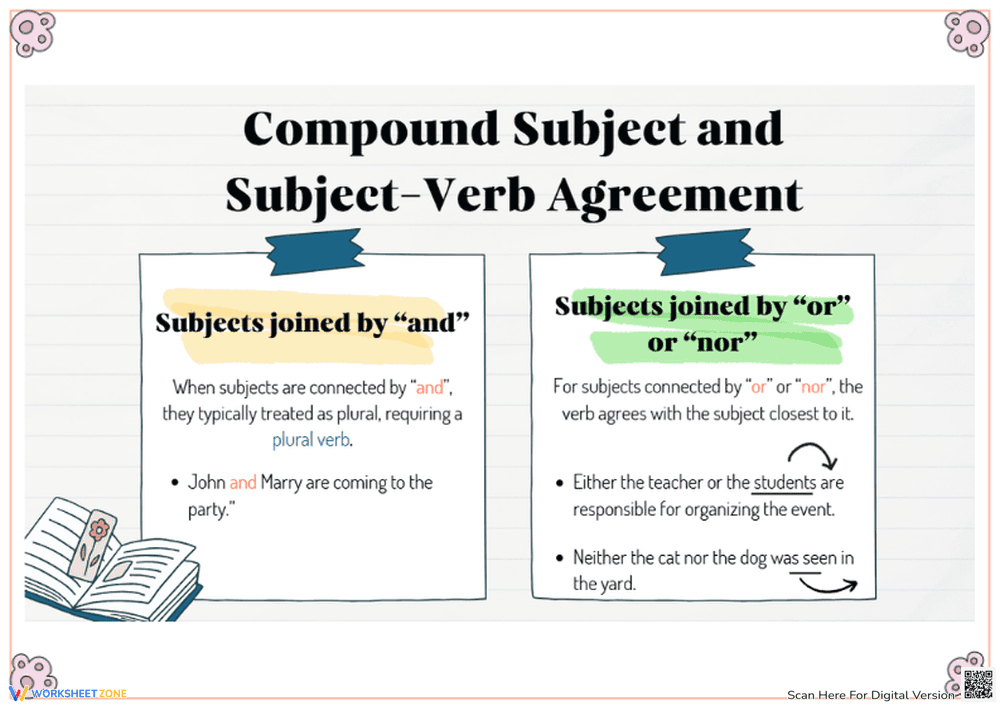

Printable Compound Subject Verb Agreement Guide
Paste this activity's link or code into your existing LMS (Google Classroom, Canvas, Teams, Schoology, Moodle, etc.).
Students can open and work on the activity right away, with no student login required.
You'll still be able to track student progress and results from your teacher account.
This Grade 3 grammar reference sheet helps students master compound subject-verb agreement rules. Students learn to match verbs correctly when subjects are joined by "and," "or," or "nor." This resource provides clear visual explanations and concrete examples to ensure students write grammatically correct sentences.
At a Glance
- Grade: Grade 3 · Subject: ELA Grammar
- Standard:
CCSS.ELA-LITERACY.L.3.1— Demonstrate command of standard English grammar conventions- Skill Focus: Compound subject-verb agreement
- Format: 1 page · 3 examples · Reference guide · PDF
- Best For: Grammar lessons and writing support
- Time: 10–15 minutes
This single-page anchor chart features two distinct instructional blocks. The left column explains the rule for compound subjects connected by "and," showing how they require plural verbs. The right column details the rule for subjects connected by "or" or "nor," illustrating how the verb must agree with the closest subject. Clear visual cues, including color-coded conjunctions and arrows pointing to the subject-verb relationship, help students grasp these complex grammar mechanics.
Teachers can implement this resource with a simple three-step workflow. First, print the single-page guide or display it digitally on your interactive whiteboard in under 1 minute. Second, distribute the sheet to students or have them paste it into their grammar notebooks during a 5-minute introduction. Third, review the rules and the 3 provided examples together for 5 minutes before starting independent writing. This zero-prep tool serves as an excellent reference for substitute teacher plans or quick grammar reviews.
This resource aligns directly with the primary standard CCSS.ELA-LITERACY.L.3.1, which requires students to demonstrate command of the conventions of standard English grammar and usage when writing or speaking. By focusing specifically on subject-verb agreement with compound subjects, it supports foundational writing skills. Both standard codes can be copied directly into lesson plans, IEP goals, or district curriculum mapping tools.
Use this reference sheet during direct instruction as a visual anchor chart to introduce compound subjects. Alternatively, print copies for students to keep in their writing folders as a self-monitoring tool during independent writing workshops. Teachers can observe if students apply the "closest subject" rule during writing time to formatively assess their understanding. The guide takes about 10 to 15 minutes to review and discuss.
This guide is designed for third-grade students learning advanced subject-verb agreement, but it also serves as a helpful review for fourth graders. It supports English language learners who struggle with plural verb forms. Pair this reference sheet with a targeted sentence-writing worksheet or a short reading passage to practice identifying compound subjects in context.
According to research from Fisher & Frey (2014) on the gradual release of responsibility, visual anchors and clear reference tools are critical during the guided practice phase of learning. This Grade 3 grammar guide aligns with CCSS.ELA-LITERACY.L.3.1 by breaking down the complex rules of compound subject-verb agreement into digestible visual components. By explicitly showing how conjunctions like "and," "or," and "nor" dictate verb agreement, the resource helps students build the self-regulation skills needed to edit their own writing. Providing students with permanent reference materials reduces cognitive load, allowing them to focus on sentence construction and composition. Educators can confidently integrate this structured reference sheet into daily writing workshops, grammar mini-lessons, or intervention sessions to support long-term retention of standard English conventions.


