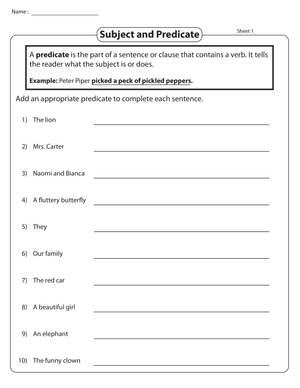
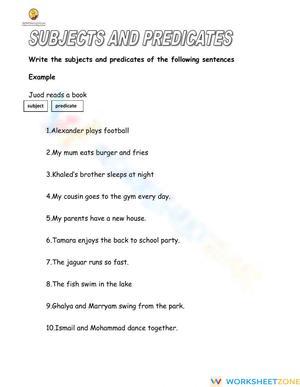
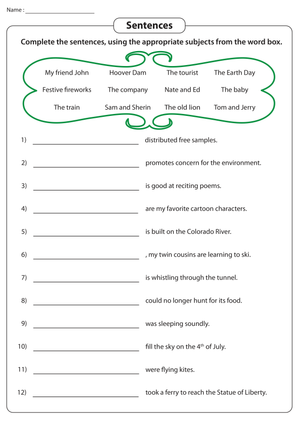
These subject and predicate printable worksheets for 3rd grade give teachers a focused set of exercises that make sentence structure visible — not just audible. Third graders hear complete sentences all day long, but hearing isn't the same as understanding how the naming part and the telling part function as separate jobs. That gap shows up fast once students start writing longer sentences in their reading responses and science journals.
Skills These Worksheets Build
Each worksheet targets a specific layer of subject-predicate knowledge rather than reviewing all of it at once. The progression moves from simple identification — circling the subject, underlining the predicate — toward more demanding work with complete subjects and complete predicates.
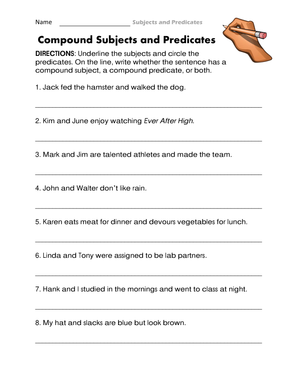
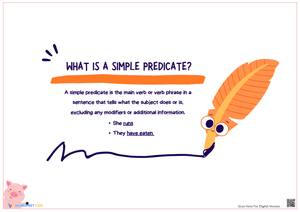
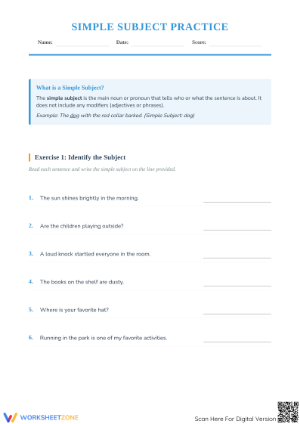
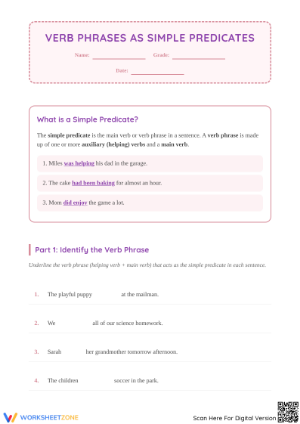
- Identify the simple subject (the main noun or pronoun) and the simple predicate (the main verb) in short sentences
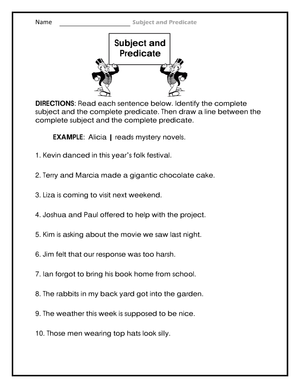
- Mark the complete subject and complete predicate by drawing a vertical dividing line between the two halves of a sentence
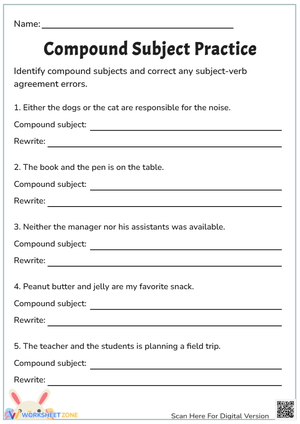
- Distinguish between sentence fragments and complete sentences, then add the missing component to repair each fragment
- Build original sentences from a given subject or predicate, writing the other half independently
- Sort phrases into "naming part" and "telling part" columns using cut-and-paste exercises
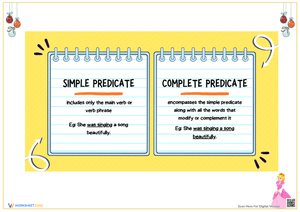
The move from simple to complete subjects is where the real conceptual work happens. In the sentence The noisy kids at the back table finally stopped talking, the simple subject is just kids, while the complete subject is The noisy kids at the back table. Students who understand this distinction begin writing more precisely because they see adjectives and prepositional phrases as belonging somewhere specific in the sentence — not floating freely between ideas.
Mistakes Students Make That These Worksheets Help You Catch
Two predictable errors appear at this level, and they require different classroom responses.
The first is picking the wrong noun as the subject when a sentence contains more than one. In a sentence like After the storm, the old tree in the yard fell, third graders frequently circle storm or yard — whichever noun felt most prominent when they read through. The "who or what is doing the action" strategy helps, but students need repeated application before it becomes reliable. Several worksheets in the set use multi-noun sentences precisely to build this habit.
The second error is treating a complete subject with no predicate as a finished sentence. A student who writes The tall boy with the red backpack. and moves on has produced a thought, not a sentence. What makes this mistake stubborn is that the fragment sounds correct when read aloud — students can't hear the missing verb the way they might notice it in print. The fragment-identification worksheets address this by mixing complete sentences with fragments and asking students to mark each before attempting any corrections, which separates the diagnosis from the fix.
One specific pattern worth flagging before assigning certain worksheets: linking verbs trip students up when they search for predicates. A third grader who has internalized "predicate means action" will struggle to underline the predicate in The sky was cloudy all morning unless they recognize was as the verb. Expect to address this in a brief whole-group lesson before worksheets with heavy linking-verb content go out to students.
How to Work These Worksheets Into Your Weekly Plans
These resources fit naturally into short windows — the 8–10 minutes at the start of a language arts block, or the stretch before students transition to specials. One quick worksheet used consistently three days a week builds more retention than a single long grammar lesson weekly. That's spaced retrieval doing what spaced retrieval does.
During a writing unit, the fragment-repair worksheets earn a specific place in the editing conference. When a student's draft includes fragments, working through a fragment-identification worksheet together — rather than simply circling the errors on the draft — gives the student a cleaner learning moment. They articulate the rule on neutral material first, then return to their own writing with a more active understanding of what they are looking for. Subject and predicate printable worksheets for 3rd grade also function well as Monday morning warm-ups that reactivate grammar knowledge after the weekend without requiring any setup from students.
The sentence-building exercises — where students write a predicate to complete a given subject — work naturally as a prewriting activity before paragraph-level writing. Students who have just spent five minutes constructing complete sentences with varied predicates carry that sentence awareness into their independent drafting.
Differentiating the Set Across Student Readiness Levels
Students who find the concept slippery benefit most from sentences where the structure is unambiguous: one short noun, one clear action verb, minimal modifiers. Moving from The dog ran. to The old spotted dog from next door ran across the yard. is not about making the work easier — it's about isolating the concept before complexity enters. For these students, allow the "who or what" prompt to function as a written step on the worksheet itself rather than as a silent internal question they're expected to hold in their heads.
Students who are already solid on basic identification are ready for harder work: marking subjects and predicates in paragraphs pulled from their independent reading books, or rewriting sentences by deliberately expanding either the complete subject or the complete predicate while keeping the other half unchanged. That second task is a genuine writer's move — not just a grammar exercise — and students who understand it that way tend to engage with it more willingly.
Standard Alignment
The primary connection is CCSS.ELA-LITERACY.L.3.1, the grade 3 language standard covering grammar and usage conventions. Sub-standards within L.3.1 include producing complete sentences and recognizing and correcting sentence fragments and run-on sentences — both central to what this set practices. In instructional terms, this standard represents an outcome at the end of a progression: students cannot expand and combine sentences until they know what makes a sentence complete in the first place. Subject and predicate printable worksheets for 3rd grade also connect to W.3.5, which requires students to revise and edit their own writing — the fragment-repair exercises transfer directly into the editing phase of any writing unit when students apply the same marking strategy to their own drafts.
Frequently Asked Questions
What is the clearest way to explain the difference between a simple subject and a complete subject to a third grader?
Tell students the simple subject is the single star of the sentence — the one noun or pronoun doing the action. The complete subject is the star plus all its describing words. In The tiny green frog on the log jumped, the star is frog, but the whole naming part — the star's full introduction — is The tiny green frog on the log. Most students catch this distinction quickly when they see it in a concrete sentence rather than a definition.
How does the "who or what" strategy work when students get stuck finding the subject?
Have students find the verb first, then ask "who or what is doing that?" The order matters. Students who hunt for the subject before locating the verb tend to latch onto whichever noun feels most prominent — which is not always the subject. Verb first, then subject, works more reliably at this age and pairs well with any worksheet that asks students to circle the subject and underline the predicate as separate steps.
Can these worksheets help students who consistently write fragments in their independent writing?
Yes — with a specific instructional move. Pull the fragment-identification and correction worksheets for a small-group session with students whose drafts contain fragments. Work through a worksheet together, then ask those students to apply the same marking strategy — subject underlined once, predicate underlined twice — directly onto one paragraph of their own draft. That transfer step is what closes the gap between worksheet practice and independent writing. Subject and predicate printable worksheets for 3rd grade do their most useful work in these targeted small-group sessions, not simply as seat work students complete and submit without any follow-up.












 Interactive Worksheet Maker
 Quiz Maker
 Word Search Maker
 Crossword Puzzle Maker
 Word Scramble Generator
 Sentence Scramble Generator
 Handwriting Worksheet Generator
 Name Tracing Generator
 Fill In The Blank Generator