


























Views
Downloads

Grade 3 Subject-Verb Agreement — Printable Worksheet
Paste this activity's link or code into your existing LMS (Google Classroom, Canvas, Teams, Schoology, Moodle, etc.).
Students can open and work on the activity right away, with no student login required.
You'll still be able to track student progress and results from your teacher account.
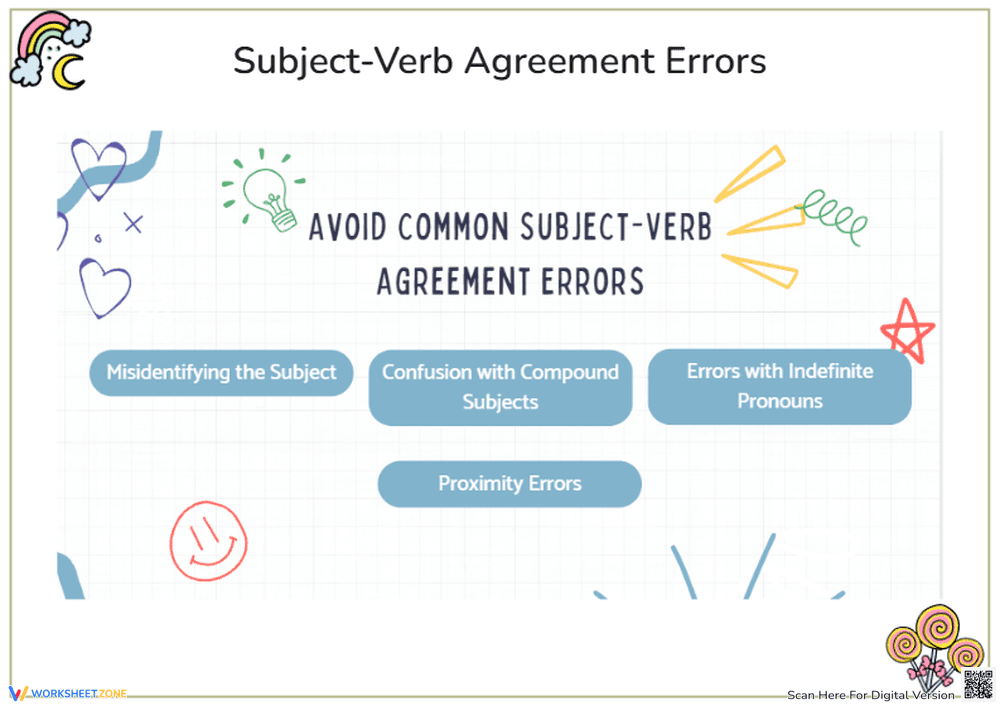
This subject-verb agreement worksheet helps third-grade students identify and correct common grammatical errors in their writing. By focusing on tricky areas like compound subjects, indefinite pronouns, and proximity errors, learners build the essential skills needed to ensure singular and plural subjects match their verbs correctly, improving overall writing clarity and sentence structure.
At a Glance
- Grade: Grade 3 · Subject: ELA Grammar and Mechanics
- Standard:
CCSS.ELA-LITERACY.L.3.1.F— Ensure subject-verb and pronoun-antecedent agreement in student writing- Skill Focus: Subject-verb agreement error correction
- Format: 2 pages · 15 problems · Full answer key included · Printable PDF format
- Best For: Independent grammar practice, morning work, and homework review
- Time: 15–20 minutes of focused classroom work
This printable resource features a structured layout designed to target specific error types. Inside, students will find 15 targeted sentences containing common subject-verb agreement mistakes, including proximity errors and compound subject confusion. The worksheet includes a clear word bank and helpful sentence frames to support struggling writers, alongside a complete answer key for quick grading.
This resource is designed for a rapid, zero-prep classroom workflow that takes under 2 minutes of teacher preparation time. First, print the double-sided worksheet (1 minute). Second, distribute the copies to your students for independent or partner work (30 seconds). Finally, review the answers as a whole group using the included answer key (5 minutes). This straightforward structure makes it an excellent option for emergency sub plans or quick morning work.
This worksheet aligns directly with the Common Core State Standard CCSS.ELA-LITERACY.L.3.1.F, which requires students to demonstrate command of the conventions of standard English grammar and usage by ensuring subject-verb and pronoun-antecedent agreement. Additionally, it supports general sentence construction skills. Both standard codes can be copied directly into lesson plans, IEP goals, or district curriculum mapping tools.
Use this worksheet during the independent practice phase of your grammar lesson, immediately following direct instruction on subject-verb agreement. Alternatively, assign it as a formative assessment at the end of the week to gauge student mastery. While students work, observe whether they can identify the true subject when prepositional phrases create proximity errors. Expect completion to take between 15 and 20 minutes.
This activity is tailored for third-grade students learning core grammar mechanics, but it also serves as a valuable intervention tool for fourth-grade students needing targeted remediation. Teachers can differentiate by pairing this worksheet with a visual anchor chart on singular and plural nouns. It pairs naturally with a direct instruction lesson on identifying subjects and verbs in complex sentences.
This educational worksheet targets the standard CCSS.ELA-LITERACY.L.3.1.F, focusing on the plain-English skill of identifying and correcting subject-verb agreement errors in sentences. Research from Fisher & Frey (2014) highlights that structured, scaffolded grammar practice helps young writers internalize syntactic rules, leading to improved writing fluency and fewer mechanical errors in independent composition. By addressing common pitfalls such as proximity errors, compound subjects, and indefinite pronouns, this resource provides the targeted practice necessary to move students toward mastery. The inclusion of a clear answer key and structured tasks supports teachers in delivering effective, evidence-based grammar instruction. Educators can confidently integrate this worksheet into their daily ELA routines, knowing it aligns with established pedagogical frameworks for language acquisition and conventions mastery, ultimately fostering stronger reading comprehension, academic writing skills, and overall literacy development across all elementary grade levels.


