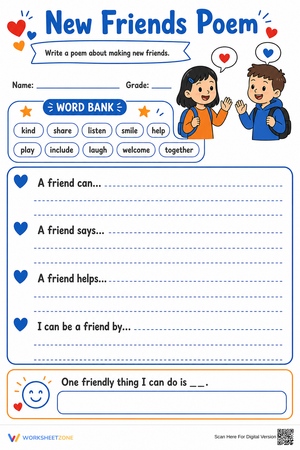
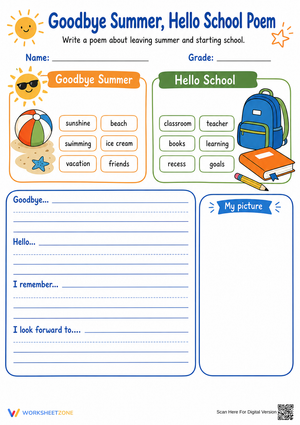
2nd grade fiction writing printable worksheets give teachers a structured way to move students through the full narrative writing process — character development, setting, plot conflict, and resolution — in separate, targeted worksheets that let students build one skill at a time rather than juggling everything at once. The set spans pre-writing, drafting support, and story structure and holds up across a full Writer's Workshop unit, not just a single lesson.
The Specific Skills These Worksheets Target
Each worksheet addresses a distinct element of fiction rather than packing the entire writing process onto one sprawling graphic organizer. The set includes:
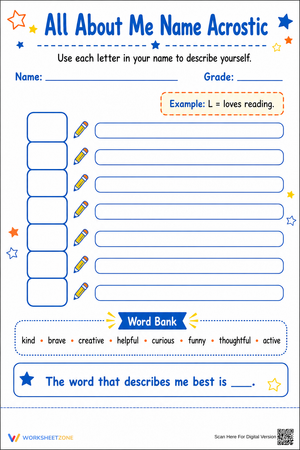
- Character profile worksheets that ask students to name external traits and internal ones — what the character wants, what they fear, what they would never do, not just what they look like.
- Setting worksheets with sensory prompts rather than open-ended description space: students answer "what would your character hear in this place?" instead of "describe the setting."
- Problem-solution frames that require students to name the central conflict first, then map at least two attempts before the resolution — building narrative structure from the planning stage outward.
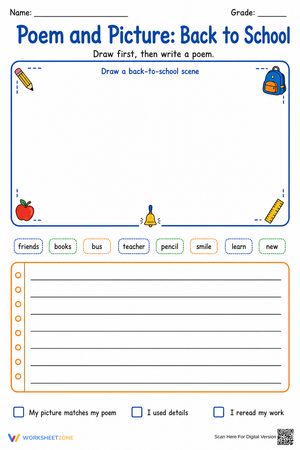
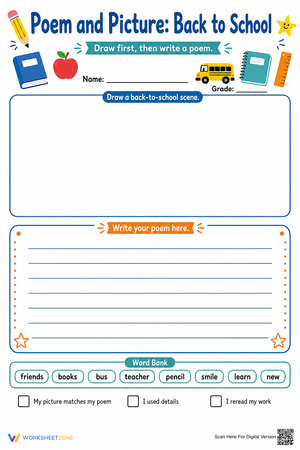
- Draw-then-write worksheets that let students sequence events in panels before writing sentences, a format that works especially well for students who narrate confidently aloud but freeze at a blank lined page.
- Story starter worksheets with partial opening sentences that handle the hardest moment in fiction writing: getting the character into motion on sentence one.
Used across a unit, 2nd grade fiction writing printable worksheets cover pre-writing, drafting support, and story structure without repeating the same task in different packaging.
Error Patterns That Surface in Almost Every Second-Grade Fiction Unit
The dominant structural problem in second-grade fiction is the "and then" chain: She went to the park and then she found a puppy and then the puppy ran away and then she chased it and then she brought it home. That's a timeline, not a story — there's no central problem driving the sequence, just events accumulating. Students who fill in a story map before drafting almost never produce pure "and then" writing, because naming the problem first restructures how they think about everything that follows.
A second predictable error appears in character work. Students write descriptions that are entirely external: brown hair, red sneakers, lives with grandma. That level of detail produces characters who float through a story without agency. The moment a student writes "she wants to win the science fair but her partner keeps changing the project idea," the story has somewhere to go. The character profile worksheets are built around exactly that shift — from appearance to motivation — and the difference shows up immediately in student drafts.
Setting work produces its own recurring problem: one-word descriptions. "Forest." "Space." "Beach." Students treat the setting label as the job done. The sensory prompts on the setting worksheets counter this by asking specific questions rather than providing open white space. "What would your character smell in this place?" pulls detail out of students who would never generate it in response to a vague "describe the setting" instruction.
Fitting These Worksheets Into Your Teaching Week
The Writer's Workshop model is the most reliable frame for these resources. A focused mini-lesson — five to eight minutes on the difference between a character's appearance and a character's motivation, for example — followed immediately by students working on the corresponding worksheet keeps the gap between instruction and practice tight enough that most students still have the teaching in mind when they start the task. That immediacy matters more than most other structural decisions in a writing block.
Draw-then-write worksheets earn their place during the 8–10 minutes before a specials period when there isn't enough time for full drafting but too much time to leave unstructured. Keeping a folder of story starters in a writing center gives early finishers a natural place to go without requiring any teacher setup. Monday mornings after a long weekend — before the class has fully re-engaged — are another good moment for a story starter: focused, low-stakes, and doable in a short window.
For small-group work with students who find fiction writing overwhelming, 2nd grade fiction writing printable worksheets that focus on pre-writing — the character profile and story map specifically — belong in rotation before any drafting begins. Students who try to write fiction without a plan spend most of their cognitive energy deciding what happens next, leaving little available for sentence construction. Moving that planning work onto paper first produces noticeably stronger first drafts.
Adjusting the Set for a Range of Learners
Students who need more support work well with the draw-then-write worksheets even after their peers have moved past them. Drawing the story first separates the generative work from the transcription and lets a student demonstrate story comprehension before they're asked to handle a blank writing line. For English Language Learners, the visual prompt worksheets — which provide an image as a story starting point — reduce the ideation demand while still producing real writing practice.
Students writing fluently can work with the same story map under a tighter constraint: require three failed attempts before the resolution, or ask them to write from the perspective of a secondary character they've also mapped. Neither adjustment requires a different worksheet — just a different expectation communicated at the start of the task. The character profile worksheets extend naturally into character comparison charts for students who are ready to write stories where two developed characters interact and conflict.
Standard Alignment
These worksheets align to CCSS.ELA-LITERACY.W.2.3, which asks second graders to write narratives that recount a well-elaborated sequence of events, include details describing actions, thoughts, and feelings, use temporal words to signal order, and provide a sense of closure. "Well-elaborated" and "sense of closure" are precisely where second graders most often fall short — and exactly what the story map and problem-solution worksheets address directly. The standard pairs naturally with W.2.5, which covers production and distribution of writing with adult guidance, making these resources a solid fit for the brief planning conferences that Writer's Workshop typically includes.
Frequently Asked Questions
What if a student completes the story map but still freezes when it's time to draft?
Usually the freeze means the student treated the map as a task to complete rather than actual planning — they filled in the boxes without really owning the story. Sit with them, point to the problem box, and ask them to say out loud what happens first. Most students can narrate the story easily; the stall is the move from speaking to writing. Having them draw the first panel of the draw-then-write worksheet — even if the rest of the class has moved past that format — often functions as a bridge back into the student's own story.
How long should a second-grade fiction story actually be?
Early in the year, three to five sentences with a clear beginning, problem, and resolution makes a complete story. By spring, students who have been writing regularly can sustain two to three paragraphs. Length matters less than structural completeness: a story with a character who has a clear want, a problem, at least one attempt, and a resolution is stronger writing than a longer piece that wanders without anything driving it. These worksheets orient students toward structure from the start, and length tends to follow as fluency builds.
Do these worksheets fit a homeschool writing curriculum?
Yes. Each worksheet in the set addresses a discrete skill, which makes it straightforward for a parent to introduce one element — character motivation, for instance — and then hand the corresponding worksheet over for independent practice. Because 2nd grade fiction writing printable worksheets follow the narrative structure described in CCSS W.2.3 and most equivalent state standards, they fit into any writing curriculum that builds toward that benchmark without requiring a separate planning framework. Student character maps and story drafts from earlier in the year alongside later ones also serve as useful portfolio evidence of growth over time.












 Interactive Worksheet Maker
 Quiz Maker
 Word Search Maker
 Crossword Puzzle Maker
 Word Scramble Generator
 Sentence Scramble Generator
 Handwriting Worksheet Generator
 Name Tracing Generator
 Fill In The Blank Generator