


























Views
Downloads

School Chant Poem Worksheet | Grade 1 Essential
Paste this activity's link or code into your existing LMS (Google Classroom, Canvas, Teams, Schoology, Moodle, etc.).
Students can open and work on the activity right away, with no student login required.
You'll still be able to track student progress and results from your teacher account.
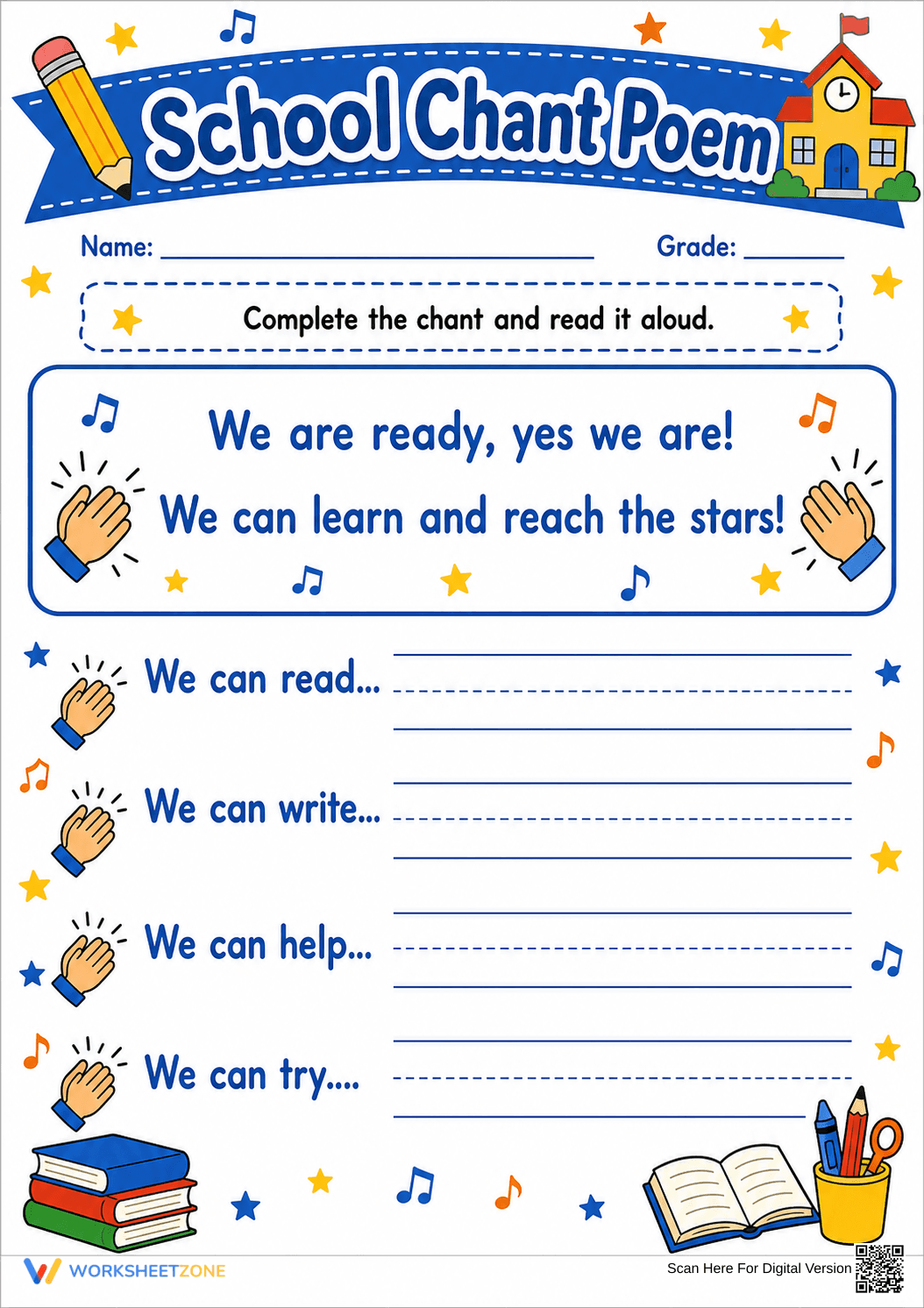
This Grade 1 School Chant Poem worksheet helps students build reading fluency and creative writing skills through rhythmic repetition. By completing and performing a classroom chant, learners develop confidence in their oral expression while practicing sentence structure. It provides a structured yet playful way to start the school year or a new unit.
At a Glance
- Grade: 1 · Subject: ELA
- Standard:
CCSS.ELA-LITERACY.RF.1.4.b— Read grade-level text orally with accuracy and expression- Skill Focus: Fluency and Sentence Completion
- Format: 1 page · 4 tasks · Open-ended · PDF
- Best For: Morning meetings or fluency practice
- Time: 10–15 minutes
The worksheet features a vibrant, student-friendly layout with a primary focus on a rhythmic chant. It includes a two-line choral reading section followed by four guided sentence starters. Each line is accompanied by visual clapping icons to encourage rhythmic participation. The single-page PDF is designed for high-contrast printing with clear primary-grade handwriting lines.
Zero-Prep Workflow
- Print: Select the single-page PDF and print enough copies for your class (30 seconds).
- Distribute: Hand out the worksheets during a morning meeting or ELA block (1 minute).
- Review: Model the rhythmic chant once, then allow students to complete their lines and perform (10 minutes).
Total teacher preparation time is under 2 minutes, making this an ideal sub-plan or warm-up activity.
Standards Alignment
The primary standard addressed is `CCSS.ELA-LITERACY.RF.1.4.b`, which requires students to read grade-level text orally with accuracy, appropriate rate, and expression on successive readings. Additionally, it supports `CCSS.ELA-LITERACY.W.1.3` by having students write brief responses to complete a narrative sequence. Both standard codes can be copied directly into lesson plans, IEP goals, or district curriculum mapping tools.
How to Use It
Use this worksheet during the first week of school as a community-building activity. After students complete their lines, have the class perform the chant together, clapping on the icons. For a formative assessment, observe students during the oral reading phase to check for proper pacing. It works best after a direct instruction lesson on rhythm and rhyme.
Who It's For
This resource is designed for first-grade students but is highly adaptable for Kindergarten or second-grade learners needing fluency support. It is particularly effective for English Language Learners (ELLs) who benefit from the repetitive sentence frames. Pair this worksheet with a classroom anchor chart on "What We Can Do" to provide additional vocabulary support.
The School Chant Poem worksheet is a practical application of the CCSS.ELA-LITERACY.RF.1.4.b standard, focusing on the development of oral reading fluency through rhythmic text. According to Fisher & Frey (2014), the use of choral reading and repetitive chants significantly improves student prosody and confidence, especially in early elementary settings. This worksheet provides the necessary scaffolding for students to move from guided choral reading to independent sentence completion. Research from the RAND AIRS 2024 report suggests that integrating creative writing with oral performance enhances memory retention of high-frequency words and sentence structures. By requiring students to generate their own endings to the chant, the resource encourages higher-order thinking within a supportive, rhythmic framework. This dual-modality approach—combining writing and speaking—aligns with evidence-based literacy practices that prioritize active student engagement and the gradual release of responsibility in the primary classroom.


