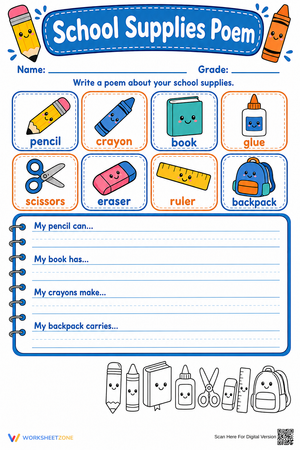
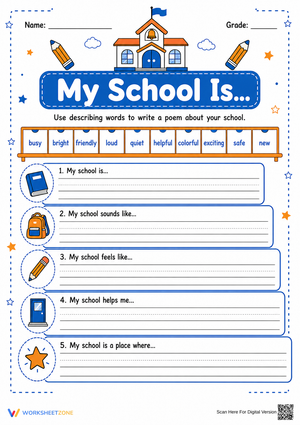
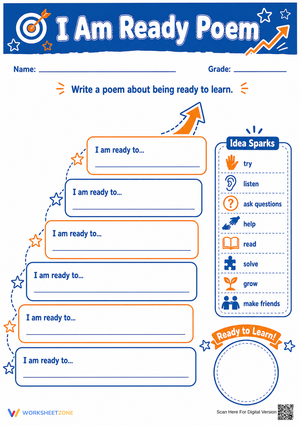
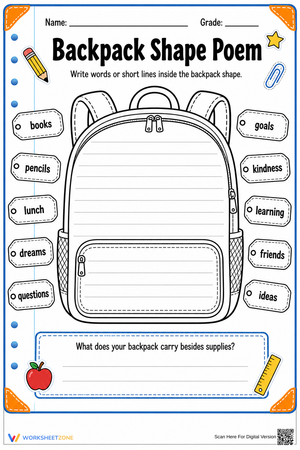
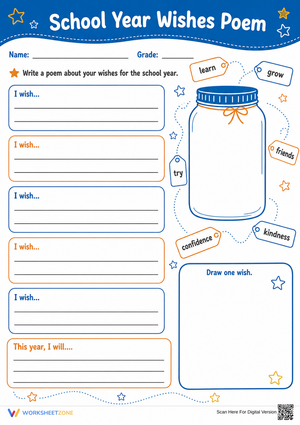
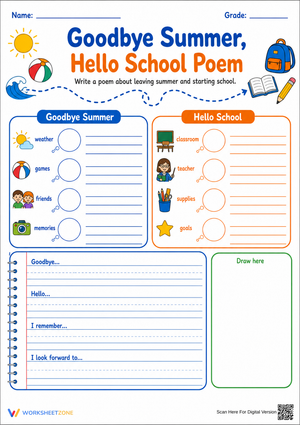
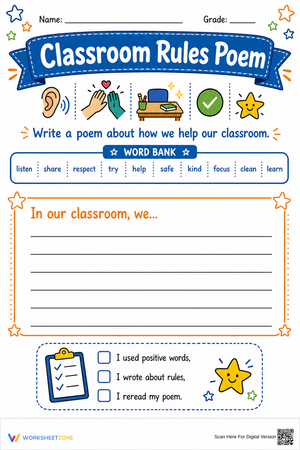
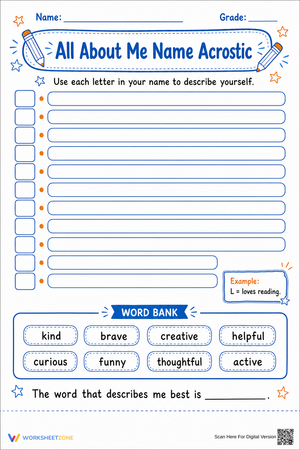
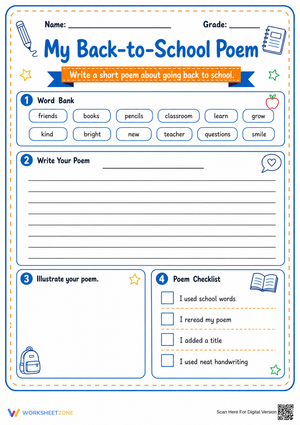
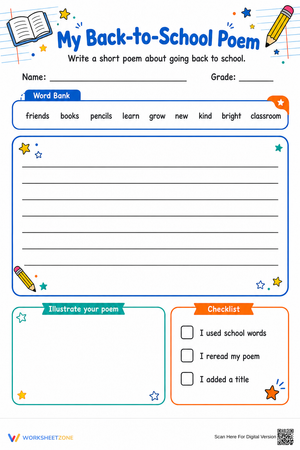
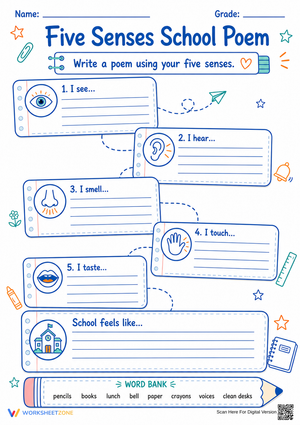
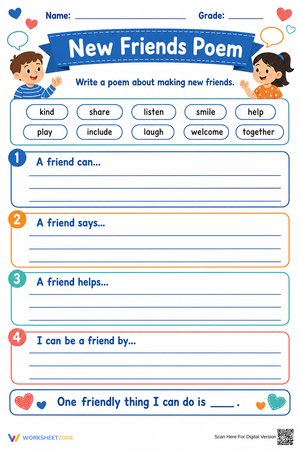
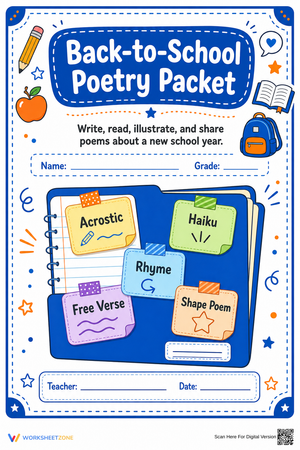
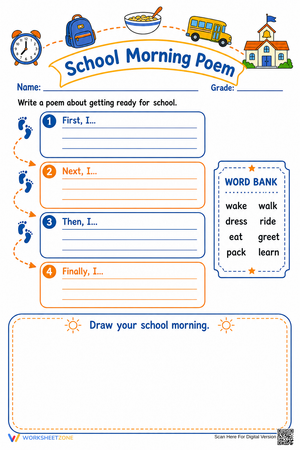
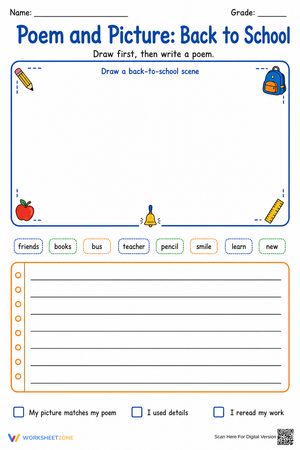
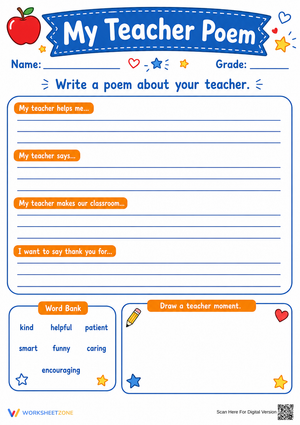
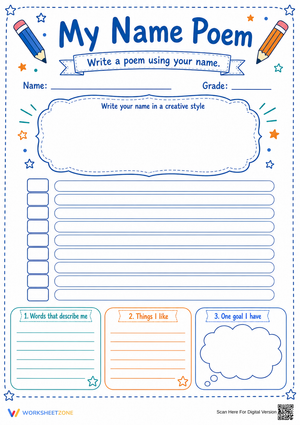
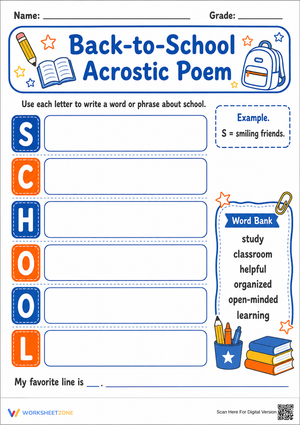
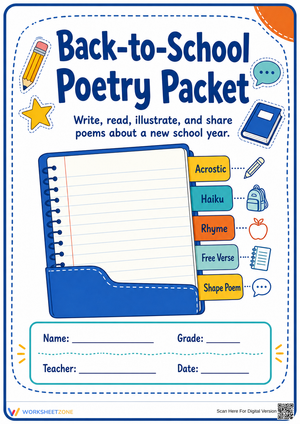
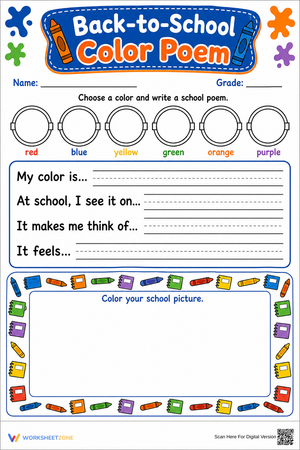
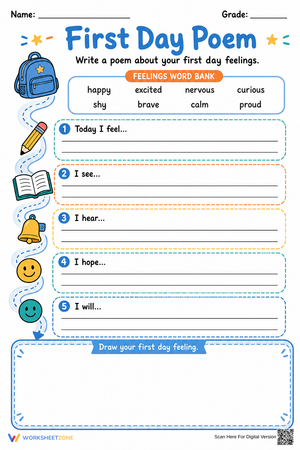
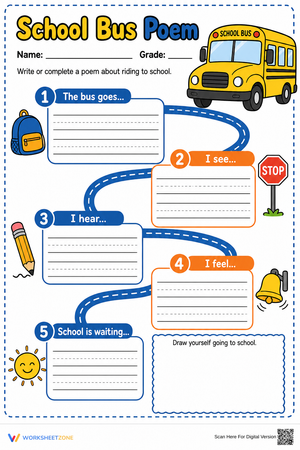
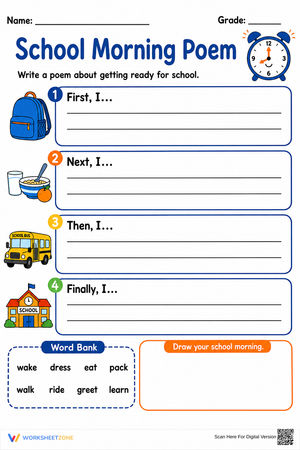
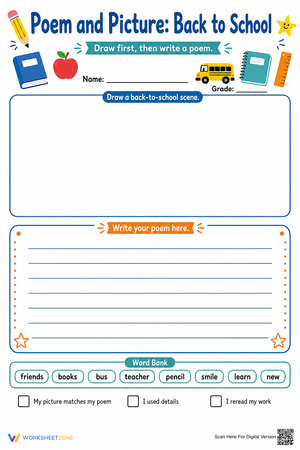
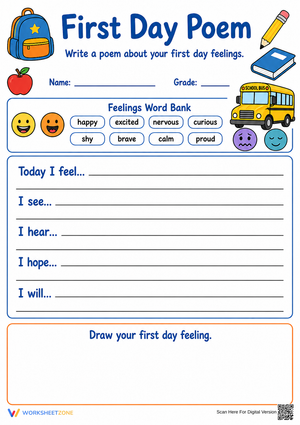
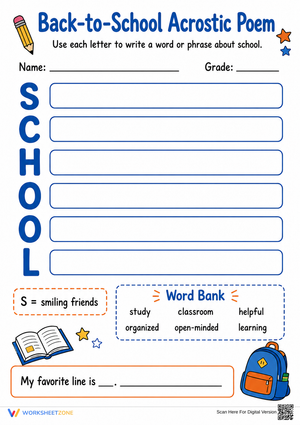
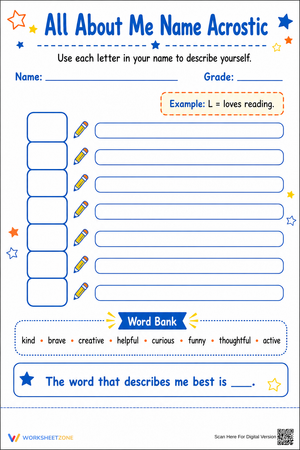
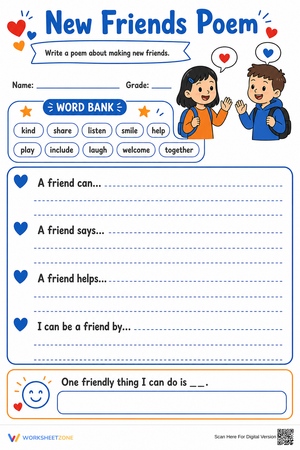
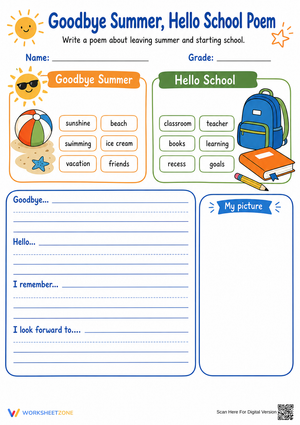
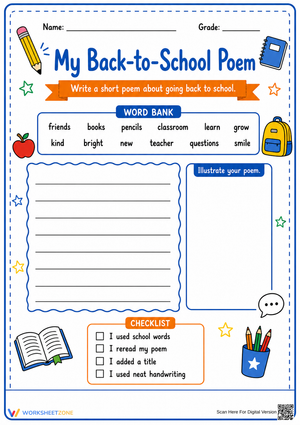
These poetry printable worksheets for 2nd grade give teachers a concrete writing resource built around forms that 7- and 8-year-olds can complete in one sitting — acrostic poems, haiku, cinquain, rhyming couplets, and free verse — each on its own worksheet with a brainstorming section, a drafting space, and a spot for illustration. The writing process is built into the structure, so students move through prewriting and drafting without switching materials or waiting for repeated teacher direction. The set works across independent work time, guided small groups, and morning warm-ups.
The Specific Skills Targeted in Each Worksheet
Each worksheet focuses on a single form so cognitive load stays manageable — second graders introduced to three forms in one session typically produce weaker writing across all three than students who spend a full period on one. Here is what each format builds:
- Acrostic poems: Students write a subject word vertically and construct a phrase or sentence from each letter. The format rewards students who know their subject well and prevents the structure from feeling arbitrary. A labeled guide on the worksheet shows the letter-phrase relationship before students attempt their own.
- Haiku: Students practice syllable segmentation using the 5-7-5 pattern, with a small counting box built into the worksheet for tracking. This is the form most directly tied to phonological awareness — students hear syllable breaks in words they thought they already knew.
- Cinquain: Each line carries a specific grammatical requirement (noun, adjectives, -ing action words, phrase, synonym), and a completed example sits above the blank draft area. This format builds precise word choice because students cannot use just any word — it has to fit the line's function.
- Rhyming couplets: A margin word bank removes the pressure of hunting for rhymes so students stay focused on meaning and keep lines complete rather than stopping when they hit a word they cannot match.
- Free verse: Sensory prompts replace structural rules. Students respond to questions like "What does the classroom sound like before the bell?" to push writing past basic description into genuine observation.
Where Students Go Wrong With These Poetic Forms
The most consistent error in student haiku is syllable miscounting on multisyllabic words. Students writing about nature — a perennial second-grade topic — will confidently count "butterfly" as two syllables instead of three. A whole-class clapping exercise before drafting catches this for most students, but a handful will still finger-count and come up short. The worksheet's counting box exists specifically for this step; students who use it produce accurate 5-7-5 lines at a noticeably higher rate than those who skip it and try to count in their heads.
In acrostic work, the pattern that shows up most often is adjective-only lines. A student writing the word RAIN comes back with "Red clouds, Angry sky, Icy wind, Noisy thunder" — structurally acceptable but flat. The worksheet includes a prompt asking students to write at least one line as a full sentence, which disrupts the adjective default without restricting what students say. In cinquain, the third line asks for three action words ending in -ing, and students frequently drop nouns there instead — "rain, puddle, storm" rather than "pouring, splashing, soaking." Asking students to underline the -ing ending on each word before moving on takes about thirty seconds and catches the substitution before it becomes a habit.
Building These Worksheets Into Your Weekly Lessons
The most productive slot for this set is the first ten minutes of the literacy block — not as a throwaway warm-up, but as focused practice that connects to the week's writing goal. A reliable sequence: introduce the form as a class on Monday using a projected example, release students to their own worksheets Tuesday and Wednesday, use Thursday for a targeted revision step (check the syllable count, replace one adjective with a more specific word, confirm the -ing requirement), and close Friday with students reading aloud. Even two or three students sharing while the class listens gives the week's writing a real audience, which changes how students approach the drafting earlier in the week.
Poetry printable worksheets for 2nd grade also integrate naturally into science and social studies units. Students produce more specific writing when they work from content they have already studied, and poetry's constraints push them to select words carefully rather than simply retelling facts. A few cross-curricular combinations that have worked well:
- A haiku about the water cycle, written during a weather unit
- An acrostic built from a community helper's job title, used during a social studies sequence on neighborhoods
- A free verse poem written from the perspective of a seed, following a plant-growth observation lesson
Standard Alignment
The set aligns most directly with CCSS.ELA-LITERACY.RL.2.4, which asks students to describe how words and phrases — including regular beats, rhymes, and repeated lines — supply rhythm and meaning in a poem or song. Every worksheet asks students to make at least one intentional structural choice: a rhyme pair, a syllable count, a grammatically specific line type. That choice produces a visible record of whether a student understands that form carries meaning — something that is genuinely difficult to capture in prose-writing assessment alone. Haiku and rhyming couplet worksheets also address CCSS.ELA-LITERACY.RF.2.3 by embedding phoneme segmentation and rhyme recognition inside original writing rather than in isolated phonics drills. The built-in brainstorming and revision prompts create a documented writing process that supports teacher observation under CCSS.ELA-LITERACY.W.2.5, and the set as a whole gives teachers a semester-long record of how individual students develop as writers across multiple forms.
Fitting the Worksheets to Mixed-Ability Classes
For students ready for more challenge, the haiku worksheet becomes a comparison task: write a second version using a 7-5-7 pattern and read both aloud to hear which feels more natural. That comparison builds metalinguistic awareness — the ability to hear and analyze how language works — that most second graders are not asked to develop this early. Students working on cinquain can skip the example poem at the top and work from the line requirements alone, removing the model and adding ambiguity that stronger writers often find energizing rather than disorienting.
Poetry printable worksheets for 2nd grade that include an image prompt at the top of the worksheet give reluctant writers a concrete starting point — a photograph or line drawing narrows the blank-page problem without making the writing decision for the student. For students who need the most support with idea generation, the acrostic format is genuinely the most forgiving entry point: the subject word is already on the page, and each letter provides a starting constraint that limits scope without limiting expression. One pairing strategy worth trying — matching a reluctant writer with a stronger peer during brainstorming only, not during drafting — keeps the final poem the student's own work while reducing the friction of starting from nothing.
Frequently Asked Questions
My students freeze when they see the syllable-counting requirement on the haiku worksheet. What helps most?
Do the counting out loud as a class before anyone picks up a pencil. Say the word, clap the syllables, hold up fingers. For "caterpillar," most students are surprised it counts to four, not three. Running through five or six words this way — including some the class suggests — takes less than five minutes and means fewer students stall mid-draft when they hit an unfamiliar word. Students who use the counting box on the worksheet produce more accurate 5-7-5 lines than those who skip it and try to hold the count in their heads.
Can I use these worksheets during centers or independent work without a whole-class introduction first?
For the structured forms — acrostic, haiku, cinquain — one prior whole-class introduction is enough. The example poem printed at the top of each worksheet carries most of the instruction when students work independently afterward. Free verse worksheets are harder for cold independent use: students who have not internalized what "no rules" actually means in poetry will write a list of sentences or stop after two lines. One brief whole-group session before free verse becomes a center activity saves a significant amount of redirection later in the week.
How do I assess these worksheets without making the writing feel graded?
Use structural criteria rather than quality judgments. A haiku either follows the 5-7-5 count or it does not. A cinquain either places -ing words on the third line or substitutes nouns there. These are binary checkpoints, not rubric scores, and students can apply them to their own work in a thirty-second self-check before turning the worksheet in. Reserve teacher feedback for one specific observation per student — something like "Your last line is your strongest; read it again and hear why" — rather than a written evaluation of every poem. That ratio keeps feedback actionable without turning the writing process into an evaluation event.
When in the school year should I introduce this set?
Poetry printable worksheets for 2nd grade work better as an October introduction than a spring unit opener. Students who write acrostic poems in October and haiku in January arrive at a spring poetry unit already understanding that different forms carry different rules — which is the conceptual foundation that unit needs. Starting from scratch in spring means spending most of the unit on basics rather than pushing toward more expressive and ambitious writing. The forms in this set are also low-stakes enough to introduce early, when students are still building confidence as writers and benefit from clear structural expectations that tell them exactly what success looks like.












 Interactive Worksheet Maker
 Quiz Maker
 Word Search Maker
 Crossword Puzzle Maker
 Word Scramble Generator
 Sentence Scramble Generator
 Handwriting Worksheet Generator
 Name Tracing Generator
 Fill In The Blank Generator